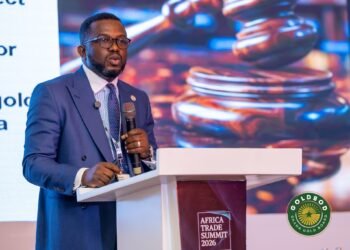
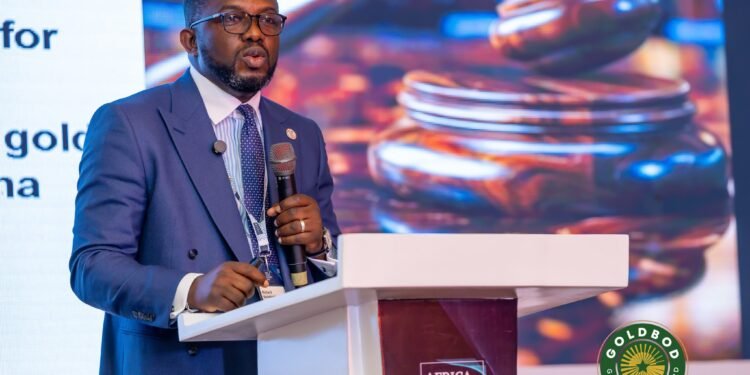
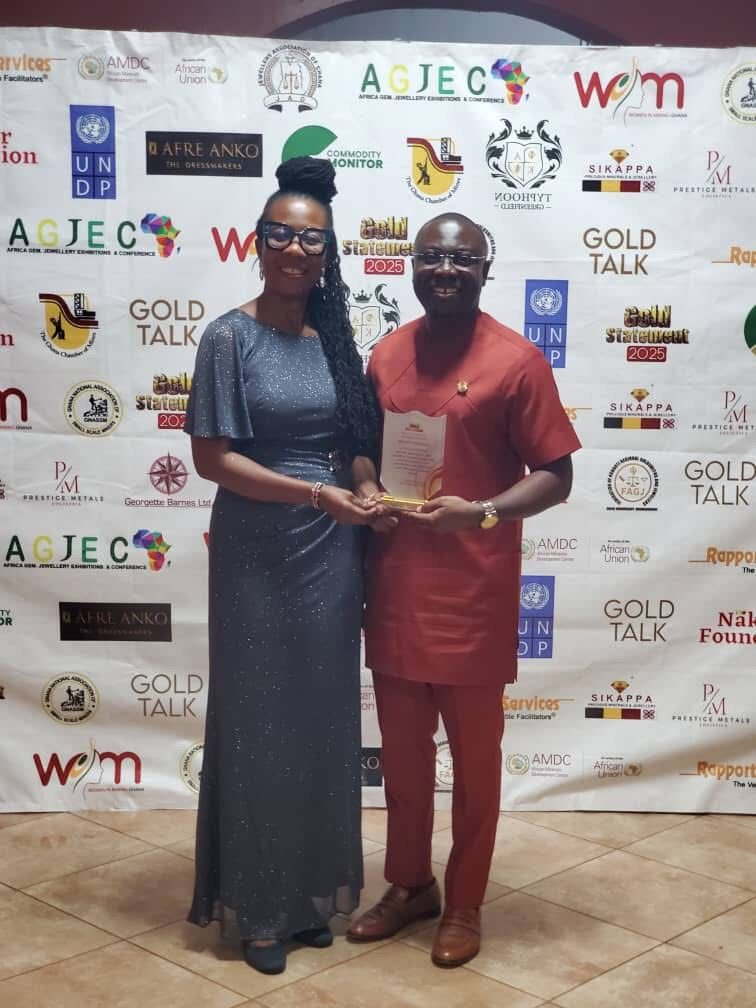
Minerals Commission (MINCOM) has been honored with a prestigious award for its exceptional regulatory leadership and steadfast commitment to the jewelry industry at the Gold Statement 2025 Conference.
The recognition, presented during a glittering Gala Night at the Golden Bean Hotel in Kumasi, underscores the Commission’s pivotal role in bridging the gap between raw mineral extraction and high-end value addition.
As the grand finale of a two-day Pan-African summit, the ceremony celebrated the Commission for fostering a regulatory environment where Ghanaian gold is not merely exported but transformed into a symbol of national heritage and global competitive advantage.
“This award is not just for the Commission; it is a recognition of the shared vision we hold with every miner, jeweller, and designer in this room. It reaffirms our collective commitment to transforming Ghana’s mineral wealth into a source of sustainable livelihood, environmental responsibility, and global pride through jewellery. The Commission is committed to deepening this collaboration to ensure our gold tells a story of integrity from the mine to the market.”
Minerals Commission
This milestone achievement highlights the Commission’s success in formalizing Ghana’s artisanal and small-scale mining (ASM) sector, a move that has directly stabilized the supply chain for local artisans.
By integrating responsible mining practices into the core of its regulatory framework, the Commission has ensured that the “story of integrity” begins at the pit and carries through to the final jewelry piece.
The award comes at a time when the Gold Statement summit has evolved into a continental dialogue, drawing industry heavyweights from Nigeria, Botswana, and Tanzania, and cementing strategic partnerships with academic institutions like KNUST to bolster technical skills within the minerals value chain.


Regulatory Excellence and ASM Formalization

The merit behind this award is rooted in the Minerals Commission’s aggressive performance metrics throughout 2024 and 2025.
Under its current leadership, the Commission successfully oversaw a 26.8% increase in total gold production, reaching over 5 million ounces, while simultaneously granting 343 new mineral rights to stimulate sector growth.
Central to its success has been the rollout of the Responsible Cooperative Mining and Skills Development Program (rCOMSDEP), which replaced punitive measures with a partnership-based model.
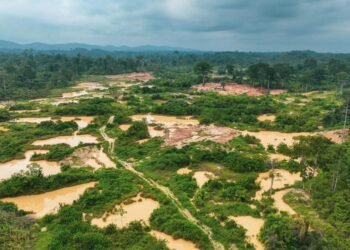
By providing mercury-free processing technology and geological support to community cooperatives, the Commission has effectively reduced the environmental footprint of small-scale operations.
This shift toward “clean gold” has provided the jewelry industry with the ethical assurance required to compete on the international stage, proving that regulation can be a catalyst for economic diversification rather than a bottleneck.
Strategic Impact on Future Extractive Governance
This recognition serves as a powerful endorsement of the Commission’s transition from a traditional “monitor” to a “key architect” of the mineral value chain.
For an agency often tasked with the difficult enforcement of mining laws, the Gold Statement 2025 award provides the necessary “social license” to deepen its reforms.
It validates the Commission’s efforts to move Ghana beyond the “dig and ship” colonial model toward a sophisticated economy centered on local value retention.
Experts suggest that this accolade will boost investor confidence, particularly in the burgeoning gemstone and lapidary sub-sectors, as it signals a stable and collaborative regulatory climate. #
By aligning with international ESG (Environmental, Social, and Governance) frameworks, the Commission is now better positioned to attract green funding and global partnerships, ensuring that Ghana remains Africa’s premier mining destination while championing ethical standards.
Strengthening the Mine-to-Market Value Chain
The summit’s conclusion marked a renewed focus on the convergence of responsible extraction and industrial skill-building.
The Commission’s role in cementing the partnership between the Lapidary Institute of Ghana and KNUST is a testament to its forward-thinking approach to human capital development.
This synergy ensures that the next generation of Ghanaian miners and jewelers are equipped with the technical expertise to handle advanced mineral processing.
As the Commission continues to refine its “pit-to-port” traceability systems, the 2025 award acts as a springboard for further transparency initiatives.
This proactive stance ensures that every ounce of gold produced in Ghana contributes to a resilient, ethical, and globally competitive African jewelry industry, effectively turning mineral wealth into a sustainable engine for national prosperity and cultural pride.
READ ALSO: IMANI Urges President Mahama to Anchor Foreign Policy in West African Stability