The government’s ‘golden child’ policy has lost traction among the working class of the country, as few workers opt for the opportunity to consider a 24-Hour Economy based work.
According to data from the Ghana Statistical Service (GSS), fewer than 50 percent of workers are ready to work on a shift-based work. It also appears that the initiative is not welcomed by urban workers.
“Shift-based work is rare, but desired. Fewer than 2 percent of workers currently do night or shift work, yet nearly half of workers say they would consider shift-based work, especially men and rural workers.”
GSS 2025 Labour Force Statistics for Q1-3
The 24-Hour Economy policy initiative has faced fierce criticism since its conception, from the campaign ground to today, while in government. Although several education and policy documents have been provided, many are still left with distrust for the policy and its implementation.
Government’s Preparedness to Kick-Off the 24-Hour Economy Policy
According to the government, the initial stages of building the necessary infrastructure to support a full 24-hour economy are still being formed as key supporting sectors remain unsubdued: the energy sector efficiency, transportation, security, digital infrastructure, labour force and workforce preparation, industrial zones and economic hubs, and public sector readiness. These sectors are all unique in how they complement the policy initiative and are necessary participants of the policy for success.
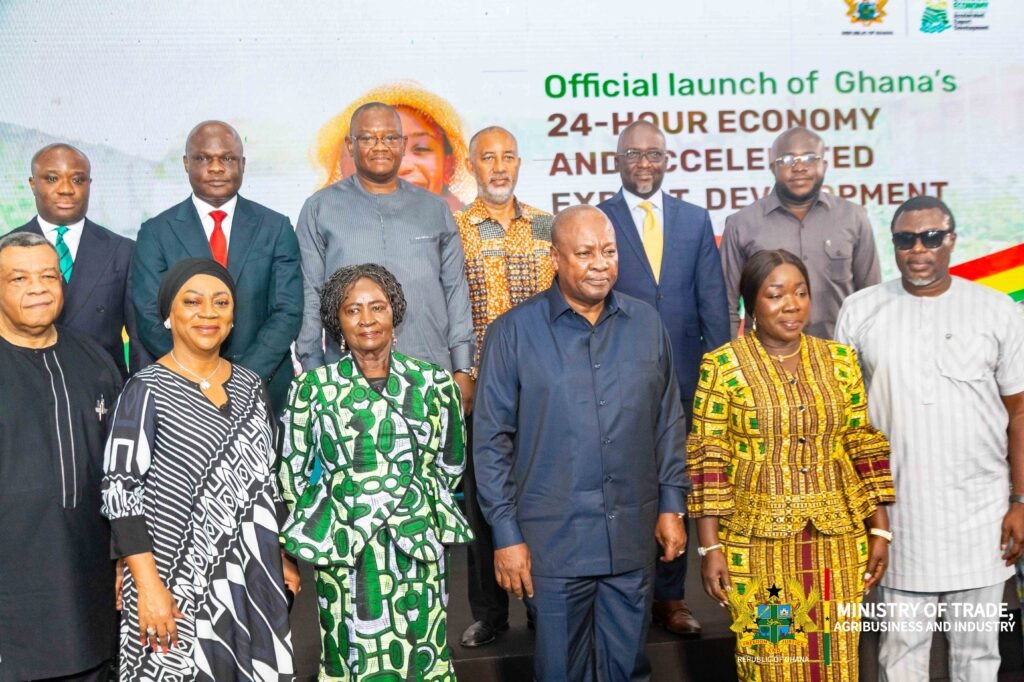
The government has made headway in resolving most of the energy sector challenges. However, some level of power outages remains in some regions, though not as intense as the previous year. The government has made commitments to invest in renewables and renegotiate power purchase agreements, but those medium- to long-term plans have not yet yielded short-term operational stability.
Still largely under only day time operation is Ghana’s transport systems. There remain locations where public transport fails beyond a certain time in the day, some charging ridiculous fares as soon as night falls. Aside from the temporal busses released by the government for the festive season to ease traffic, there has been no significant night-transport policy and institution. Road safety concerns persist, especially at night due to inadequate lighting and police patrols. The government’s infrastructure upgrades are also slowly ongoing.


Digitization in most public services have receives upgrades such as system applications, registration systems, and tax portals. Mobile Money and FinTech industry are expanding rapidly, while internet cost, however, remain high with national coverage gaps.
The policy initiative requires functional, especially in the public sector, shift-based labour policy, night-shift incentives, and updated labour protections.

The government has proposed the expansion of the country into economic zones to support continuous production. Currently, some industrial parks are being advanced, although businesses are yet to add night shift, revealing transitional challenges.
The path leader in the 24-Hour Economy policy is the public sector – to gradually unlock the private-sector participation. Key economic sectors remain inefficient or less efficient at night, like customs.
The public sector, industrial activities, labour readiness, digital infrastructure, public security at night, transportation at night, and the national energy reliability need unlocking and strict interventions to effectively institutionalize the 24-Hour Economy policy. A year on, the Ghanaian Economy still lies awake to the footprints of the economy.
Satisfying Workers’ Needs for Smooth Transition
According to the Government Statistician, Dr Alhassan Iddrisu, to create stable employment for Ghanaians, especially the youth, jobs must match skills to optimize productivity. The 24-Hour Economy policy, which aims to create jobs and boost national economic operations, must prioritize youth employment pathways must be prioritized.

These include apprenticeships, digital skills, and school-to-work transitions. Also, job quality must improve, especially by reducing vulnerable employment through formalization, access to finance, and labor protections.
Furthermore, skills training must align with labor market demand, with closer collaboration between governments, training institutions, and employees. The shift-based work must be supported responsibly, with strong protections for workers.
According to Dr Iddrisu, “if Ghana is to operate around the clock, workers must have protection, a good transportation system, fair pay, and decent working conditions.”
Most of the foundational preparations for the operationalization of the 24-Hour Economy policy are medium- to long-term establishment, especially the structural requirements. Ghanaians are hoping that in 2026, a clear achievement path will be visible to build trust among Ghanaians, especially the public sector workers.
READ ALSO: Ablakwa Demands Coordinated Global Action on Reparations at Diaspora Summit