
Ghana’s Constitutional Review Committee (CRC) has proposed far-reaching reforms to rein in the cost of elections, recommending constitutional limits on the duration of political campaigns and strict controls on how much political parties and candidates can spend.
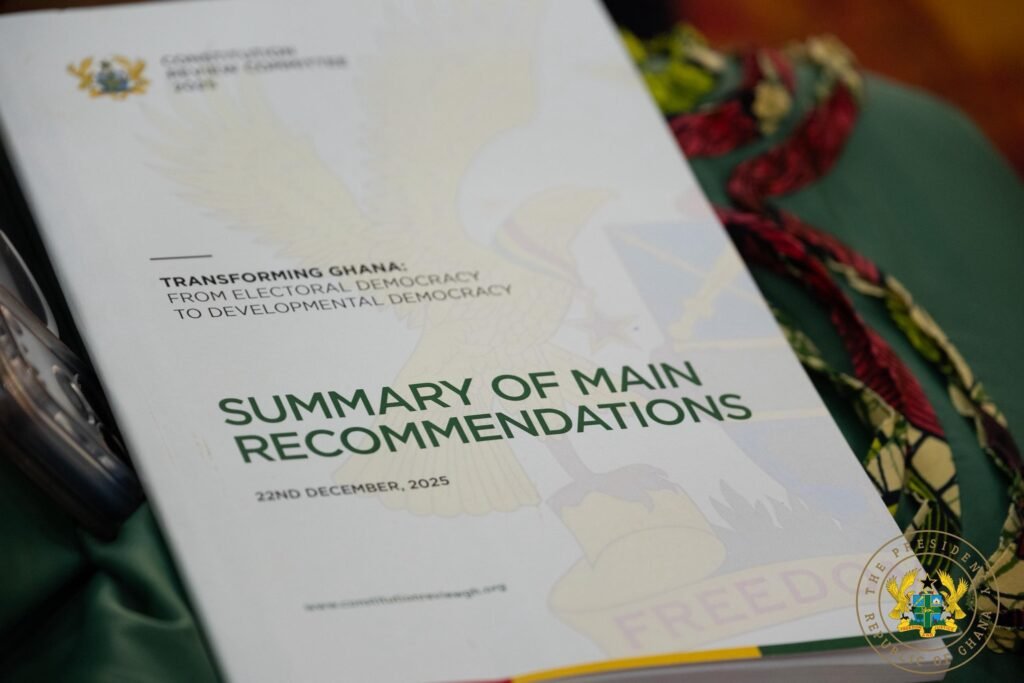
The proposals, contained in the Committee’s final report submitted to President John Dramani Mahama on December 22, 2025, are aimed at addressing the growing monetization of politics and its impact on democratic participation and governance. At the center of the recommendations is a proposed amendment to Chapter Seven of the 1992 Constitution, which governs political parties.
The CRC argues that prolonged campaign periods and unregulated spending have turned elections into high-cost ventures that favor wealthy candidates and incumbents, while sidelining capable citizens without access to significant financial resources.
According to the Committee, unchecked campaign financing has also encouraged vote buying, abuse of incumbency, and other practices that weaken public trust in the democratic process.
The Committee is recommending that Parliament, within a specified period after the amendment comes into force, enact new legislation or revise existing laws to regulate the cost of electioneering and political campaigns.

Central to this framework is a proposal to cap the period of electioneering and campaigning to a defined number of days or weeks immediately before general elections. The CRC suggests a maximum campaign window of 120 days, before which no electioneering or campaign activity, as defined by law, would be permitted.


The report explains that limiting the campaign period would help reduce financial pressure on political actors and curb the culture of perpetual campaigning that has come to dominate Ghana’s political landscape. By shortening the campaign season, the Committee believes political debate would become more focused, issue-driven, and accessible to a broader range of candidates.
Restriction on Campaign Financing and Regulation of Internal Primaries
In addition to time limits, the CRC proposes restrictions on the amount and type of expenditure political parties and candidates may incur during campaigns. These spending limits would be set out in law and enforced by an independent regulatory body.
The Committee notes that without clear expenditure ceilings, political competition risks becoming a contest of financial strength rather than ideas, experience, and leadership.
Internal party processes are also addressed in the proposals. The CRC recommends that the fees political parties charge aspirants and candidates during internal primaries for parliamentary or presidential elections should be subject to review and approval by a regulator.
According to the Committee, high filing fees have become a significant barrier to entry, particularly for women, young people, and professionals outside established political networks. Regulating these fees, the report argues, would promote inclusiveness and internal democracy within political parties.
Transparency and accountability are key elements of the proposed reforms. The Committee is calling for mandatory disclosure of campaign finances, spending, and funding sources by political parties and candidates.
These disclosures would be subject to external audits to ensure accuracy and compliance. The CRC states that greater financial transparency is essential to exposing illicit funding sources and preventing the misuse of public or private funds for electoral advantage.
The proposals also seek to tackle the abuse of incumbency, which the Committee identifies as a persistent challenge in Ghana’s elections. The recommended legal framework would regulate and sanction the use of state resources, public platforms, or official authority for electioneering purposes.
Establishing an Independent Registrar and Regulator of Political Parties and Campaigns
According to the CRC, clear rules and penalties are necessary to ensure a level playing field between incumbents and challengers. To enforce these reforms, the Committee recommends the establishment of a new independent constitutional body, the Independent Registrar and Regulator of Political Parties and Campaigns (IRRPC).
The IRRPC would be constituted in the same manner as the Electoral Commission and other independent governance institutions, ensuring security of tenure and operational independence. Under the proposals, the IRRPC would take over the registration and regulation of political parties from the Electoral Commission, but with an expanded mandate and enhanced enforcement powers.
The regulator would oversee compliance with campaign finance laws, monitor political party activities, and sanction violations. It would also work with Parliament to develop laws governing political parties and campaigns and to promulgate and enforce a binding Code of Conduct.
The CRC further recommends that the IRRPC be empowered to proscribe specific anti-democratic activities, including vigilantism and vote buying, which have periodically disrupted Ghana’s elections.
In addition, the regulator would be tasked with developing and enforcing compliance with agreed affirmative action benchmarks, including measures to promote gender inclusion in political participation.

As part of its broader mandate, the IRRPC would administer a proposed Democracy Fund. The fund would be used to support policy development, gender-inclusive initiatives, and other targeted, non-electioneering activities of political parties. The Committee emphasizes that the fund would not finance campaign activities but would instead strengthen party institutions and democratic culture.
President Mahama has acknowledged receipt of the CRC’s final report and announced that a dedicated Implementation Committee will be established in early 2026 to begin translating the recommendations into constitutional amendments.
While the proposals are expected to generate debate among political parties and stakeholders, the CRC maintains that regulating campaign duration and spending is necessary to protect Ghana’s democracy from the distorting influence of money.
If adopted, the reforms would mark a significant shift in how elections are conducted in Ghana, with the stated aim of making political competition fairer, less costly, and more accessible to citizens across the country.
READ ALSO: Strong Demand Pushes Treasury Bills Oversubscription to Fourth Straight Week