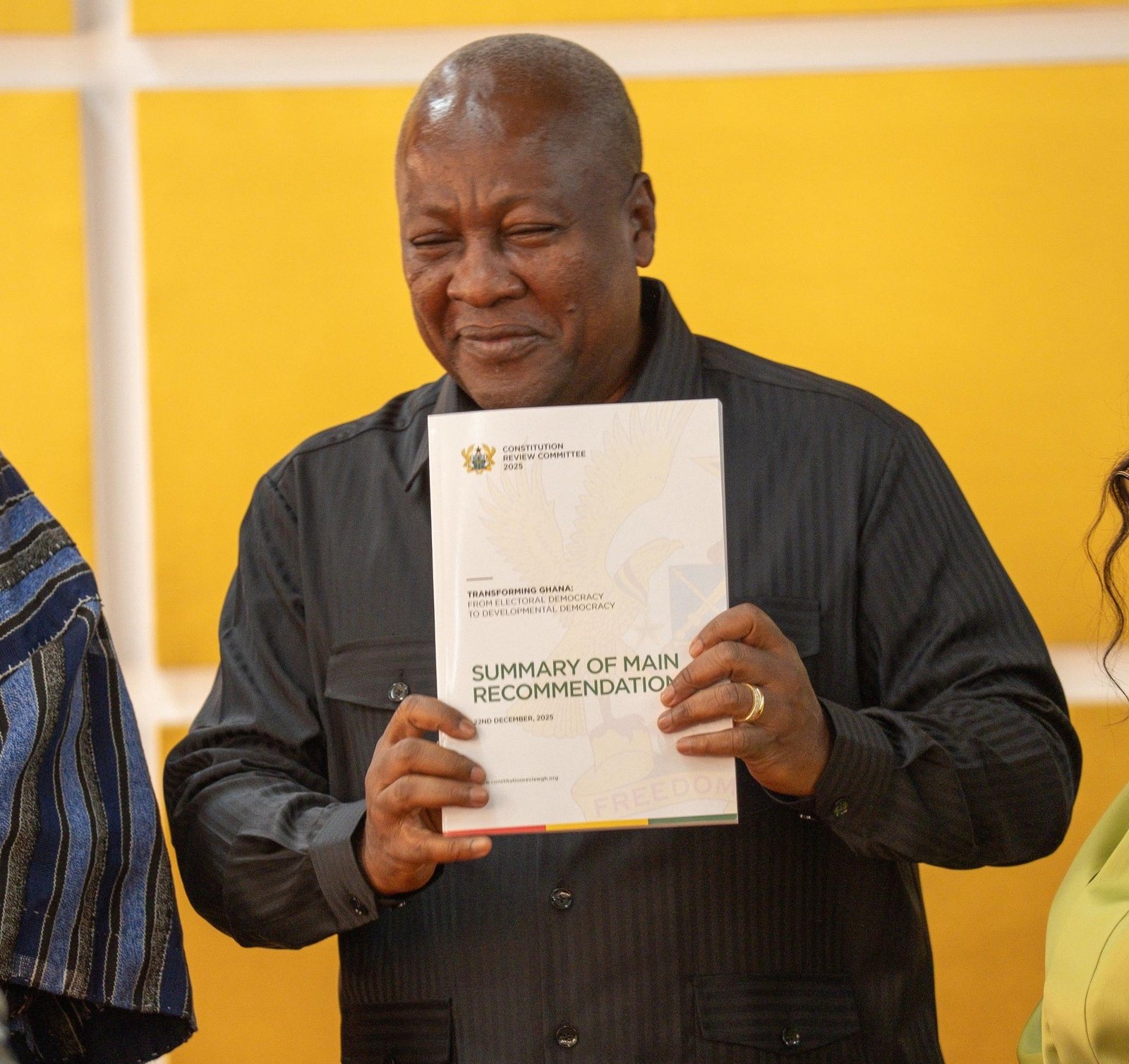
President John Dramani Mahama has described the recommendations of Ghana’s Constitutional Review Committee (CRC) as “radical but necessary,” pledging firm and decisive steps to ensure their implementation as part of a broader effort to strengthen democratic governance and restore public confidence in the constitutional order.
Speaking at the presentation of the CRC’s final report, President Mahama praised the committee for its integrity, independence, and non-partisan character, noting that the credibility of the process was critical to the acceptability of its outcomes.
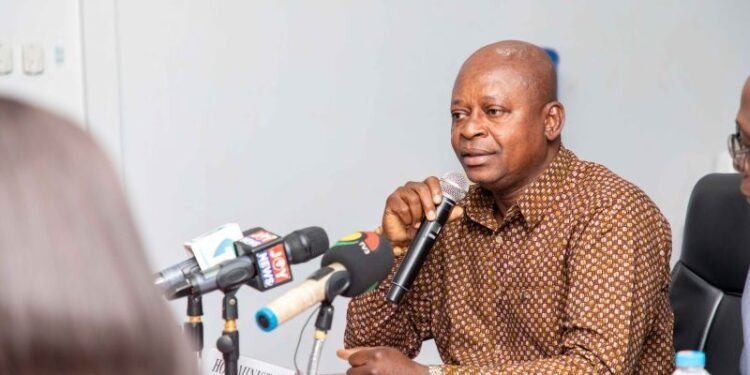
The eight-member committee, chaired by constitutional law expert Professor H. Kwasi Prempeh, spent nearly eleven months conducting nationwide consultations and technical reviews of the 1992 Constitution.
“I want to thank all the members of the committee for this beautiful Christmas,” the President said, expressing appreciation for what he described as painstaking work carried out over several months.
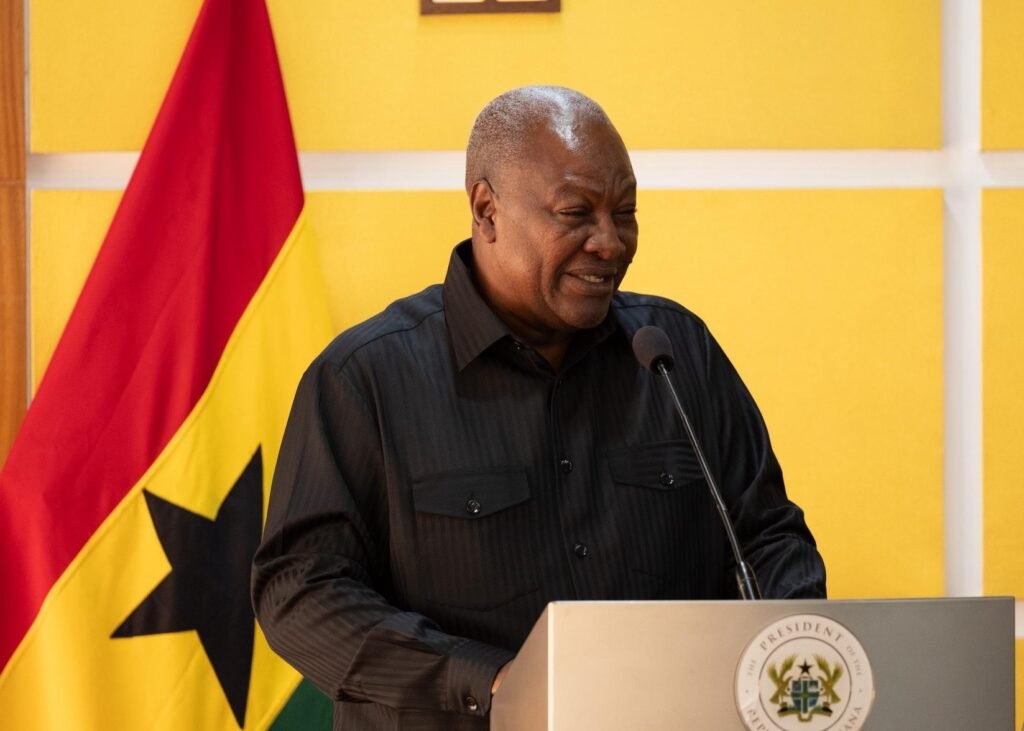
He emphasised that the committee was deliberately selected to reflect broad national confidence rather than political interest. According to him, the objective was to ensure that the recommendations would be seen as Ghanaian-owned, credible, and easier to advance through the reform process.
Far-Reaching Reforms: Bold and Timely
President Mahama acknowledged that some of the proposals may come across as far-reaching, particularly to citizens encountering them for the first time. However, he said the durability of the 1992 Constitution should not preclude periodic reflection and reform.


“It’s been the most durable constitution in the nation’s history,” he noted, adding that the recommendations were not a rejection of the constitutional framework but an attempt to strengthen it in response to emerging governance challenges.
Describing the proposals as both bold and timely, the President linked the reform agenda to broader regional trends. He warned that democratic and constitutional governance across parts of West Africa had been under strain, with several countries experiencing reversals that have eroded public trust in democratic systems.
Against that backdrop, he said Ghana must demonstrate that democracy remains the most effective system for unleashing the creative and productive potential of its people. “I think democracy, currently, we can see many countries in the sub-region backsliding with regard to democratic and constitutional governance,” President Mahama said.

He cautioned that while some citizens might feel tempted by alternative forms of governance, long-term stability and development could only be achieved through accountable and inclusive democratic institutions.
Practical Response to Growing Public Concern
The President stressed that the CRC’s work was not an academic exercise but a practical response to growing public concern about governance, accountability, and the concentration of power.
He pointed to recommendations touching on appointments, the Council of State, and executive authority as examples of proposals aimed at strengthening checks and balances within the constitutional system.
President Mahama confirmed that the next phase of the reform process would begin early in 2026 with the establishment of a dedicated Implementation Committee. He said some members of the CRC would be invited to serve on the new body to ensure continuity and institutional memory.
“We need that institutional memory to transfer into the implementation,” he explained, adding that the Attorney-General’s office would also play a key role in aligning legal interpretations and legislative drafting with the committee’s proposals.

The President indicated that careful consideration would be given to how the CRC report is handled going forward, including whether it should be published in full to allow broader public engagement.
While he did not announce an immediate decision, he signalled that transparency would be central to building national consensus around the reforms. “I don’t want it to be kept like a newspaper,” he said, suggesting the report should serve as a living document guiding national dialogue.
Bipartisan Cooperation
Throughout his remarks, President Mahama returned to the theme of bipartisan cooperation, arguing that constitutional reform should rise above partisan divisions. He urged political actors, civil society, and citizens to approach the recommendations with openness and a shared commitment to national progress.
According to him, implementing as many of the provisions as possible would require collective effort and goodwill across the political spectrum. Professor Prempeh and members of the CRC were commended for what the President described as “hard work for so many months.”
He encouraged them to take a brief rest before being called upon again in the implementation phase. The tone of his remarks underscored both appreciation and resolve, signalling that the reform agenda would not stall at the level of recommendations.

The submission of the CRC report marks one of the most significant moments in Ghana’s constitutional discourse in recent years. While the process of translating proposals into amendments will involve parliamentary scrutiny and, where required, referenda, President Mahama’s remarks leave little doubt about his administration’s intent to move swiftly and decisively.
As Ghana prepares for the next stage of constitutional reform in 2026, the President framed the CRC’s work as a necessary intervention to protect democratic governance, rebuild citizen confidence, and ensure that the Constitution evolves in line with the country’s political and social realities.
READ ALSO: Denmark Summons US Ambassador Over Greenland Envoy Appointment