
The Tema Oil Refinery (TOR) has reaffirmed its ability to refine Ghana’s locally produced crude oil, seeking to clarify growing public debate following the refinery’s return to crude processing after several years of inactivity.
Management says concerns about technical incompatibility are misplaced, stressing that the refinery was designed to handle the type of crude Ghana produces.
Speaking on the issue, the Corporate Affairs Officer of TOR, Godwin Mahama, said the refinery’s capacity to process local crude oil is well established. According to him, Ghana’s crude is classified as sweet crude, which aligns with TOR’s technical configuration.
“There have been a lot of issues as to whether TOR can refine the local crude or not.
“It is a fact that we can refine the local crude because what we are currently refining is a sweet crude, and our local crude is also sweet.”
Godwin Mahama, Corporate Affairs Officer of TOR

Mr Mahama recalled that TOR has previously refined Ghana’s crude oil successfully, providing historical evidence that counters current doubts. He pointed to operations carried out nearly a decade ago as proof of the refinery’s compatibility with local production.
He said that between 2015 and 2016, under the leadership of former Managing Director Awuah Darko, TOR refined crude from the Jubilee oil field without technical difficulties.


That experience, he noted, demonstrated that the refinery is capable of handling Ghana’s crude when the necessary operational and commercial arrangements are in place.
According to him, the key issue moving forward is not whether TOR can refine local crude, but how crude supply contracts are structured by the state.
Contract Structure Central to Refining Outcomes

Mr Mahama said, “All will depend on the contract the government signs and the type of arrangement involved,” underscoring the importance of policy and commercial decisions in determining the benefits Ghana derives from domestic refining.
He explained that one option is for the Government of Ghana to directly purchase and own crude oil for refining at TOR. Under such an arrangement, all refined petroleum products would remain within the country, enhancing domestic supply and reducing reliance on imports.
“If we buy the crude ourselves and own it, then every finished product that comes out of the refinery remains in Ghana, and Ghanaians get the full benefit.”
Godwin Mahama, Corporate Affairs Officer of TOR
This model, according to energy analysts, could strengthen fuel security, conserve foreign exchange and improve price stability on the local market.
Mr Mahama also outlined an alternative arrangement under which private companies supply crude oil to TOR for processing under a tolling system.
In such cases, TOR would earn processing fees, but ownership of the refined products would remain with the companies that supplied the crude.
“If companies bring their crude and we refine for them under the tolling system, we only take charges, and the finished product goes back to them.”
Godwin Mahama, Corporate Affairs Officer of TOR
While this model provides revenue for TOR and ensures utilisation of the refinery, it may limit the direct impact on domestic fuel availability, depending on where the refined products are ultimately sold.
Refinery Restart Marks Sector Milestone
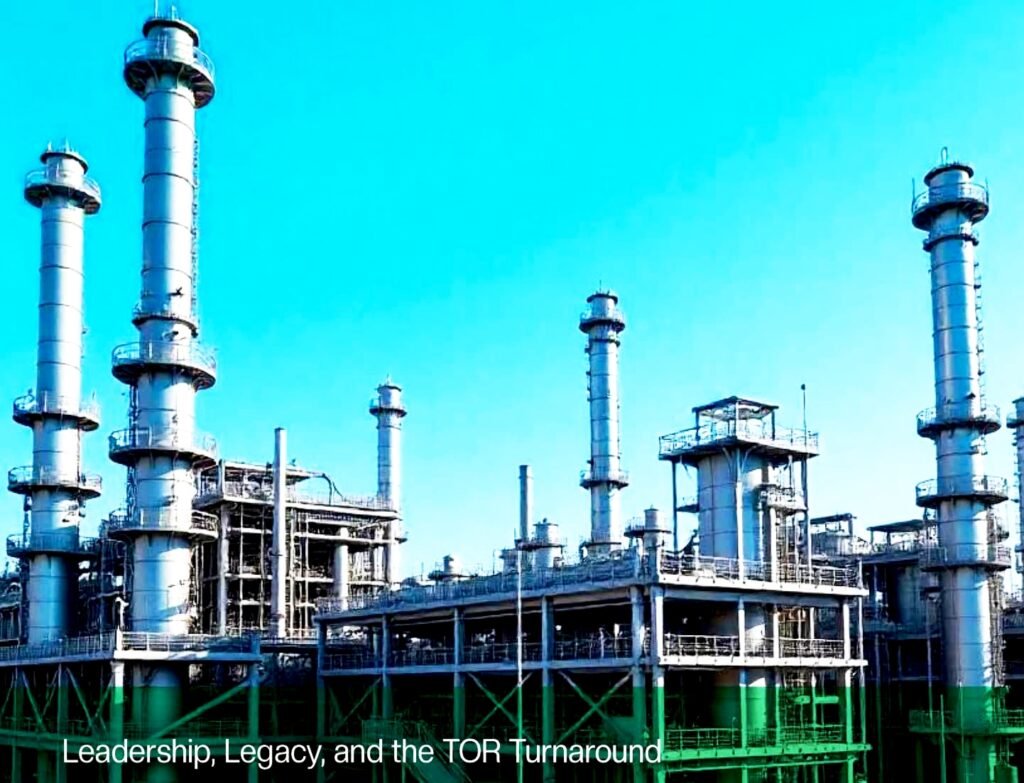
The clarification from TOR comes against the backdrop of the refinery’s recent resumption of crude oil refining, a development widely described as a milestone in efforts to revive Ghana’s downstream petroleum sector.
TOR returned to operations after completing extensive Turnaround Maintenance (TAM) works on its Crude Distillation Unit (CDU). The maintenance exercise, which ran from August 1 to October 30, 2025, focused on restoring the integrity, safety and efficiency of the refinery’s core processing systems.
According to TOR, the works were completed within schedule and carried out in line with international engineering, safety and operational standards.
Following the maintenance works, the National Petroleum Authority (NPA) conducted comprehensive inspections of the facility. TOR said the regulator confirmed full compliance with mandatory requirements and subsequently cleared the refinery to resume operations.
As part of a phased return to full capacity, TOR is currently stabilising its systems and optimising performance. Management says this cautious approach is intended to ensure long-term operational reliability and prevent disruptions as production ramps up.
In addition to restoring operations, TOR has completed the installation of a new furnace, known as F-61, which is expected to be commissioned soon and integrated into the CDU.
Once operational, the furnace will raise refining capacity from the current 28,000 barrels per stream day to the refinery’s original nameplate capacity of 45,000 barrels per stream day.
As TOR resumes operations and clarifies its technical capabilities, attention is increasingly shifting to policy and contractual decisions that will shape the refinery’s long-term impact.
With management insisting that the refinery can refine Ghana’s crude, stakeholders say the challenge now lies in crafting arrangements that maximise national benefits and ensure sustainable operations.
READ ALSO: Majority of Ghanaians Backs Key Constitutional Review Committee’s Proposals