
New polling data by the Global InfoAnalytics point to a notable reshaping of Ghana’s political landscape, with the National Democratic Congress recording significant growth in regions that have become increasingly decisive in national elections.
The figures published by its Executive Director, Mussa Dankwa show that Ashanti, Greater Accra and the Central Region are emerging as the core pillars of the NDC’s voter base, underscoring a gradual but important shift in regional political alignments since the 2024 general elections.
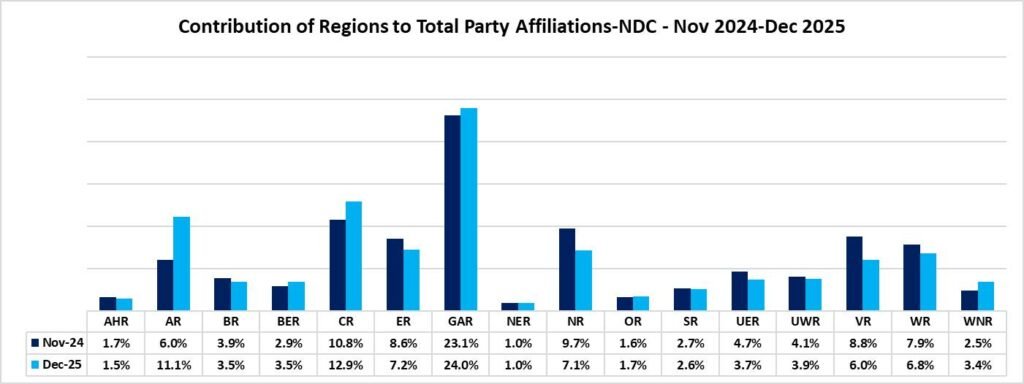
According to the data, the Ashanti Region has become one of the most important growth areas for the NDC. Traditionally regarded as a stronghold of the opposition New Patriotic Party, Ashanti now accounts for 11 percent of all NDC voters nationwide, up from just 6 percent in 2024.
This near doubling of the party’s share in the region suggests sustained inroads into an area that has historically been difficult terrain for the NDC.
Analysts say the trend reflects changing voter attitudes, especially among younger and urban voters, as well as the impact of broader national dynamics that have softened long-held partisan loyalties.
Greater Accra remains the single largest contributor to the NDC’s national support base. The region now accounts for 24 percent of all NDC voters, representing a marginal increase from 23 percent in 2024.


While the growth rate in Greater Accra appears modest, its significance lies in the region’s size, diversity and political competitiveness. As the country’s administrative and economic hub, Greater Accra continues to be a bellwether for national political sentiment, with shifts there often mirroring broader trends across the country.
The Central Region has also strengthened its position within the NDC’s support structure. The data show that the region now contributes 13 percent of the party’s voters, up from 11 percent in the previous year.
The Central Region has long been considered a swing region in Ghanaian politics, capable of tilting national outcomes. The latest figures suggest that the NDC has consolidated gains there, reinforcing the region’s reputation as a critical battleground where voter preferences remain fluid and responsive to national issues.
Taken together, Ashanti, Greater Accra and the Central Region now account for 48 percent of all NDC voters nationwide. This represents a substantial increase from 40 percent in 2024, highlighting a growing concentration of the party’s support in regions that are both populous and politically competitive.
This notable shift could have far-reaching implications for future elections, as success in these regions often translates into national victory.
Modest Decline in Other Regions
While gains have been recorded in these key areas, the data also reveal declines in several other regions. The Eastern Region recorded a modest drop of 1.3 percent in its contribution to the NDC’s voter base.
The Northern Region saw a more pronounced decline of 3 percent, while the Upper East Region registered a 1 percent decrease. The Volta Region, traditionally considered a stronghold of the NDC, experienced a 3 percent drop, and the Western Region recorded a decline of 1 percent.
These reductions suggest a degree of redistribution within the party’s national support, rather than an overall contraction. Mussa Dankwa cautioned that declines in traditionally loyal regions such as Volta should not be ignored.
While the region remains an important base for the NDC, the figures may indicate voter fatigue or rising expectations that demand renewed engagement and policy responsiveness.
At the same time, the shifts highlight how Ghana’s electoral politics are becoming less predictable, with regional loyalties increasingly shaped by performance, credibility and national economic conditions.
Decline in Support for Other Political Parties
The data also provide insights into support for other political parties beyond the two dominant ones. Although their overall share remains relatively small at around 3 percent nationally, the figures show that these parties continue to draw most of their support from the Western, Ashanti and Volta regions.
This pattern suggests that political pluralism, while limited in scale, remains geographically concentrated and influenced by local dynamics.
One of the most striking changes in this category is the sharp drop in the Central Region’s contribution to support for other political parties. The region now accounts for just 3 percent of their combined support, down significantly from 15 percent in 2024.
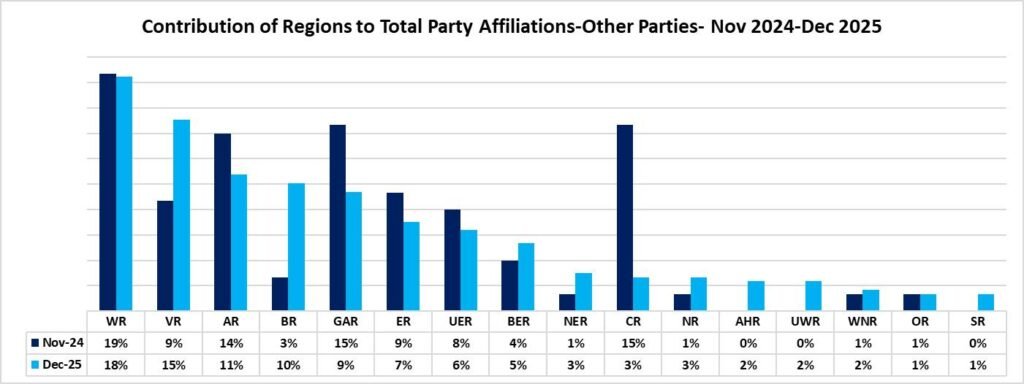
This decline suggests that voters in the Central Region may be consolidating around the major parties, particularly the NDC, reducing space for smaller political movements in what was previously a more open field.
Overall, the emerging picture is one of a political landscape in transition. The NDC’s growing presence in Ashanti, coupled with sustained strength in Greater Accra and improved performance in the Central Region, points to a strategy that is yielding results in areas that matter most electorally.
At the same time, the redistribution of support away from some traditional regions underscores the need for continued engagement across the entire country.
As Ghana moves further away from the 2024 elections, these trends suggest that regional political identities are becoming more fluid. Voters appear increasingly willing to reassess long standing allegiances, placing greater emphasis on national leadership, policy direction and perceived performance.
For the NDC, the challenge ahead will be to consolidate gains in its new growth regions while addressing slippage in others, as the competition for the political centre continues to intensify.
READ ALSO: Oil Prices Slip Despite Venezuela Shock