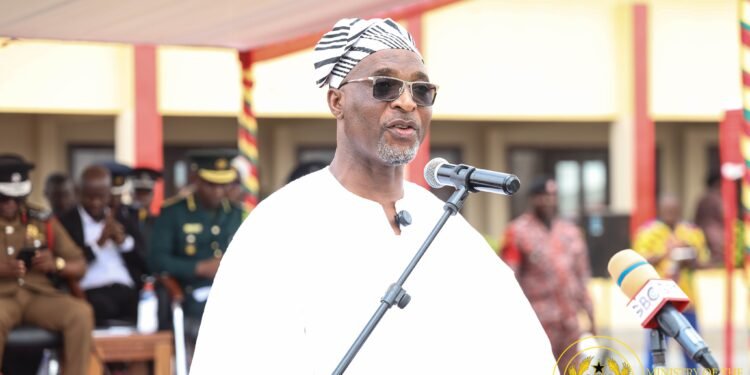
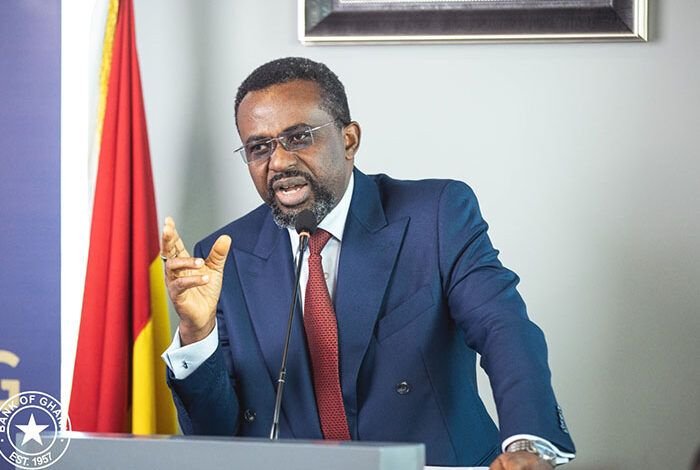
Governor of the Bank of Ghana (BoG), Dr. Johnson Pandit Asiama, has called for reforms of the Domestic Gold Purchase Programme (DGPP), arguing that the initiative and its associated frameworks were essential interventions designed to tackle systemic national economic crises.
Amidst rising scrutiny over recorded financial losses, the Governor clarified that the initiatives, including the Gold-for-Oil (G4O) and Gold-for-Reserves (G4R) schemes, were never intended as profit-making ventures in the traditional commercial sense but as strategic tools to stabilize the cedi and build critical buffers.
He emphasized that the focus should remain on the fundamental problems these schemes solved, specifically the mitigation of foreign exchange leakages and the curbing of gold smuggling that has historically drained the nation’s wealth.
“So as I’ve mentioned, it’s not a question about losses then and now. It is that these schemes were introduced to address a specific national problem. What to do going forward is how to reform it, how to make it more efficient.”
Dr. Johnson Pandit Asiama
Expanding on this position, Dr. Asiama provided a transparent breakdown of the fiscal costs associated with these interventions over the last three years. In 2022, the G4O scheme recorded a net loss of GH₵74.44 million, while the G4R program maintained a stable position.
However, as the global and local economic landscape shifted in 2023, the financial burden increased, with G4O losses rising to GH₵317.69 million and G4R recording a significant loss of GH₵1.054 billion.
By 2024, the figures climbed further to GH₵1.8 billion for G4O and GH₵3.8 billion for G4R. While the 2025 data remain under audit, the Governor asserted that these costs must be weighed against the “mind-blowing” leakages the country would have otherwise suffered.


The BoG is now moving toward a “unified manner” of reform, seeking to sharpen the efficiency of the programs to support long-term economic stabilization.
Assessing the Economic Impact and Strategic Trade-offs

From an extractive and mining perspective, the DGPP represents a paradigm shift in how Ghana manages its natural resources as financial assets.
Historically, the artisanal and small-scale mining (ASM) sector operated largely in the shadows, with a significant portion of doré gold being smuggled across borders, depriving the state of foreign exchange.
By formalizing this sector through the Ghana Gold Board (GoldBod) and the central bank’s purchasing power, the government has successfully quadrupled its gold reserves from 8.74 tonnes to over 32 tonnes in less than four years.
This “reserve buildup” acts as a sovereign insurance policy, providing the liquidity needed to intervene in the FX market and reduce reliance on expensive external borrowing.
Experts note that while the “trading losses” cited in financial statements are substantial, they often reflect the price of “market-neutral intermediation” and foreign exchange fluctuations.
In 2024 alone, the program managed a gold value of approximately $4.07 billion. If this gold had been smuggled, the net loss to the Ghanaian economy would have exceeded the recorded accounting losses by several orders of magnitude.
The strategy has effectively converted a physical commodity into a liquid reserve that supports the national balance of payments, even when the immediate accounting entries show a deficit.
Collaborative Path Toward Institutional Reform

The transition toward a more efficient DGPP is already underway, signaled by high-level collaboration between the Bank of Ghana and GoldBod.
Dr. Asiama revealed that a joint board meeting is scheduled to harmonize strategies, with an open invitation for parliamentary experts and industry stakeholders to join the reform process.
The primary objective is to reduce “intermediary costs” and “sharpen efficiency” within the supply chain.
By eliminating redundant charges and improving the pricing framework for small-scale miners, the central bank aims to make the program a “win-win” for both the state and the local mining community.
Industry analysts suggest that the next phase of reform should focus on digitalizing the gold supply chain to improve transparency and tracking.
This would further reduce the “leakages” that Dr. Asiama described as “mind-blowing” over the years.
By integrating beneficial ownership data and implementing a more robust due diligence framework, the BoG can ensure that the gold entering its reserves is ethically sourced and priced competitively against the international market.
The ultimate goal is to move beyond “apportioning blame” for historical losses and instead build a resilient, unified framework that protects Ghana’s extractive wealth.
Strengthening Macroeconomic Resilience through Gold

The future of Ghana’s economic stabilization depends heavily on the successful consolidation of these gold-backed schemes. The Governor’s appeal for national unity on this issue highlights the existential importance of the program.
As the BoG prepares to publish its full financials by March this year, the focus will shift to how the 2025 audit findings can inform better fiscal prudence without sacrificing the strategic benefits of the DGPP.
The intent is clear: to ensure that the “space for smugglers” remains permanently closed and that the value of Ghana’s gold remains within its borders to anchor the national currency.
Refining the DGPP is not merely a technical adjustment; it is a vital step in asserting sovereign control over the mining value chain.
With inflation dropping and the cedi stabilizing as of early 2026, the BoG maintains that the strategic “investment” in gold reserves has already paid dividends in the form of restored investor confidence.
By working together with experts and parliamentary committees, the central bank seeks to evolve these schemes from emergency interventions into permanent pillars of Ghana’s financial infrastructure.
READ ALSO : BoG Report Highlights Uneven Sector Performance in Q3 2025