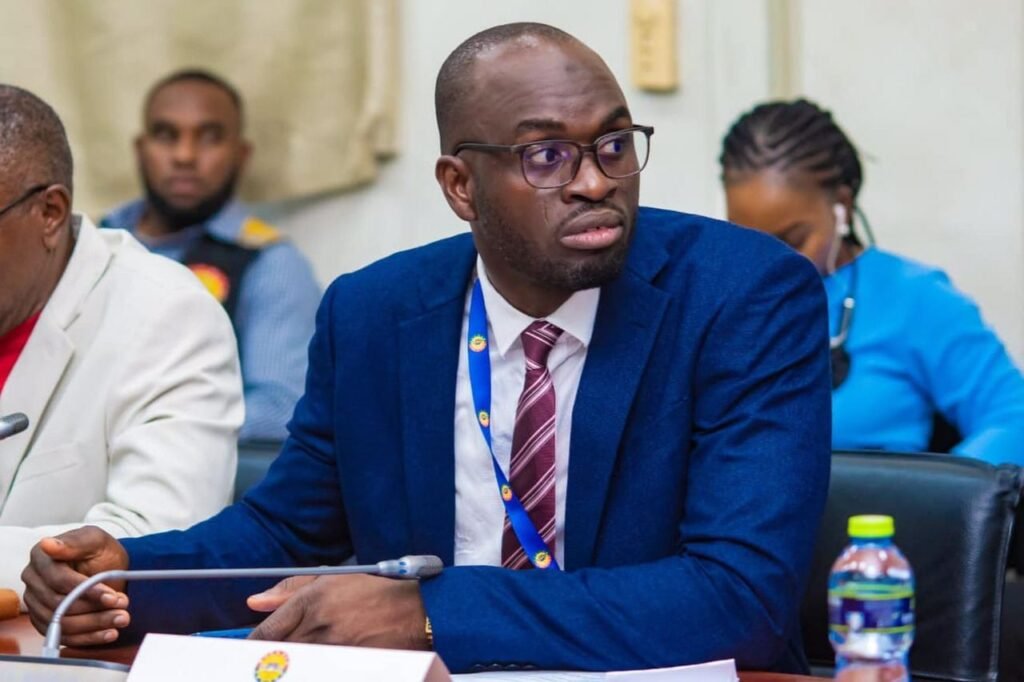
Member of Parliament for Walewale, Hon. Dr. Tiah Abdul-Kabiru Mahama, has intensified the scrutiny surrounding the Domestic Gold Purchase Programme (DGPP) by questioning the legal and operational eligibility of Bawa-Rock Company Limited.
As an economist and a prominent voice on the Finance Committee, Dr. Kabiru argued that the firm was originally incorporated in 2015 for farming and fishing, rendering it fundamentally unqualified to act as a state-funded gold aggregator.
He contended that the selection of a non-extractive entity for such a critical role is not merely an administrative oversight but a presumptive act of state capture that threatens the integrity of Ghana’s mineral reserves.
“Bawa Rock was never set out to deal in gold and could not have dealt in gold business as was incorporated in 2015. It is a fact that it was set up for FARMING /FISHING. Public interest, transparency and Section 42 of the GoldBod Act support this call for full disclosure.”
Hon. Dr. Tiah Abdul-Kabiru Mahama

Expanding on these assertions, Dr. Kabiru highlighted a significant legal hurdle involving the “ultra vires” rule, noting that the abolition of this doctrine under Act 992 in 2019 cannot retrospectively validate gold trading activities conducted by a company registered for agriculture in 2015.
He pointed to the persistent refusal of the Ghana Gold Board (GoldBod) to publish the underlying contract terms including commissions and fees as evidence of a “fishy deal” that lacks the transparency mandated by Section 42 of the GoldBod Act.
This opacity, combined with Bawa-Rock’s sudden rise to “sole aggregator” status despite previously being unqualified, has led to estimated state losses of US300 million by the end of 2025.


The Legality of Retrospective Regularization

The controversy deepens when examining the transition of Bawa-Rock from a rural enterprise to a high-stakes mineral middleman.
Dr. Kabiru asserted that “you cannot say that just because it was registered in 2015 and was given a license in 2016, it was regularly engaged in gold trade” without violating established corporate laws.
The lawmaker insisted that the Minority’s call for a Parliamentary Inquiry is the only way to “settle the matter conclusively” and determine if the state’s gold has been unconscionably mortgaged to a private individual.
He warned that Goldbod’s attempt to “sweep away this scandal under the argumentative umbrella of evidence” is a desperate flight from accountability.
Financial Hemorrhage and Market Distortion
The economic implications of engaging an ineligible company in the DGPP are profound, extending beyond simple administrative errors to systemic financial leakage.
By concentrating state funding into a “sole aggregator” that lacked prior operational profitability or technical expertise, the program has effectively created a de facto monopoly that stifles competition.
This hegemony results in the “loss of US300 end year 2025) to the State,” depriving the nation of the foreign exchange stability the DGPP was designed to provide.
When an ineligible firm manages such massive volumes of wealth, the resulting trading deficits and high commissions erode the very reserves the Bank of Ghana seeks to build.
Accountability and the Promise of Defense

Dr. Kabiru drew a sharp contrast between the current government’s apprehension and their past rhetoric while in opposition.
He also noted that the same administration previously promised to investigate “the US$58 million National Cathedral scandal” and “illegal and inflated single-sourced contracts” like PDS and Agyapa.
According to him, fighting “potential state capture” at Bawa-Rock is a fulfillment of the promise to defend the Republic.
For the extractive sector, the impact of such “unpardonable” governance is a loss of international trust, as previously qualified aggregators are sidelined in favor of an entity with a “past operational (non)profitability” record.
The DGPP was intended to formalize the artisanal sector and bolster the cedi, but critics argued it has been transformed into a “scheme to loot from the state.”
Without the competitive bidding required to ensure fair pricing for miners and maximum returns for the government, the program risks becoming a vehicle for “galamsey fraud” and “missing excavators” narratives.
As Dr. Kabiru concludes, the “circumstantial information to support a reasonable belief of corruption” is now too overwhelming for the government to ignore, making a formal inquiry into Bawa-Rock’s hegemony over Ghana’s gold an absolute necessity for national survival.
READ ALSO: NPP Moves To Expel Prof. Frimpong-Boateng Over ‘Fake Party’ And Rigging Allegations