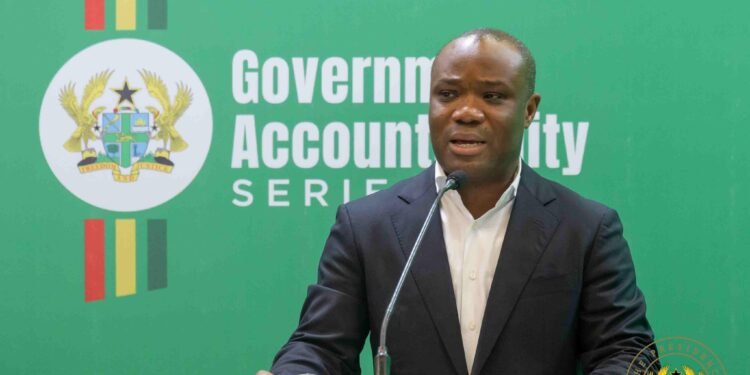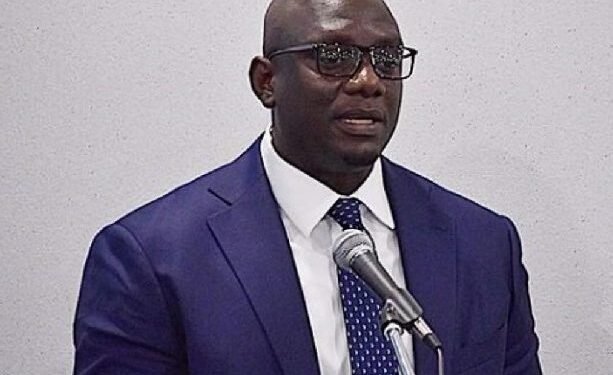
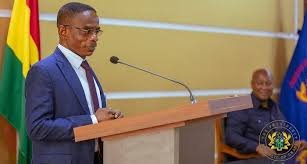
The Auditor General has moved decisively against 35 contractors engaged under the government’s Agenda 111 hospital project, demanding the refund of 7.9 million dollars, equivalent to about 94.6 million cedis, after a special audit uncovered widespread non performance and grossly inadequate delivery despite the release of substantial mobilisation funds.
The action follows a validation review conducted by the Ghana Audit Service, which revealed that millions of dollars paid to contractors between 2021 and 2024 could not be justified by the level of work executed on the ground.
According to the audit findings, the contractors received a total of 11.16 million dollars as mobilisation fees to commence work on 19 hospital sites across the country. However, physical inspections and payment reviews showed that work executed by the contractors amounted to only 5.96 million dollars.
In several cases, contractors either failed to move to site entirely or undertook work valued at less than 10 percent of the sums paid to them, raising serious concerns about value for money and compliance with contract terms.
The audit further disclosed that an additional 4.35 million dollars was paid to 11 companies whose contracts were subsequently terminated. These firms collectively executed inception works valued at 2.49 million dollars, leaving 1.92 million dollars worth of work undone before their contracts were cancelled.
The scale of the shortfall compelled the Auditor General, Johnson Akuamoah Asiedu, to invoke his constitutional authority to recover the funds through surcharges on the companies and individuals involved.



The findings form part of a validation review following a special audit into the Agenda 111 programme, a flagship health infrastructure initiative intended to expand access to hospital services nationwide.
The audit examined payment records, contract documentation, and bank transfer advices, and was supported by physical inspections of project sites. It identified a recurring pattern in which contractors received the standard 10 percent mobilisation fee of their contract sums, intended to support preparatory works and ensure speedy commencement, but delivered little or no construction activity.
$5.9m Payment by Valid Contractors
Out of the total surcharge amount, 24 contractors whose contracts are still valid have been directed to refund 5.96 million dollars because the value of work done fell far below expectations. The audit cited multiple instances of zero work despite full mobilisation payments.
At Adeiso, Imperial Homes received over 1.01 million dollars, while Grand Unique Company Limited and Terraefuoco Limited received 81,074.40 dollars and 130,910.19 dollars respectively, yet none of these companies executed any work on site.
Similar cases were recorded at Agbogbloshie, where Casa City Limited and Dynamic Access Limited were paid to construct a hospital but failed to commence any work. Other companies listed for zero performance after receiving mobilisation include Josano Limited, Asvas Company Limited, Ghire Limited, Concord Consult Limited, Delovely Company Limited, Osini Group Limited, and Noble Gen Limited.
Terminated Contracts
In the category of terminated contracts, the audit found that Hallwort Ghana Limited, contracted to build a hospital at Adabokrom, was paid 67,772.60 dollars without executing any work.
Dominion Covenant Company Limited, responsible for a project at Akrofuom, received 129,866.30 dollars for zero work, while Aarun bis Company Limited, assigned to a project at Bunkpurugu, also carried out no work despite receiving mobilisation funds.

One of the most significant cases involved Mendanha and Sousa, which received 960,937.69 dollars to construct a hospital at Mankranso. The company completed less than 10 percent of the expected work before its contract was terminated, leaving 375,702.30 dollars to be refunded to the state.
Tk Waters Limited similarly executed work valued at 571,112.89 dollars out of a 1.10 million dollar mobilisation fee for the Nangodi hospital, resulting in a refund of 530,513.11 dollars.
Overpayment
The audit also highlighted instances where payments far exceeded progress. 4G Building Technologies Limited received over 1.3 million dollars but achieved only two percent of the expected work, leaving more than 1 million dollars to be recovered.
While the report acknowledged that a few contractors delivered work close to the mobilisation sums received, these cases remained the exception rather than the norm.
Among those with relatively higher performance, Rajar Engineering executed 9.8 percent of work after receiving 937,724.53 dollars for a project at Akatsi. Jaborah Construction Limited completed 9.7 percent of work at Akrofuom, while Ark Express Ghana Limited executed nine percent of the 129,866.30 dollar mobilisation at Busunya.
Kofi Job Company Limited delivered 8.63 percent of work after receiving 1.43 million dollars for the Bantama Sub Metro Ampabame project. The audit report recommended that the Auditor General invoke Article 187 subsection 7 clause b of the Constitution to surcharge all 35 contractors for the amounts to be refunded.
The provision empowers the Auditor General to disallow any expenditure found to be contrary to law and to surcharge the person responsible for the improper payment.
The surcharge action follows a nationwide audit exercise initiated by the Auditor General to validate outstanding financial claims, commitments, and bank transfer advices submitted by ministries, departments, and agencies.

On November 3, 2025, Mr Akuamoah Asiedu released a list of such claims for verification, setting November 7, 2025 as the deadline for final validation. The Ministry of Finance had submitted the claims, covering works and services delivered up to December 31, 2024, for audit scrutiny.
The audit, conducted between May and October 2025, was carried out by the Ghana Audit Service in collaboration with international accounting firms PricewaterhouseCoopers and Ernst and Young.
The findings are expected to reinforce fiscal discipline, strengthen accountability in public procurement, and signal a tougher stance against the misuse of public funds within major infrastructure programmes.
READ ALSO: Government Affirms Reforms to Restore Financial Discipline at ECG