Former Vice President Dr Mahamudu Bawumia has opened a commanding lead in the race to become the New Patriotic Party’s flagbearer for the 2028 general elections, according to the latest headline polling figures released by Global InfoAnalytics.
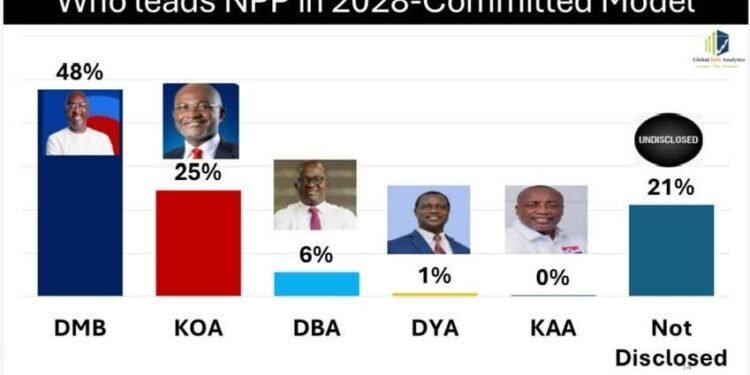
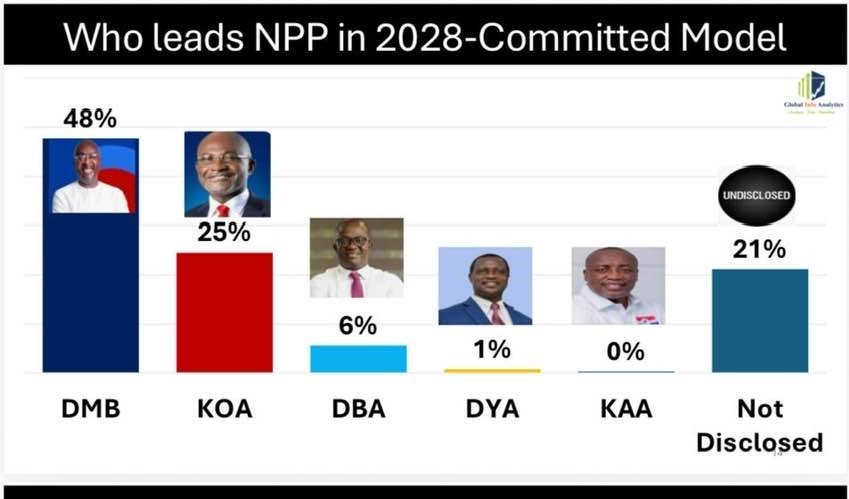
The final pre primary poll places Dr Bawumia at 48 percent, giving him a decisive advantage over his closest competitors just days before the party goes to the polls. The findings, shared by the Executive Director of Global InfoAnalytics, Mussa Dankwa, indicate what he describes as a significant leap in Dr Bawumia’s standing within the party.
Mr Dankwa noted that a more detailed predictive model, outlining expectations for the final outcome of the race, will be published soon. The headline figures, however, already suggest a contest in which one candidate has built substantial momentum ahead of voting day.
The New Patriotic Party is scheduled to hold its presidential primaries on Saturday, January 31, 2026, to select a flagbearer for the 2028 elections. Voting will take place between 7 a.m. and 2 p.m. at 333 polling centres nationwide, with more than 211,000 accredited delegates expected to cast their ballots.
The outcome will shape the party’s direction as it seeks to return to power in the next general elections. Five aspirants have been cleared to contest the primary. Dr Bawumia, who served as Vice President from 2017 to 2025 and was the party’s presidential candidate in the 2024 elections, leads the field with 48 percent in the Global InfoAnalytics poll.
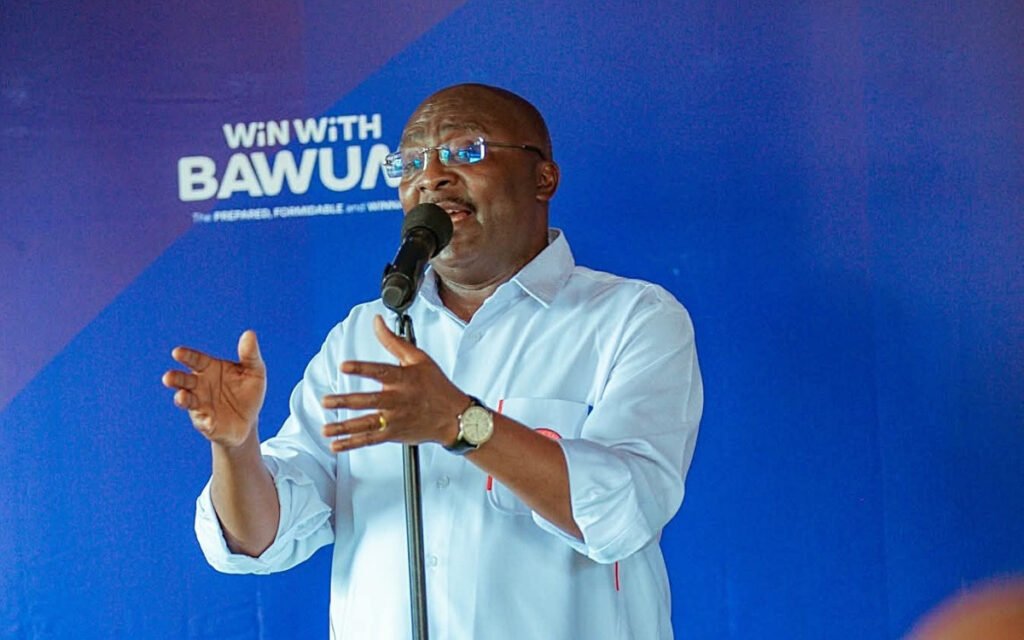
His closest challenger is former Assin Central Member of Parliament Ken Ohene Agyapong, who polled 25 percent. Mr Agyapong, known for his outspoken style and strong grassroots appeal, remains the only other candidate with a substantial share of delegate support.


The remaining contenders trail some distance behind. Bryan Acheampong, the Member of Parliament for Abetifi and former Minister of Food and Agriculture, recorded 6 percent in the poll.
Dr Yaw Osei Adutwum, the Bosomtwe Member of Parliament and former Minister of Education, polled 1 percent, while Kwabena Agyei Agyepong, a former General Secretary of the NPP, registered no measurable support in the headline figures. Mr Dankwa described the numbers as reflective of current sentiment within the party rather than a definitive prediction of the final outcome.
He stressed that internal party elections can be fluid, especially in the final days before voting, but acknowledged that the margin suggested by the poll places Dr Bawumia in a strong position going into the primaries. According to him, the forthcoming predictive model will provide further insight into likely voting patterns and turnout dynamics.
Beyond the polling figures, the run up to the primaries has been marked by efforts to ensure a peaceful and credible process. On January 22, 2026, all five aspirants signed a peace pact in Accra, committing themselves to a transparent contest and pledging to support whoever emerges as the winner.
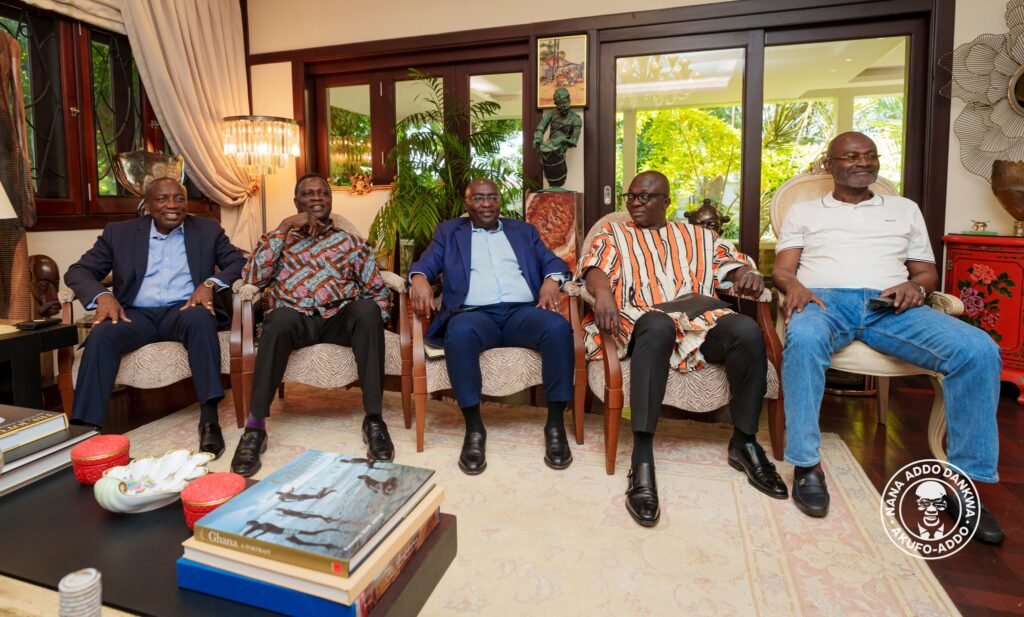
The agreement binds the candidates to respect the outcome of the election and to work together to maintain unity within the party ahead of the 2028 general elections. Party leaders have consistently emphasised cohesion as a central priority, particularly after what they describe as lessons learned from previous internal contests.
The peace pact also commits the aspirants to refrain from rhetoric or actions that could undermine party unity before, during, or after the primaries. Security arrangements have also been tightened to safeguard the integrity of the vote.
The Ghana Police Service is expected to deploy between 70 and 150 officers to each polling centre across the country. The security presence is intended to deter misconduct and provide a safe environment for delegates to exercise their franchise.
In a significant procedural change, proxy voting has been officially abolished for this election. Party officials say the decision is aimed at preventing abuses and ensuring that only duly accredited delegates physically present at polling centres are allowed to vote.
The move has been welcomed by some party members as a step toward enhancing transparency, although others have raised concerns about delegates who may face logistical challenges in attending.
Oversight of the primaries will be provided by the Electoral Commission of Ghana, reinforcing the credibility of the process. The NPP’s Presidential Election Committee, chaired by former Parliamentarian Joseph Osei Owusu, has declared the party’s full readiness for the exercise.

Mr Osei Owusu has assured delegates and the general public that all logistical and administrative arrangements are in place to deliver a smooth election. As the primaries draw closer, attention is increasingly focused on whether Dr Bawumia’s polling advantage will translate into victory on election day or whether late shifts among delegates could narrow the gap.
While the Global InfoAnalytics figures suggest a clear frontrunner, party insiders caution that internal elections are often influenced by last minute engagements, regional dynamics, and turnout levels at polling centres.
For now, the poll positions Dr Bawumia as the candidate to beat, setting the stage for a closely watched contest that will determine the New Patriotic Party’s standard bearer for the 2028 presidential race.
READ ALSO: Ghana’s Central Bank Admits Six Crypto Firms