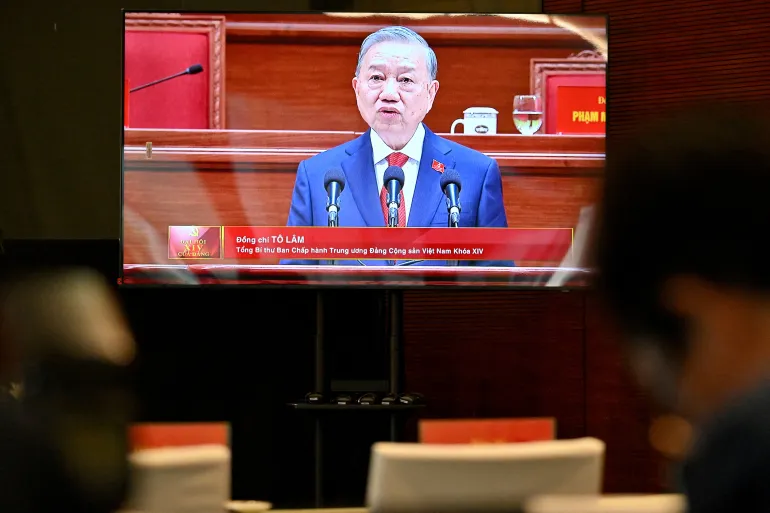
Vietnam’s Communist Party has re-appointed To Lam as its General Secretary, extending his top leadership position in the Southeast Asian nation for the next five years.
According to an announcement made at the conclusion of the party’s five-yearly congress in the capital Hanoi, To Lam was “unanimously” re-elected to the post of General Secretary.
The party said in a statement that the party Central Committee “absolutely unanimously elected Comrade To Lam to continue holding the position of General Secretary.”
Tran Thanh Man, Chairman of Vietnam’s National Assembly, said that the party Chief had received 180 votes out of 180 to remain in the top job.
Lam’s re-election as party Chief will send a reassuring message to foreign investors who regularly cite political stability as a key factor in Vietnam’s appeal as a pro-business environment.
The Congress was framed by Vietnam’s defining national question: whether the country can transform itself into a high-income economy by 2045. During the meeting, Vietnam set a target of average annual GDP growth of 10% or more from 2026 to 2030.
The gathering brought together nearly 1,600 delegates to outline Vietnam’s political and economic direction through 2031. It also confirmed a slate of senior appointments, electing 19 members to the Politburo, the country’s top leadership body.
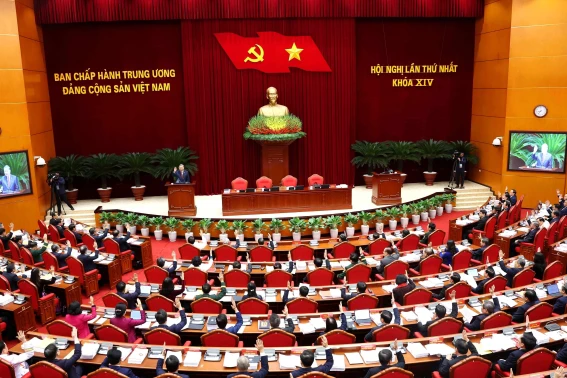
Earlier this week, addressing hundreds of congress delegates seated in a red-carpeted conference hall under a towering statue of the Communist Party’s founder and liberation struggle hero, Ho Chi Minh, Lam promised to continue fighting corruption and ensure annual growth above 10 percent through to 2030.
Vietnam’s transformation into a global manufacturing hub for electronics, textiles, and footwear has been striking. Poverty has declined and the middle class is growing quickly.
However, challenges loom as the country tries to balance rapid growth with reforms, an aging population, climate risks, weak institutions and US pressure over its trade surplus.
At the same time, it must balance relations with major powers. Vietnam has overlapping territorial claims with China, its largest trading partner, in the South China Sea.
Lam Seeks A System Grounded In Integrity
In a speech, To Lam said that he wanted to build a system grounded in “integrity, talent, courage, and competence,” with officials to be judged on merit rather than seniority or rhetoric.
No announcement was made about whether Lam will also become President.
However, Le Hong Hiep, a fellow at Singapore’s ISEAS–Yusof Ishak Institute, opined that the composition of the newly elected 19-member Politburo, the party’s top decision-making body, “strongly suggests” Lam will further concentrate his power with the presidency.
Such consolidation could speed decisions and push through reforms, he said, but risks weakening intra-party checks and complicating succession.
If he were to get both positions, he would be the country’s most powerful leader in decades, similar to Chinese leader Xi Jinping.
Lam has overseen Vietnam’s most ambitious bureaucratic and economic reforms since the late 1980s, when it liberalized its economy.
Under his leadership, the government has cut tens of thousands of public-sector jobs, redrawn administrative boundaries to speed decision-making, and initiated dozens of major infrastructure projects.
Lam spent decades in the Ministry of Public Security before becoming its minister in 2016. He led an anti-corruption campaign championed by his predecessor, Nguyen Phu Trong.
During his rise, Vietnam’s Politburo lost six of its 18 members during an anti-graft campaign, including two former presidents and Vietnam’s parliamentary head.
READ ALSO: South Korea’s Former Prime Minister Jailed For 23 Years