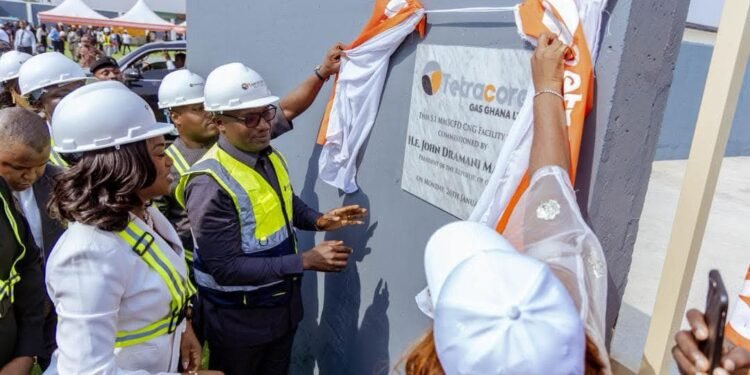
Ghana has reached a significant milestone in its energy transition journey with the commissioning of its first-ever Compressed Natural Gas (CNG) facility, a development the Minister for Energy and Green Transition, Dr John Abdulai Jinapor, says will accelerate the shift toward cleaner, more affordable, and more reliable energy sources.
The facility, developed by Tetracore Gas Ghana Limited, was officially commissioned with the participation of the Energy Minister, marking a new chapter in the country’s efforts to reduce reliance on expensive liquid fuels while deepening the use of domestic natural gas to power industry and economic growth.
“This project is a decisive step toward cleaner, more affordable, and reliable energy, reducing our dependence on expensive liquid fuels while supporting industrial growth and job creation.”
Dr. John Abdulai Jinapor, Minister for Energy and Green Transition

The commissioning of the CNG facility represents the first time Ghana has operationalised compressed natural gas as a commercial energy solution, expanding the country’s gas value chain beyond power generation and industrial feedstock.
CNG, which is produced by compressing natural gas to reduce its volume for storage and transportation, offers a cleaner-burning alternative to diesel and petrol, particularly for industrial users, commercial fleets, and heavy-duty transport.
Dr Jinapor noted that the facility aligns with Ghana’s long-term vision of maximising the value of its domestic gas resources. By converting locally produced natural gas into compressed form, the country can reduce fuel import bills, improve energy security, and offer competitively priced energy to the productive sectors of the economy.


Expanding Gas Infrastructure

The Energy Minister reaffirmed government’s commitment to expanding gas infrastructure in line with President John Dramani Mahama’s Gas-to-Power Policy, which seeks to position natural gas as a transition fuel for Ghana’s energy mix.
Under this policy direction, government aims to leverage domestic gas production to power electricity generation, industrial processing, and now transportation and distributed energy solutions such as CNG.
Officials believe this integrated approach will enhance efficiency across the energy value chain while supporting climate commitments.
One of the most immediate benefits of the CNG facility is its potential to lower energy costs for industrial and commercial users. With liquid fuels often subject to volatile international prices and foreign exchange pressures, compressed natural gas offers a more stable and cost-effective alternative.
Energy experts note that CNG also produces fewer greenhouse gas emissions and significantly lower particulate matter compared to diesel and petrol, making it a cleaner option for urban transport and industrial operations.
Dr Jinapor underscored this environmental advantage, linking the project to Ghana’s green transition objectives. The facility, he said, supports the dual goal of economic growth and environmental responsibility, ensuring that industrial expansion does not come at the expense of air quality and public health.
Private Sector Investment Driving Transition

The project highlights the growing role of private sector investment in Ghana’s energy transition. Tetracore Gas Ghana Limited, already a key player in the country’s gas processing and distribution space, has expanded its footprint by investing in infrastructure that broadens gas utilisation.
Government officials see such investments as critical to achieving scale in alternative energy solutions. By partnering with private developers, the state can accelerate infrastructure delivery while focusing public resources on regulation, planning, and enabling frameworks.
Dr Jinapor praised Tetracore’s leadership, describing the project as evidence that clear policy direction and investor confidence can deliver transformative outcomes in the energy sector.
Beyond energy supply, the CNG facility is expected to contribute to job creation and industrial competitiveness. From construction and operations to downstream logistics and maintenance, the facility opens up new employment opportunities while supporting industries that depend on reliable energy inputs.
For Dr Jinapor, the facility represents more than a single project; it is a proof of concept for how Ghana can diversify its energy mix while strengthening energy security. As demand for cleaner fuels grows, CNG could play a complementary role alongside renewables and gas-to-power solutions.
As Ghana charts its path toward a more resilient and sustainable energy future, the success of the CNG facility will be closely watched as a model for scaling cleaner energy infrastructure nationwide.