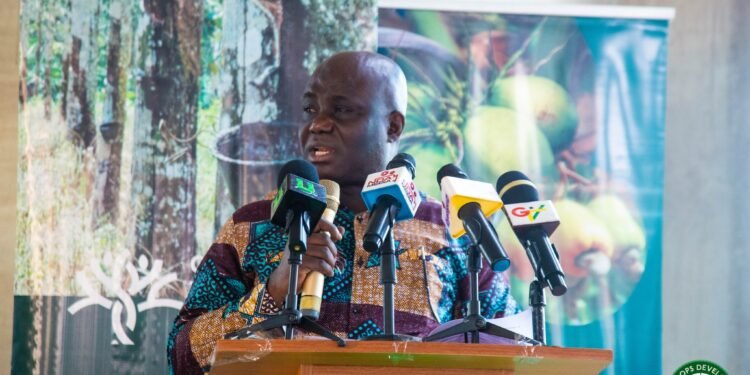

The Minister for Roads and Highways, Hon Governs Kwame Agbodza, has announced that government is set to commence construction of the Adawso Ekye Amanfrom Bridge, a major infrastructure project expected to significantly improve connectivity and economic activity in parts of the Eastern Region and beyond.
The minister disclosed that upon returning to his office, he would sign the contract authorising the contractor to begin work on the bridge, marking a critical step in the implementation of one of Ghana’s most ambitious transport projects.
Speaking on the scope of the project, Hon Agbodza explained that the bridge will stretch for about three kilometres and will cross one of the major tributaries of the Volta system. He clarified that while many people broadly refer to the water body as the Volta River, the river takes on different names in different locations.
In the Oti enclave, for instance, the same river system is identified as the Oti River. The minister noted that regardless of the name used locally, the bridge will span a significant section of the river, linking communities that have long relied on unreliable ferry and pontoon services.
The Adawso Ekye Amanfrom Bridge is designed to connect the towns of Adawso and Ekye Amanfrom across the Afram River, providing a permanent and dependable crossing.
For decades, residents, traders, farmers, and commuters in the area have depended on ferries that are often affected by mechanical challenges, water levels, and long waiting times. These challenges have constrained movement and limited economic opportunities, particularly for farming communities in the Afram Plains.



The government considers the bridge a central pillar of its Big Push infrastructure programme, which aims to unlock economic potential through large scale investments in roads, bridges, and transport networks.
According to sector officials, the bridge will be among the largest ever constructed in Ghana, both in length and strategic importance. Current projections indicate that the structure will range between three and three point six kilometres, making it the longest bridge in the country upon completion and one of the longest on the African continent.
The bridge has been designed to accommodate two main traffic lanes, a service lane, and dedicated pedestrian walkways to ensure safety and ease of movement for both vehicles and pedestrians. This design reflects the government’s intention to future proof the structure and cater for increasing traffic volumes as economic activity expands in the surrounding regions.
Beyond its physical dimensions, the project is expected to have far reaching economic implications. The Afram Plains is widely recognised as one of Ghana’s major agricultural zones, with large scale production of maize, rice, cassava, yam, and other food crops.
However, poor road and river crossing infrastructure has often made it difficult for farmers to transport produce to major markets in the Ashanti and Greater Accra regions. The new bridge is expected to ease this constraint, reduce travel time, and lower transportation costs, thereby improving incomes for farmers and traders.

In terms of financing and approvals, the project has passed several critical milestones. As of January 2026, Parliament’s Finance Committee approved the commercial and credit facility agreements supporting the bridge construction.
The bridge forms part of a broader financing package estimated at about three hundred and fifty million euros, which also includes the development of related road infrastructure such as the Bunso Adawso road. These complementary roads are intended to ensure that the bridge is fully integrated into the national road network.
The design and construction contract has been awarded to the BNIP Janson Adawso Consortium from the Netherlands under a design build arrangement. This approach places responsibility for both the design and construction on the contractor, a model government believes will enhance efficiency and accountability.
Feasibility studies and detailed designs commenced and were completed in 2025, clearing the way for physical works to begin in earnest. Hon Agbodza stressed that the bridge represents more than just a physical structure.
In his view, it symbolises the government’s commitment to addressing long standing infrastructure gaps that have held back entire communities. He noted that once completed, the bridge would permanently change the movement of people and goods across the river and integrate previously isolated areas into the mainstream of national economic life.

Construction activities are expected to gather momentum throughout 2026, with stakeholders expressing cautious optimism about timelines and delivery. While no specific completion date has been publicly announced, officials indicate that steady progress will be prioritised to ensure value for money and adherence to technical standards.
As work begins, expectations are high among residents of Adawso, Ekye Amanfrom, and surrounding communities. For many, the bridge promises safer travel, improved access to social services, and new economic opportunities.
For government, it stands as a flagship project under the Big Push agenda, aimed at using strategic infrastructure to drive inclusive growth and national development.
READ ALSO: Ghana Commissions First CNG Facility in Energy Transition