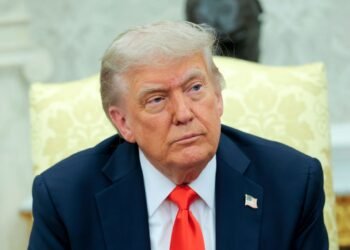
Last week, US President Donald Trump convened the inaugural meeting of his newly formed Board of Peace, describing it as the “most consequential … in terms of power and in terms of prestige.”
Meeting at the United States Institute of Peace, the board made a headline pledge; $10 billion from the United States, alongside roughly $7 billion combined from Kazakhstan, Azerbaijan, Morocco, Bahrain, Qatar, Saudi Arabia, Uzbekistan, Kuwait and the United Arab Emirates.
Yet outside the venue, dozens of demonstrators gathered in protest. Their criticism focused on Israel’s participation and the absence of Palestinian representation, casting an early shadow over the board’s claims of neutrality and global reach.
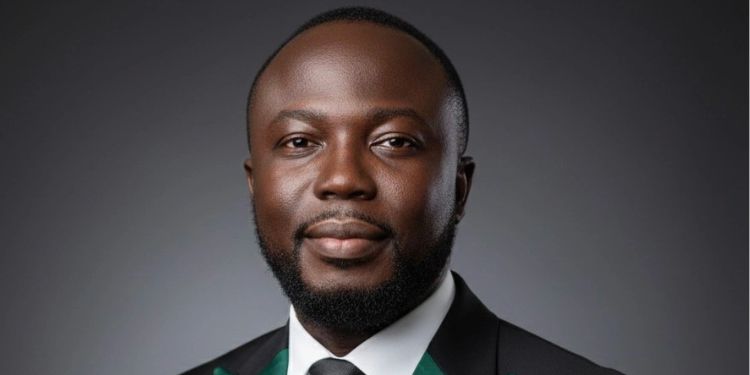
In an interview with The Vaultz News, Henry Osabutey, a human rights, peace and conflict studies scholar, opined that the Board of Peace begins with both ambition and structural weaknesses.
The board’s immediate focus is Gaza’s reconstruction and current public estimates place rebuilding costs at around $70 billion. Against that backdrop, Osabutey noted that the pledged $17 billion leaves a substantial deficit.
“From the onset, the numbers already show the core difficulties…The board begins with barely a quarter of the minimum capital required.”
Henry Osabutey
However, he cautioned that reconstruction is not simply a matter of raising funds. Post-war recovery, he explained, is never linear. Housing, water systems, electricity, sanitation, healthcare, education and governance are interconnected. As such, rebuilding one sector without stabilizing the others risks uneven or unsustainable outcomes.

Security, in particular, stands out as a pressing operational gap. “Reconstruction cannot proceed if contractors, aid agencies and civilians are unsafe,” Osabutey said.
He pointed to post-1995 Bosnia, where the Dayton Agreement created a framework accepted by the principal conflict parties, allowing rebuilding to proceed with a measure of stability. By contrast, Afghanistan’s reconstruction faced persistent setbacks amid a contested political settlement and fragile security conditions.
Beyond physical rebuilding, Osabutey emphasized the need for economic revival. Infrastructure may be restored quickly, but without employment opportunities, access to trade and functioning governance institutions, long-term recovery remains uncertain.
The board’s composition has drawn scrutiny and for Osabutey, selective participation carries consequences.
“The credibility of any peace mechanism depends less on funding and more on perceived neutrality. When one conflict party is present and the other lacks structured representation, the mechanism risks being viewed as politically aligned rather than as a mediation platform.”
Henry Osabutey
Such perceptions, he argued, could translate into operational obstacles. He referenced Afghanistan as an example where externally funded initiatives struggled because local communities did not fully trust the actors behind them. A similar dynamic, he suggested, could emerge in Gaza if residents feel excluded from decision-making processes.
He added that the fact that some countries have opted for observer status rather than full membership also signals caution. “They want to see whether the Board of Peace becomes a diplomatic forum or a geopolitical alignment bloc,” he explained.
Whether the Board of Peace evolves into a space where adversaries feel represented, rather than managed, may determine its credibility as a global mechanism.
Expansion Beyond Gaza To Pose Challenges
Although the first meeting concentrated on Gaza, the board’s charter and President Trump’s remarks suggest broader ambitions. However, Osabutey noted that expanding the Board of Peace’s remit beyond a single conflict zone presents risks.
He drew on precedents from the Balkans and West Africa. In Bosnia, clearly defined mandates tied to specific settlements proved more workable than broad, diffuse regional approaches. In West Africa, ECOWAS interventions succeeded when focused on particular crises but faced strain when managing multiple conflicts simultaneously.
He said that for the Board of Peace, rapid expansion could fragment mediation channels, particularly if it competes with existing international frameworks rather than complementing them. Parallel diplomacy, Osabutey warned, may dilute coordination instead of strengthening it.
At the same time, he acknowledged potential opportunities. The initiative could allow the United States to emphasize reconstruction diplomacy over military intervention, reshaping its global leadership profile. “Success will depend less on unilateral direction and more on multilateral buy-in,” he said.
A Platform Still Taking Shape
Moreover, Osabutey views the Board of Peace as having potential as a reconstruction financing and stabilization platform. However, he argued that it does not yet match the comprehensiveness of established global peace institutions.
Its financial capacity remains insufficient relative to its initial target. Its security architecture and operational readiness are unclear. Its political legitimacy is contested and its scalability to multiple conflict zones remains conditional.
“The board’s success will depend less on initial funding and more on whether it becomes inclusive, rule-based and well-coordinated with international political needs.”
Henry Osabutey
For now, the Board of Peace stands at an early and uncertain stage; backed by significant pledges and presidential rhetoric, yet facing operational, financial and legitimacy challenges that will shape whether it becomes a durable instrument of peacebuilding or another ambitious initiative constrained by geopolitical realities.
READ ALSO: Government Reaffirms 1,200MW State-Owned Power Plant to Cut Energy Costs