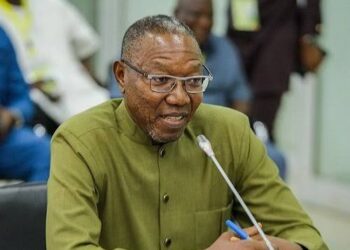
The Member of Parliament for Manhyia South and Lawyer, Honourable Nana Agyei Baffour Awuah, has argued that the proposed tribunal system is an impractical response to the challenges facing Ghana’s justice delivery system. He contended that the bill fails to identify the real causes of delays within the courts and therefore cannot provide an effective solution.
The Manhyia South MP explained that every public policy should begin with a clear understanding of the problem it seeks to solve. According to Honourable Awuah, lawmakers must first determine the nature and scale of any challenge before deciding on the most suitable remedy.
Drawing an analogy with medical treatment, the legislator observed that every illness requires the correct medication. In his view, applying the wrong solution to a legal challenge only creates new difficulties without resolving the existing ones.
“Before you prescribe medicine, you identify the disease. If you treat a headache with medicine for a stomach ache, you will never solve the problem. That is exactly what this proposal seeks to do. It is a mixed bag of wrong prescription, wrong diagnosis, impracticality, and unconstitutionality.”
Honourable Nana Agyei Baffour Awuah
Honourable Awuah also criticised the justification advanced for establishing specialised tribunals to handle selected criminal offences. He cited data from the Judicial Service covering the 2022 and 2023 legal year and argued that many of the offences listed under the proposal represent only a small fraction of cases before the courts.
He therefore questioned the wisdom of creating an entirely new judicial structure to address what he described as a relatively limited category of cases. As he explained, public resources should be directed towards reforms capable of improving the entire justice system instead of introducing parallel institutions.

Making another point, the lawyer stated that delays within the courts cannot be solved through measures that overlook the real operational challenges confronting the judiciary. He argued that policy reforms should strengthen existing institutions instead of replacing them with structures whose effectiveness remains uncertain.
From his perspective, the proposal also overlooks the practical realities of case management within Ghana’s courts. The Manhyia South MP asserted that improving staffing levels, administrative support and judicial resources would produce better results than establishing additional tribunals.
Tribunal Costs And Delays Could Burden Justice System Further
Honourable Nana Agyei Baffour Awuah also argued that the proposed tribunal system could create additional delays and increase the cost of administering justice. He asserted that the bill’s provisions may produce outcomes opposite to the objectives outlined by its proponents.
The Manhyia South MP explained that tribunal proceedings would involve a minimum of three panel members, making it more difficult to keep hearings on schedule. According to Honourable Awuah, the absence of a single panel member could force adjournments and prolong cases that would otherwise proceed before a single judge.
The legislator stated that the existing court system offers greater flexibility because one judge is responsible for hearing and determining a case. In contrast, he argued that coordinating the schedules of several adjudicators would place additional pressure on the judicial calendar.
“A tribunal with three members is more likely to suffer adjournments. If one member is unavailable, proceedings cannot continue as planned, and that creates further delays.”
Honourable Nana Agyei Baffour Awuah
Highlighting the timelines proposed in the bill, Honourable Awuah contended that statutory deadlines alone cannot guarantee faster justice. He pointed to existing court rules requiring judgments to be delivered within specified periods, explaining that practical realities often make strict compliance difficult.
Furthermore, the lawyer noted that the bill itself recognises those practical limitations by using the phrase “if practicable” in relation to certain timelines. In his assessment, that qualification demonstrates that the proposed deadlines may prove difficult to achieve in everyday judicial work.

The Manhyia South MP also questioned the financial implications of establishing regional tribunals across the country. He argued that every tribunal would require a presiding chairperson with the status of a High Court judge in addition to other panel members, administrative personnel and operational support.
“The proposal will cost more to run than the existing courts. You are paying a chairman, paying additional panel members and maintaining another administrative structure.”
Honourable Nana Agyei Baffour Awuah
According to Honourable Awuah, those additional expenses should instead be directed towards strengthening the present court system through improved logistics, staffing and infrastructure. He indicated that such investments would produce more lasting improvements in the administration of justice.
He also pointed out that the central issue is the underlying factors contributing to court backlogs. He suggested that addressing case management, judicial capacity and administrative efficiency would provide a more sustainable response than creating parallel institutions.
READ ALSO: Veteran Actress Donates 50,000 Cedis to Ailing Actor’s Transplant Fund