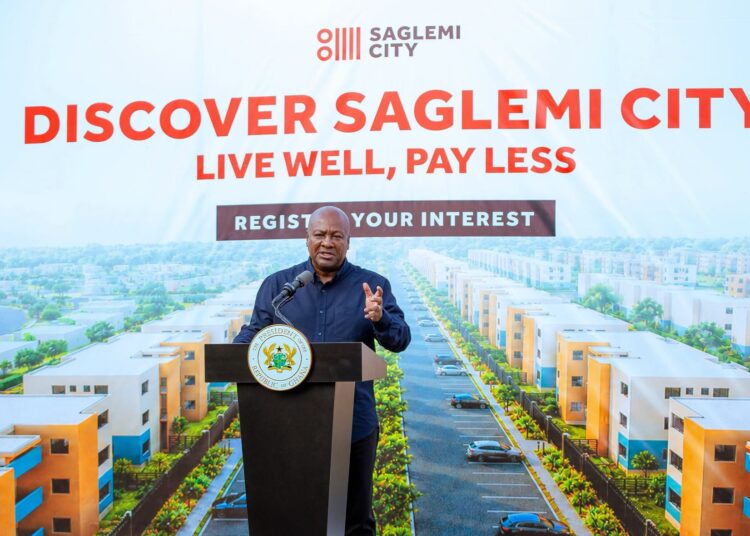
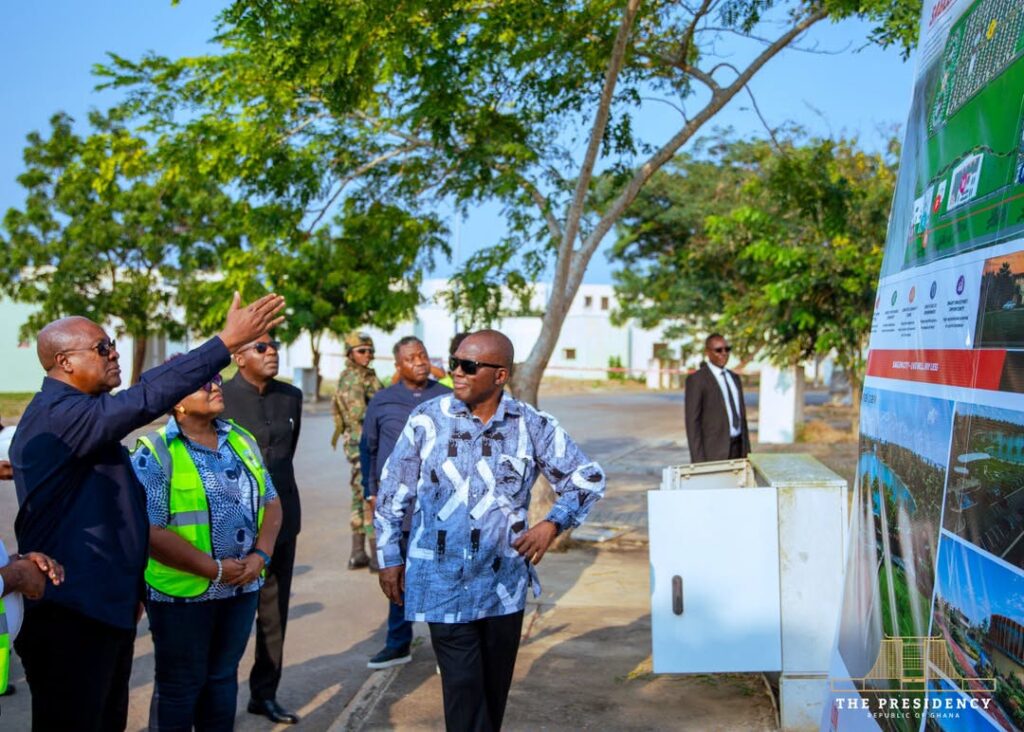
President John Dramani Mahama has toured the revived Saglemi Housing Project in the Ningo Prampram District of the Greater Accra Region, where developer LMI Holdings pledged to deliver 700 housing units by the end of March 2027 and the full first phase of 1,500 units by December 2027.
The Thursday, August 20, 2026 inspection marked the most detailed public update yet on a project that spent nearly a decade as a symbol of stalled public housing in Ghana, offering the clearest timeline so far for when the long-abandoned estate will finally house Ghanaian families.
Kojo Botsio Aduhene, Chairman and Chief Executive Officer of LMI Holdings, told the President and assembled officials that the developer invited Mahama to the site precisely because the public had been asking what was happening to Saglemi.
He offered a direct commitment on completion dates. “Mr President, be assured that by the end of March 2027, we will have 700 units ready,” he said, adding, “take me at my word.” Mr Aduhene said the site is ready to begin sales, with clearing, underground cabling and other preparatory works underway.
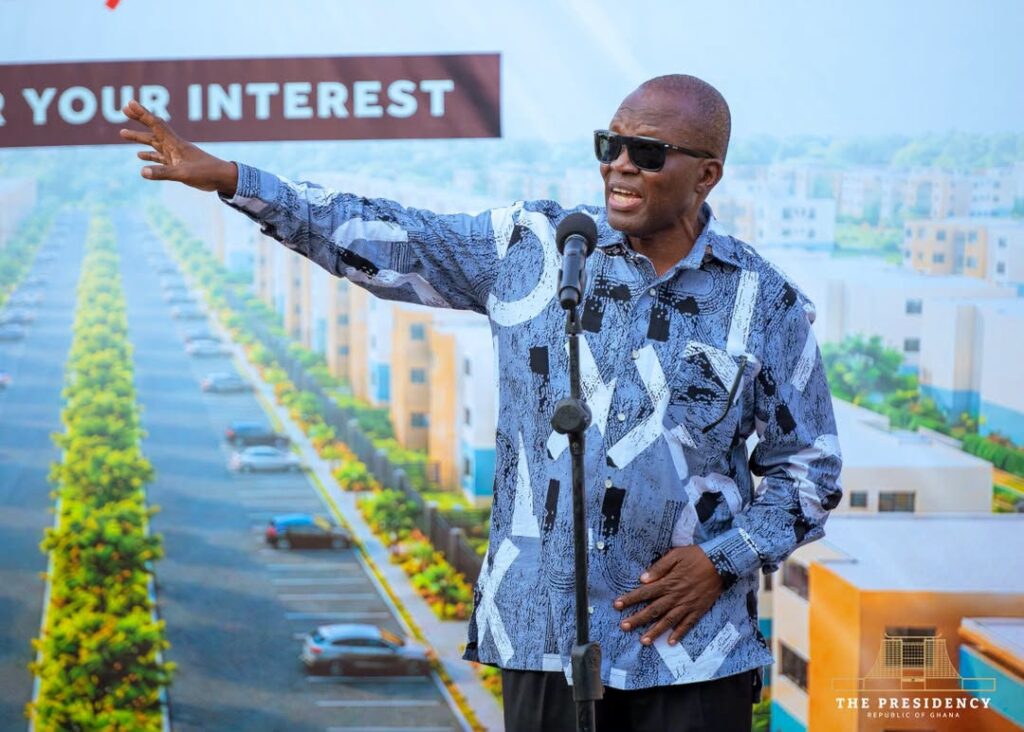
He identified water supply as the project’s most persistent historical problem and said a water treatment plant at Dawa has been built with a pipeline already laid, backed by an overhead tank under construction that will supply the entire estate outside the Dawa Industrial Zone.
He framed the project’s purpose in terms of the workers employed at nearby industrial sites, saying LMI wants those workers to live in proper housing rather than informal settlements and to commute in by rail rather than remain in slum conditions near their workplaces.
A Project With a Difficult History
President Mahama used the visit to recount the project’s troubled path. He said the vision originated under the late President John Evans Atta Mills and that he continued it during his own earlier term, but a change of government brought legal disputes and an investigation that stalled construction.
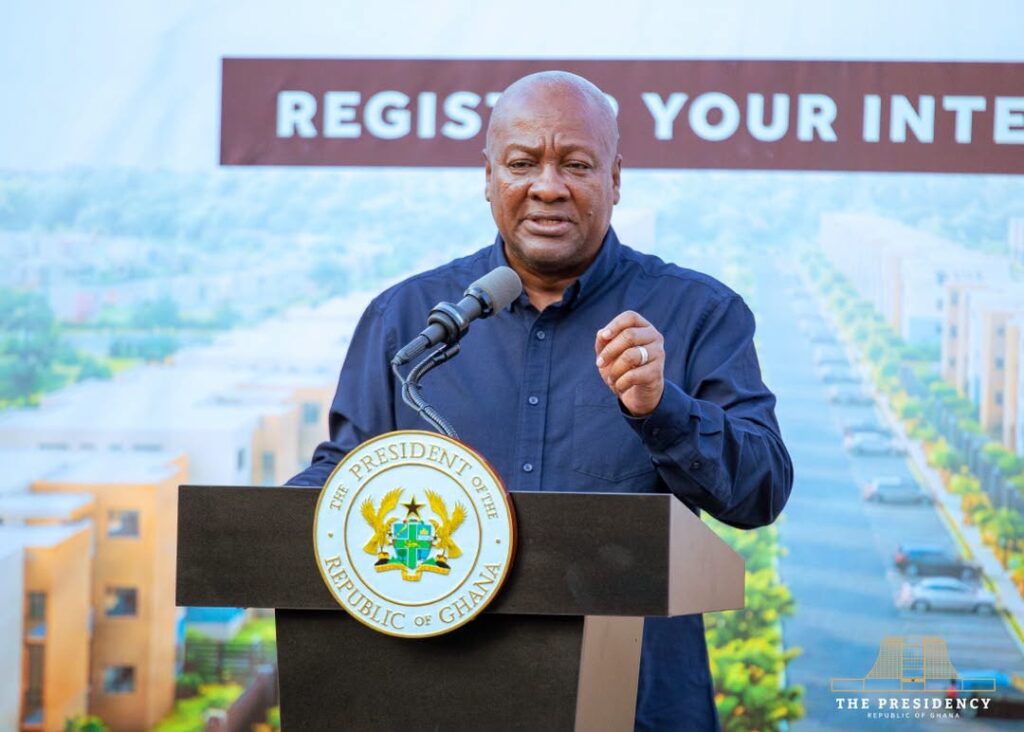
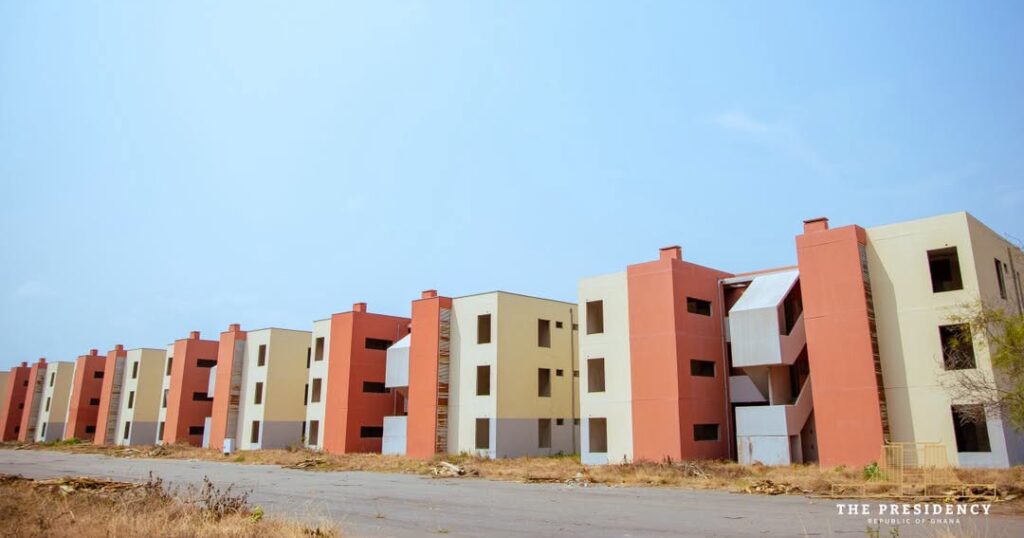
In the intervening years, he said, looters stripped the site bare. “Looters came in and stole everything: the cables, the wash basins, the baths, all the fittings, electricals, bulbs. They even took the telecom cables from underground and pulled them away,” he said, describing what was left as an empty shell.
That history matches the project’s public record. Saglemi was launched in 2012 as a flagship intervention meant to deliver 5,000 affordable housing units, financed through a $200 million facility from Credit Suisse.
By 2017, it had stalled with only around 1,500 to 1,506 units partially constructed, undermined by the absence of water, electricity and sewage infrastructure. The government selected the Quarm-LMI Consortium as preferred developer in October 2024.
This followed a competitive process involving five bidders and technical evaluation by the Ghana Institute of Surveyors, with the arrangement structured through a joint venture in which the government’s existing investment counts as equity to be recovered alongside the developer’s, once the project is completed.
Water, Roads and Rail Tying Into a Wider Corridor
President Mahama said the water supply constraint is already being addressed through excess capacity from a treatment plant serving the neighbouring Dawa Industrial Park, with surplus water to be piped both to the Saglemi estate and, in partnership with Ghana Water and Sewage Company Limited, to the Tema industrial area.
He linked the housing project to broader regional infrastructure now under way. The road from Saglemi toward Aflao is being dualised, with the first phase in progress and the second phase, from Central University onward, recently awarded.
A rail link planned for the corridor will carry both residents and industrial cargo, moving containers from nearby ports to the Dawa Industrial Park.
President Mahama tied these investments to a larger new city concept stretching from the Saglemi area through Bundasi, where a former military firing range is located, to the Volta Lake, describing Saglemi and the Dawa Industrial Park as pieces that fit naturally into that wider plan.
A Phased Handover and a Broader Housing Push
President Mahama said he expects to return around Easter to commission the first completed houses and hand them to owners, before a further visit in December 2027 to mark completion of the full 1,500-unit first phase. Once that phase is done, he said, work will begin on the remaining 3,500 units of the original 5,000-unit concept.
He said prospective buyers will be able to access mortgage financing, with the Home Ownership Fund and other financial institutions prepared to provide the customary 10 percent deposit as a loan and arrange repayment over an extended period at low interest rates.
He connected the effort to a wider housing agenda he said the Finance Minister will detail in the coming budget, alongside a district housing scheme already under way at the Works and Housing Ministry, which he said received GH¢500 million in this year’s budget to begin rolling out district housing in selected areas.
President Mahama framed the broader push as an attempt to ease pressure on Ghana’s rental market by expanding home ownership, arguing that increased supply of affordable housing would reduce the number of Ghanaians forced into the country’s informal norm of one or two years’ rent paid in advance, a practice he noted already exceeds the legal limit of six months but persists because neither tenants nor landlords report violations.
READ ALSO: Banks Could Offer 10-Year Loans Through GSE Listings- BoG