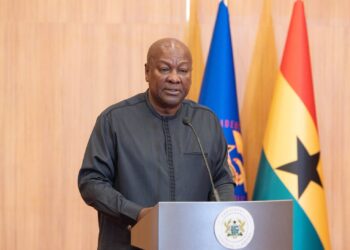
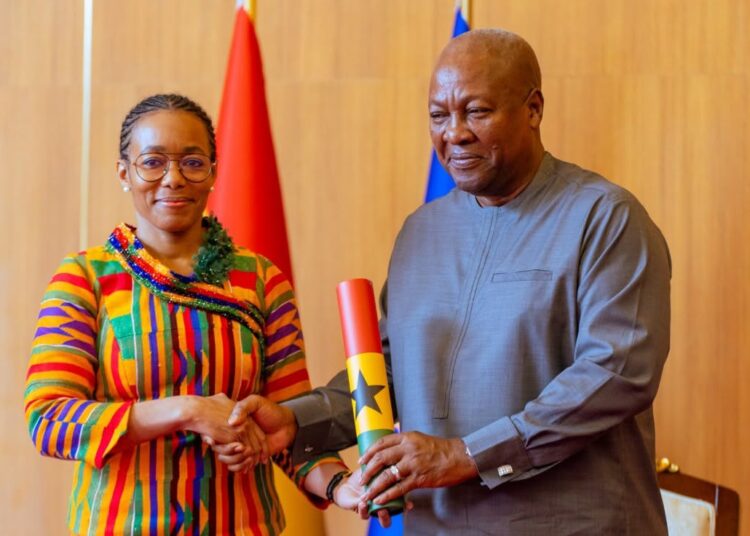
President John Dramani Mahama has charged Dr Zanetor Agyeman-Rawlings to provide determined leadership in protecting Ghana’s natural resources, describing the destruction of forests and water bodies through illegal mining as one of the gravest threats to national survival.
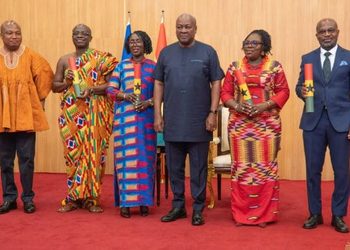
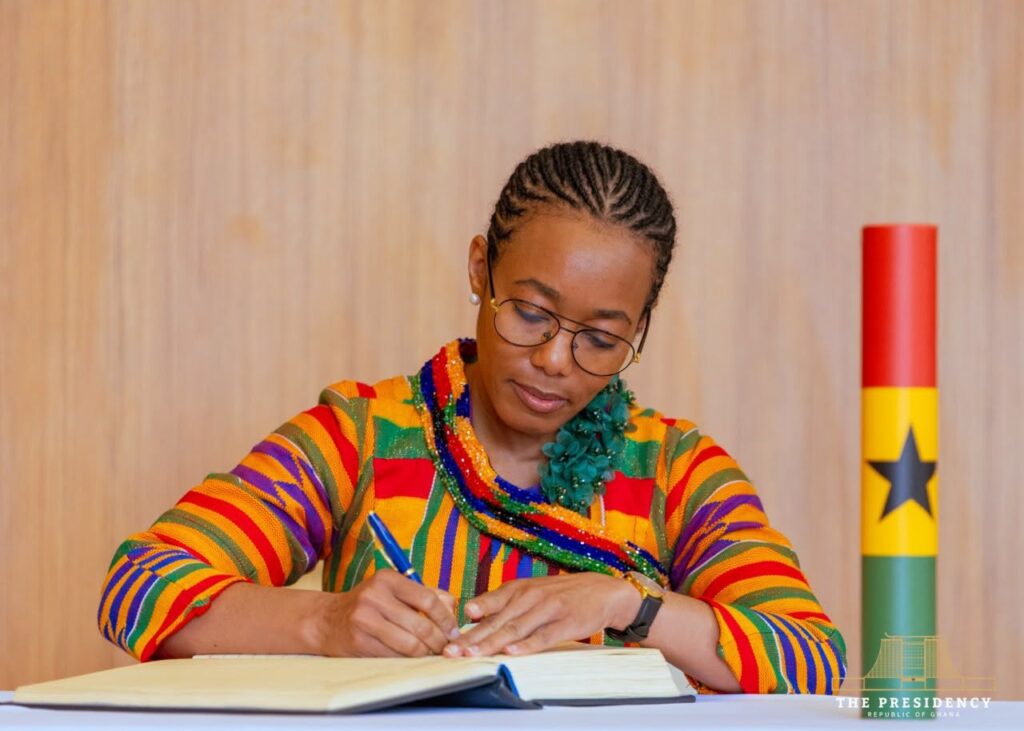
He delivered the charge at Jubilee House in Accra on Saturday, after swearing in the Klottey-Korle MP as Minister for Environment, Science and Technology. The President built the charge around her medical background, arguing that environmental damage eventually presents itself in the country’s hospitals. Her task, he said, is both environmental and human.
The Environment Is Not Separate From Human Health
President Mahama singled out the perspective a doctor brings to the portfolio. “The environment is not separate from human health,” he said, listing polluted rivers, contaminated soils, poor sanitation, unsafe air, and indiscriminate waste disposal as conditions that eventually find expression in the health of Ghanaians.

The framing recasts environmental regulation as a public health function rather than a conservation one, and it aligns with the direction Dr Agyeman-Rawlings set out at her vetting on Thursday.
She told the Appointments Committee she would strengthen monitoring at Ghana’s ports of entry to track hazardous chemicals entering the country, and that underground water, soil and farmland would be monitored to establish how far mercury has spread.
Mercury is the substance that connects her two briefs most directly. It is used in small-scale gold processing, and its movement through water bodies and farmland has been documented for years without a systematic national assessment of the extent.
Firm Action Against Illegal Mining
On galamsey, the President was categorical. The administration will continue to act firmly against those who place private profit above the collective wellbeing of Ghanaians, he said, having named the destruction of forests and water bodies as among the gravest threats the country faces.
He set out four conditions for how environmental protection should be pursued. It must rest on sound science, effective regulation, consistent enforcement and the active participation of affected communities. The last of those places residents of mining areas inside the enforcement framework rather than outside it.
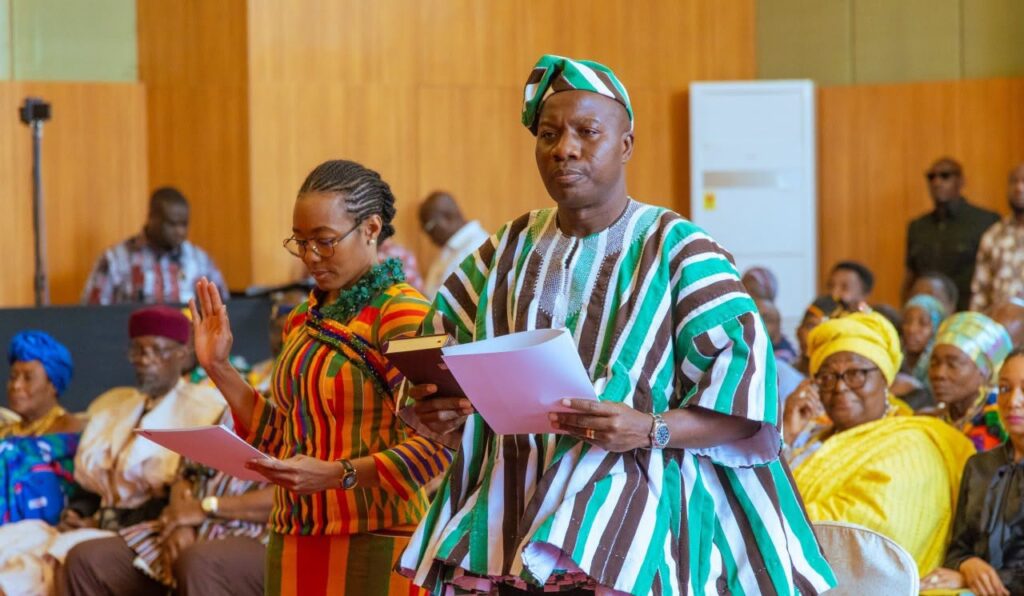
Dr Agyeman-Rawlings has taken a similar line, telling the Committee that tackling illegal mining requires an all-of-government and all-of-society approach. The charge she has now received puts the environmental half of that effort on her desk, while the licensing and district enforcement half sits with Mahama Ayariga at Local Government.
Science and Innovation at the Heart of Development
The President devoted a substantial portion of the charge to the second half of the ministry’s name, which tends to receive less attention than the first.
He instructed the ministry to place science, technology and innovation at the centre of national development, strengthening scientific research, encouraging innovation, supporting local inventors and deepening collaboration between universities, research institutions and industry.
He asked her to create openings for young Ghanaians to apply science and technology across agriculture, healthcare, energy, climate resilience, manufacturing and the digital economy.
That brief acquires added weight given the questions now surrounding artificial intelligence governance.
Asked about AI at her vetting, Dr Agyeman-Rawlings argued for appropriate legislative safeguards and human oversight to secure transparency and accountability in how public agencies deploy the technology, a position that places her on the side of statutory controls at a point when Ghana has no dedicated AI legislation.
A More Practical Response to Climate Change
President Mahama told the new minister that Ghana’s response to climate change must become more practical and urgent, pointing to flooding, coastal erosion, changing rainfall patterns and rising temperatures as effects already reaching communities, livelihoods and public infrastructure.
He asked her to lead the country towards development that creates jobs and expands opportunity without compromising the environment on which the future depends, a formulation that acknowledges the tension between the two rather than pretending it away.
Dr Agyeman-Rawlings has indicated where she intends to start. She told the Committee that Ghana would pursue opportunities in carbon dioxide trading through development of a carbon market with World Bank support, and raised the possibility of converting plastic waste into fuel as part of a wider push on sewage and solid waste management.
The Minister Who Waited
President Mahama noted the delay in her arrival at the ministry, remarking that it had taken a while but had happened at last. She was nominated on 7 August and confirmed on 27 August, but the portfolio itself had been without a substantive head for a year.
Her predecessor, Dr Ibrahim Murtala Muhammed, died in the Ghana Armed Forces helicopter crash of 6 August 2025 alongside Defence Minister Dr Edward Omane Boamah and six others.
The President described her as bringing a combination of medical training, parliamentary experience, humanitarian service and a long commitment to public health, environmental responsibility and the welfare of vulnerable communities.
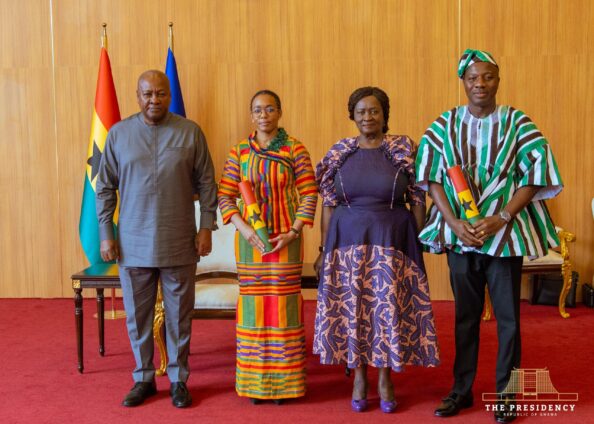
A three-term MP for Klottey-Korle and a medical doctor by training, she has served on the House committee that shadows the ministry she now heads. President Mahama also expects her to work closely with Ayariga, since sanitation, land use planning, waste management and climate resilience cut across both portfolios.
Mahama Ayariga, responding for both ministers, said the two of them would surmount what is considered insurmountable in restoring the environment, drawing on his own earlier service at the same ministry.
READ ALSO: GSE Ends Week Mixed as Market Index Holds 15,000 Points