Award-winning Ghanaian Afro-fusion duo Lali X Lola have issued a detailed critique of the 2027 Budget’s $1 billion allocation for tourism, culture and the creative arts, arguing that the plan contains a significant digital blind spot that risks allowing creative revenue to leak abroad.
In a policy review published on 20 November 2026, the twin sisters Patricia Delali Dake and Trysha Wolali Dake who identify as economists, recording artists and digital creative industry advocates- welcome the historic investment while warning that it treats the creative economy primarily as a physical destination rather than a global digital marketplace.
About the 1$ Billion
The $1 billion forms Pillar Five of the government’s four-year, $10 billion New Economy programme announced by Finance Minister Dr Cassiel Ato Forson. It aims to expand “December in Ghana” into a year-round visitor economy, complete long-stalled cultural infrastructure, restore heritage sites and create jobs and foreign exchange. The Ministry of Tourism, Culture and Creative Arts itself received a separate GH₵186 million allocation for 2027.
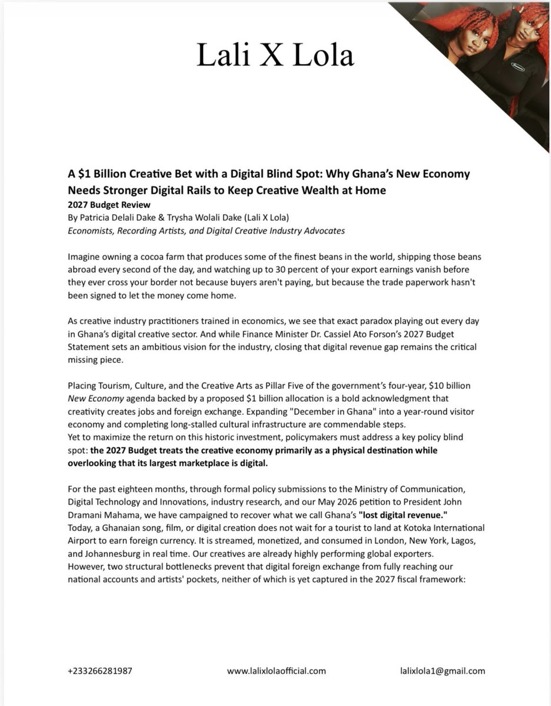
Lali X Lola contend that while physical infrastructure is important, the largest and most immediate market for Ghanaian songs, films and digital creations is online. Content is streamed and monetised in real time in London, New York, Lagos and Johannesburg without requiring tourists to land at Kotoka International Airport. Yet two structural bottlenecks, they argue, prevent much of that foreign exchange from fully reaching artists and the national accounts.
Argumemts from the Artistes
First, Ghanaian creators automatically lose up to 30 percent of their international digital earnings to foreign withholding taxes because the country lacks bilateral digital royalty treaties with major streaming jurisdictions. Creators in South Africa, Egypt and Morocco retain more of their earnings through negotiated tax waivers. The duo notes that the 2027 Budget proposes reviewing Ghana’s Double Taxation Agreements under the UN Framework Convention but does not specifically address digital royalty treatment.
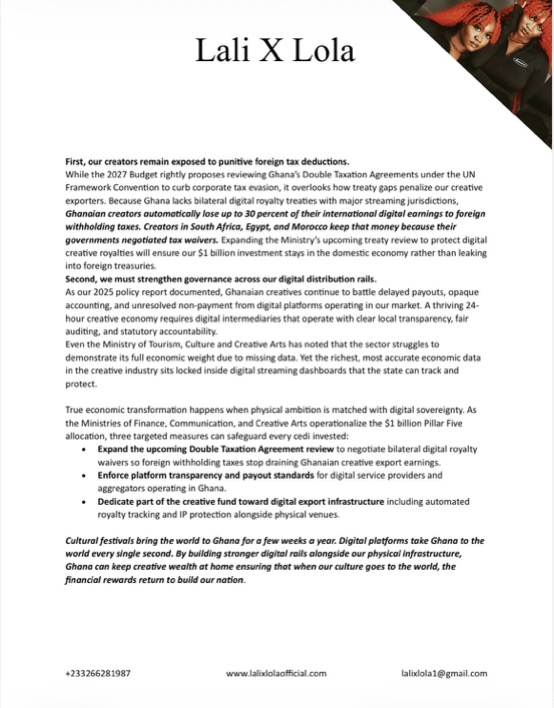
Second, they highlight weak governance across digital distribution rails. Creatives continue to face delayed payouts, opaque accounting and unresolved non-payment from platforms operating in the Ghanaian market. Even the Ministry of Tourism, Culture and Creative Arts has acknowledged difficulty demonstrating the sector’s full economic weight due to missing data- data that largely sits inside streaming dashboards.
The sisters have advocated on this issue for eighteen months, including formal submissions to the Ministry of Communication, Digital Technology and Innovations and a May 2026 petition to President John Dramani Mahama seeking recovery of what they call Ghana’s “lost digital revenue.” They previously estimated that over $100 million may have been withheld over the past decade.
Recommendation from the Artistes
To protect the $1 billion investment, Lali X Lola recommend three targeted measures: expand the upcoming Double Taxation Agreement review to negotiate bilateral digital royalty waivers; enforce platform transparency and payout standards for digital service providers operating in Ghana; and dedicate part of the creative fund toward digital export infrastructure, including automated royalty tracking and intellectual property protection alongside physical venues.
“Cultural festivals bring the world to Ghana for a few weeks a year,” they write. “Digital platforms take Ghana to the world every single second. By building stronger digital rails alongside our physical infrastructure, Ghana can keep creative wealth at home.”
Lali X Lola, who launched their music career in 2021 and have won awards including Emerging Woman of the Year at the 2024 3Music Awards and the Telecel Music for Good Award in 2026, have increasingly combined their artistic platform with policy advocacy on artist rights and the sustainable growth of Africa’s creative economy.
Their intervention adds a practitioner-economist voice to ongoing debates about how Ghana can maximise returns from its cultural assets in an increasingly digital global market.
READ ALSO:NYA Develops Digital Platform to Connect NAP Graduates With Customers