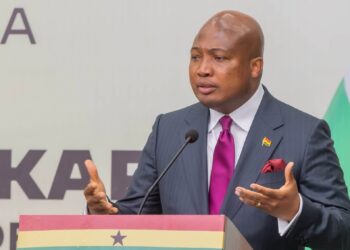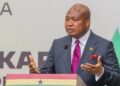
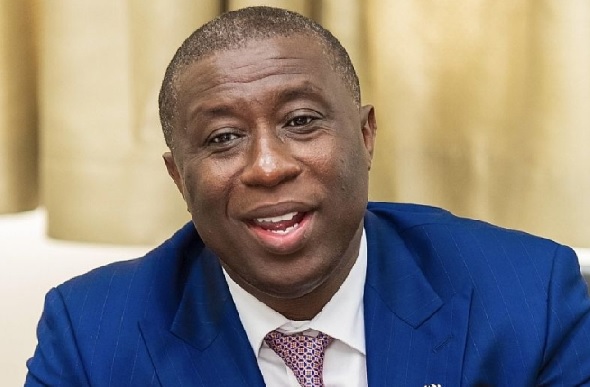
Hon. Patrick Yaw Boamah, Member of Parliament (MP) for Okaikwei Central, has mounted a forceful critique of the government’s decision to pursue construction of a new Accra-Kumasi expressway, describing the proposal as a misplaced priority that diverts attention and funds from the pressing task of completing the dualisation of the existing highway and safeguarding commuter lives.
Speaking on the floor of Parliament on Thursday, November 20, Hon. Boamah anchored his objection in road safety data and fiscal prudence, insisting that the government under President John Dramani Mahama should finish what is already underway before committing to an ambitious new road project whose funding remains unclear.
Hon. Boamah cited the National Road Safety Authority’s 2025 report to underscore the human cost tied to the current Accra-Kumasi corridor, pointing to 525 deaths in the Eastern Region, 570 in Ashanti, and 331 in Greater Accra.
For him, these figures make a compelling case for finishing the dualisation project rather than starting a parallel expressway. He challenged the government’s priorities directly in Parliament when he asked rhetorically about the source of funding for the new proposal.
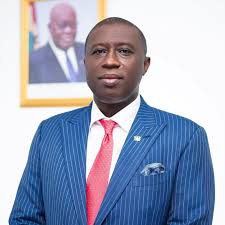
“From 2009 to 2016, not a single kilometer of road was added by the NDC government. You come into government again and instead of prioritizing the completion of the dualization of the Accra-Kumasi Road, you are telling us that you are going to construct an express road, from which funds?”
Hon. Patrick Yaw Boamah, MP for Okaikwei Central
Framing the debate not only as one of engineering and financing but as an ethical obligation, to reduce fatalities on a corridor that carries millions of commuters and livelihoods, Hon. Boamah described the expressway plan as “a complete misplaced priority,” arguing that Ghanaians expect the state to finish the dualisation before taking on further large-scale projects.
Budget Reading Timing
Hon. Boamah’s scrutiny of government decisions extended into the timing and market reception of the 2026 Budget.
He argued that the late evening reading of the 2026 Budget by Finance Minister Dr. Cassiel Ato Forson on the floor of Parliament on 13th November 2026, undermined its ability to capture creditor attention and to galvanise investor confidence.
For the Okaikwei Central legislator, presentation timing was not a trivial procedural matter but a determinant of market responsiveness.

“For the first time in many years, the budget was read at around 5:37 pm. Mr Speaker, there is a reason why budgets must be presented during prime time. When our budget was read at 5:37 pm this year, major creditors were asleep, some just waking up.
“The Chinese were asleep, Australians were waking up, our European partners were at dinner, and Ghanaians were rushing home after work. This explains why the market did not respond positively to our budget this year”
Hon. Patrick Yaw Boamah, MP for Okaikwei Central
Linking the timing to immediate currency movements, Hon. Boamah pointed to the cedi’s depreciation the day after the presentation as evidence of the budget’s muted market impact, suggesting that had the budget been presented during prime viewing hours, it might have generated a stronger, more positive investor response.
Beyond the MP challenging the government to clarify funding modules and to explain why an expressway should supersede completion of existing projects, he urged that fiscal decisions be guided by public safety and by pragmatic sequencing of infrastructure works.
In a Parliament increasingly engaged with the substance of the 2026 Budget and with infrastructure choices under President Mahama, his intervention has sharpened the discussion around policy sequencing, budget optics and the real-world consequences of selecting headline projects over unfinished commitments.

On the road safety statistics and on the budget timing, Hon. Boamah’s remarks pressed the administration to justify both the prioritisation and the mechanics of its proposals.
Whether the government responds by re-evaluating the expressway proposal or by defending its strategy, Parliament has now foregrounded commuter safety and market engagement as central measures of responsible governance.
READ ALSO: Vulnerable Households Receive Continuous Support Under GPSNP