Thailand’s election regulator has announced that the country will hold an early election on February 8, 2026.
The Election Commission added that the candidate registration would begin December 27, 2025.
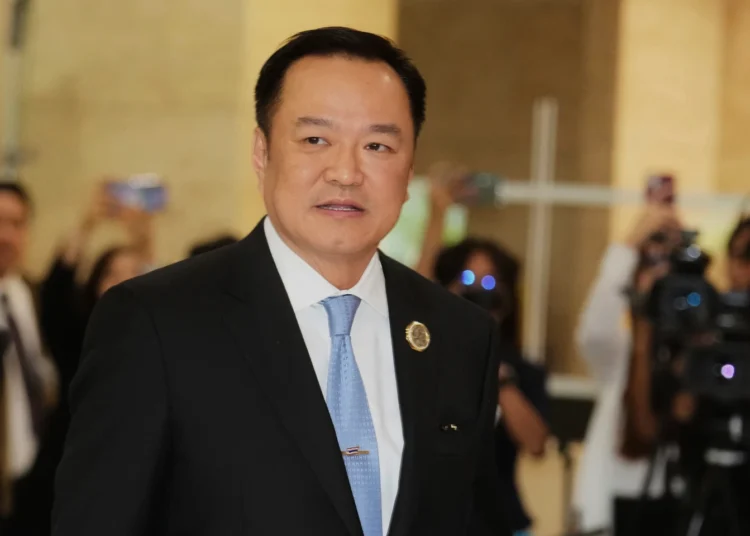
The announcement comes days after Thailand’s Prime Minister, Anutin Charnvirakul dissolved the country’s parliament.
Anutin, who has been in office for only three months and is seeking another term, disbanded the legislature after the main opposition party prepared to call for a no-confidence vote over an issue of constitutional change.
The election is likely to pit Anutin’s Bhumjaithai party, which runs on a conservative platform, against the progressive People’s Party that held the largest number of seats in the House of Representatives after the 2023 general elections. Another major contender would be the populist Pheu Thai Party, backed by billionaire former Prime Minister Thaksin Shinawatra.
Anutin won the September vote with support from the main opposition People’s Party in exchange for a promise to dissolve parliament within four months and organize a referendum on the drafting of a new constitution by an elected constituent assembly.
Anutin succeeded Pheu Thai’s Paetongtarn Shinawatra, who served only a year in office before losing office over a scandal that erupted out of a previous round of border tensions.
Paetongtarn was suspended from office before the July fighting with Cambodia started. She was found guilty of ethics violations over a politically compromising call with a Cambodian official.
Even before her suspension, her government was struggling, largely due to its failure to revive an economy that had stagnated since the COVID-19 pandemic.
The dissolution also comes as Thailand is engaged in large-scale combat with Cambodia over a long-standing border dispute. Experts claim that Anutin has adopted an aggressive military stance to appeal to nationalistic public sentiment.
Petra Alderman, Researcher and Manager of the Saw Swee Hock Southeast Asia Centre at the London School of Economics and Political Science opined that Anutin played the nationalist card from the start of his premiership and also actively courted the military.
“He gave them a free hand to deal with the conflict pretty much any way they see fit, so in many ways he was building a stock of political goodwill.”
Petra Alderman
His party saw a slip in popularity prior to the conflict due to the southern flood crisis that killed more than 160 people, and his government’s mishandling of major scam scandals, which tainted some officials and figures in the Thai business community.
The People’s Party, meanwhile, faced significant backlash from its supporters for backing Anutin’s premiership, given his conservative agenda, which many viewed as running counter to the party’s core principles.
Analysts also see its progressive platform might backfire as the country is running high on nationalist sentiment.
Additionally, Alderman said that given the military’s increasing popularity, “the People’s Party might find it hard to find support for some of its progressive agenda.”
“Things like a military reform could be much harder to sell to the voters right now, so the party might lose some of its progressive edge if it wants to cast a wide electoral net.”
Petra Alderman
Parties Likely To Get Comparable Vote Shares In Thailand’s Early Election
Purawich Watanasukh, a Political Scientist at Bangkok’s Thammasat University, said that these three major parties are likely to receive comparable vote shares and seat totals given the current circumstances.
He noted that under the current constitution, it is challenging for any single party to secure a majority and form a one-party government.
He noted that a multi-party coalition government, “similar to the pattern of recent years, remains the most likely outcome.”
READ ALSO: Albanese Vows Action On Gun Control In Bondi Beach Shooting Aftermath