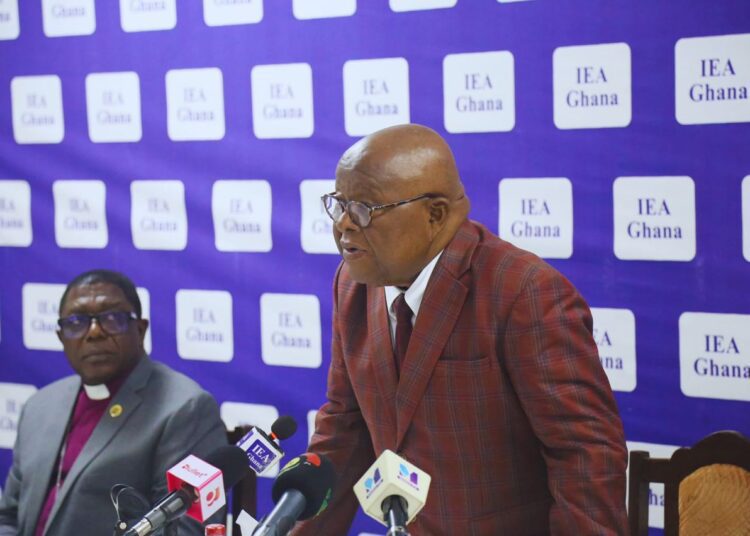
Professor Aaron Mike Oqauye, an IEA Fellow and former Speaker of Parliament, has alleged that poor utilization of endowed mineral resources is responsible for frequent visits to the International Monetary Fund (IMF) for bailout.
The recurring economic instability in Ghana, which has led the nation to seek 17 separate bailouts from the IMF, is a direct consequence of a flawed minerals management regime that prioritizes foreign interests over national resource sovereignty.
Prof. Mike Oquaye argued that the current “colonial heritage” of mineral agreements characterized by restrictive royalty caps and inadequate state participation deprives the country of the essential liquid capital needed to fund development, thereby creating a perpetual “bailout situation.”
“If the medicine will heal your ailments, it’s only one spoon. IMF is not a drug, and after 17 times, we should see that it cannot be our therapy. We have not been fair to our nation at all in terms of these gold and diamond matters.”
Prof. Mike Oquaye
This structural deficit is further compounded by the mismanagement of other key sectors, such as cocoa, where Ghana is projected to lose its global standing to competitors like Ecuador due to illegal mining (Galamsey) and lack of inputs.
The current fiscal framework for minerals, particularly the controversial lithium and gold agreements, highlights a “paradigm” that Prof. Oquaye describes as fundamentally unfair to the nation.
While recent debates have centered on whether the royalty percentage should be 5% or 10%, the former Speaker emphasizes that the real issue lies in the legislative “capping” of these rates, which prevents Ghana from negotiating for a fairer share of high-value commodities.
He notes that while the government recently celebrated a $256 million debt restructuring agreement with the United Kingdom under the G20 Common Framework, such measures are merely temporary reliefs for a “cash-strapped” economy that fails to match its financial income with its output expenditure.
Paradox of Mineral Wealth and Debt Restructuring

In his analysis, Prof. Oquaye points out the irony of a resource-rich nation like Ghana consistently requiring external bailouts to survive. He cites the recent bilateral agreement signed by the finance minister, Hon. Cassiel Ato Forson and U.K. Trade Commissioner John Humphrey as a necessary survival mechanism, yet one that underscores the failure of internal resource utilization.
The “new paradigm” proposed by Prof. Oquaye suggests that the country must move beyond debating marginal percentage increases and instead focus on total ownership or significantly higher “at least 20%” benchmarks.
He argued that by fixing lower limits rather than upper limits for royalties, the state has effectively institutionalized its own poverty.
Threat to Ghana’s Agricultural Backbone
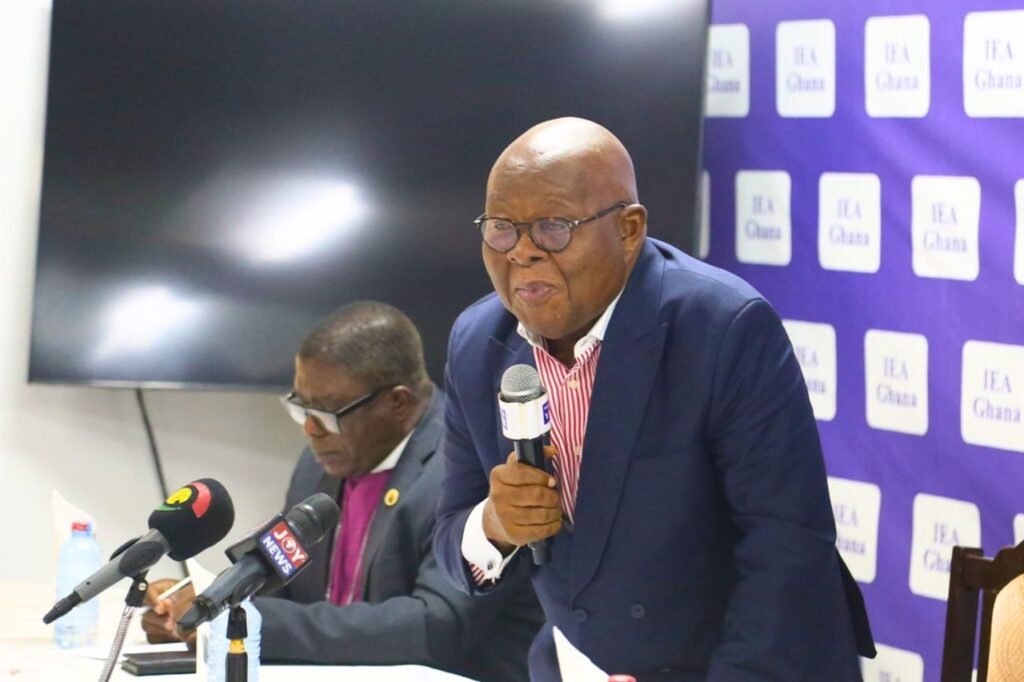
Beyond minerals, the mismanagement of the extractive sector is physically encroaching upon Ghana’s agricultural heritage.
Recent data suggests that Ghana, once the world’s leading cocoa producer, is on the verge of being overtaken by Ecuador by the 2026-2027 season.
With Ecuador’s production projected to reach 650,000 tonnes against Ghana’s 600,000 tonnes, the decline is attributed to the devastation caused by Galamsey and pest, which are destroying cocoa trees at an alarming rate.
Prof. Oquaye maintains that this systemic failure across both the mining and agricultural sectors is what drives the nation back to the IMF, as the state lacks the resources to perform its basic duties without external assistance.
New Paradigm for Resource Sovereignty
To break the cycle of 17 IMF interventions, a total overhaul of the mining and extractive laws is required to ensure that high-value commodities like lithium contribute directly to the national reserves.
Prof. Oquaye suggests that the current lithium agreement is a continuation of the same problematic framework that has historically disadvantaged Ghana.
He posits that if the country were to secure a fairer share of its mineral value moving away from the “anything from 5% downwards” mentality the resulting financial independence would render the IMF “drug” unnecessary.
The “signs” of the failure are clear: without capturing the true value of its gold, diamonds, and lithium, Ghana will remain in a state of perpetual debt distress.
READ MORE: Fitch Divulges Principal Vulnerabilities to Ghana’s Economy in 2026