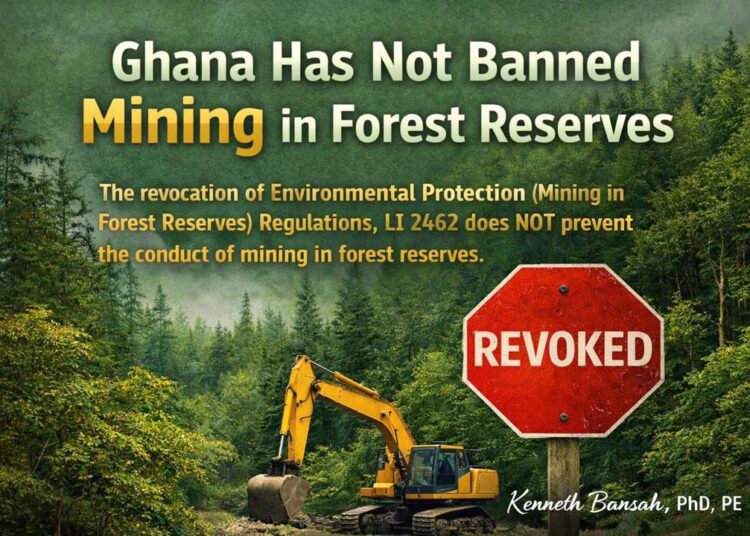
Ghanaian-US-based resource governance expert Dr. Kenneth Bansah has clarified that the recent revocation of the Environmental Protection (Mining in Forest Reserves) Regulations, 2022 (L.I. 2462), does not constitute a ban on mining within Ghana’s forest reserves.
The mining expert noted that while the public and various media outlets have celebrated the move as a definitive end to extraction in protected areas, the legal reality remains far more complex and permits for mining are still accessible under existing primary legislation.
“If anyone tells you that mining in forest reserves has been banned, at least for now, that claim is inaccurate. What the revocation of LI 2462 has effectively done is remove the additional environmental requirements that would have applied if mining were to take place in forest reserves. If the state intends to ban mining in forest reserves, that can only be achieved through an amendment to the Minerals and Mining Act, 2006 (Act 703).”
Dr. Kenneth Bansah
Dr. Bansah explained that the confusion stems from a fundamental misunderstanding of the hierarchy of Ghanaian mining laws, specifically the relationship between the Minerals and Mining Act, 2006 (Act 703), and subsidiary environmental instruments.
He pointed out that while L.I. 2462 provided a framework for environmental requirements in forest environments, its removal does not strip away the underlying authority of the Minister responsible for Mines to grant mineral rights.
“The revocation of L.I. 2462 does not prevent mining from taking place in forest reserves,” Dr. Bansah emphasized, noting that as long as Act 703 remains unamended, the legal pathway for forest entry permits remains open to operators who meet the primary statutory requirements.
Legal Loophole: Act 703 vs. L.I. 2462

The core of the expert’s argument rests on Section 18 of the Minerals and Mining Act, 2006 (Act 703), which governs forestry and environmental protection.
According to Dr. Bansah, L.I. 2462 was never the source of mining rights; rather, it was a regulation issued by the Ministry of Environment to guide the “how” of mining in sensitive areas.
By revoking this instrument, the government has arguably removed a layer of environmental scrutiny rather than the activity itself.
In the absence of a specific amendment to Act 703 that explicitly prohibits mineral operations in reserves, the Ministry of lands retains its sovereign authority to issue licenses.
This distinction is critical for industry stakeholders. Without the “additional guidance” provided by the now-revoked L.I. 2462, mining activities may revert to less stringent or more generalized environmental standards.
Dr. Bansah warned that “the authority to grant mining permits lies with the Ministry of lands through the Minerals Commission,” and as such, any operator holding a valid Forest Entry Permit can still legally access these protected zones.
The current narrative, he suggests, provides a false sense of security while leaving the back door to the reserves wide open.
Forest Vulnerability and the Galamsey Threat

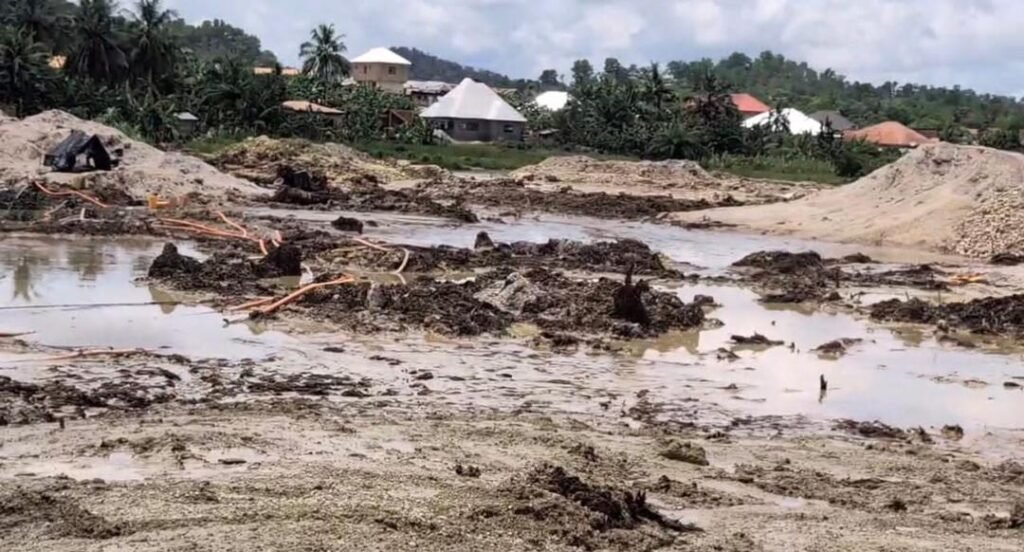
Critics argued that L.I. 2462 actually exposed up to 89% of Ghana’s forest reserves to potential mining activities. However, the revocation of the law has not magically shielded these lands from the “galamsey” (illegal small-scale mining) menace.
In fact, many environmentalists contend that the reserves remain as vulnerable as ever. The high economic stakes and deep-rooted social issues surrounding gold continue to drive illegal operators into the heart of protected forests, often regardless of which legislative instrument is in or out of force.
Furthermore, the vulnerability of the reserves is exacerbated by the lack of a “National Forest Protection Strategy” and the continued existence of over 2,000 mining licenses already granted within these areas.
The revocation of a subsidiary regulation does not automatically nullify existing leases or stop the violent resistance often mounted by galamsey operators.
The Path to a Real Ban
For a total ban to be realized, the government must move beyond the revocation of subsidiary instruments and confront the structural weaknesses of the Minerals and Mining Act.
Dr. Bansah insists that only an amendment to Act 703, or a sovereign decision to deny all access permits, would truly safeguard the reserves.
He cautioned the public and media to remain vigilant and accurate in their reporting, as the current legal framework still prioritizes mineral ownership by the Republic over absolute forest preservation.
READ ALSO: Gov’t Pledges Sustained Financial Prudence in 2026 – Ato Forson