According to Professor Godfred Bokpin, an economist and lecturer at the University of Ghana Business School (UGBS), the government’s strategy for 2025 was a reform-led growth to ease pressure on the economy and stimulate growth.
Assessing the first year of the government, Prof. Bokpin noted that the government’s chosen path towards growth was to stabilize macroeconomic indicators, such as inflation and the exchange rate, before focusing on actual economic expansion and job creation.
“They [the government] chose the first path, which was to calm the economy. Let’s bring inflation down. Then we can engineer job-rich growth.”
Professor Godfred Bokpin
Prioritizing Structural Economic Changes
In clarifying his earlier statement, Prof. Bokpin mentioned that the economic situation at the beginning of 2025 necessitated the government’s reform-led growth path. Though it was a choice, it was the only choice to reset the economy. He, however, stressed that the trade-off is not achieving optimal growth of the economy.
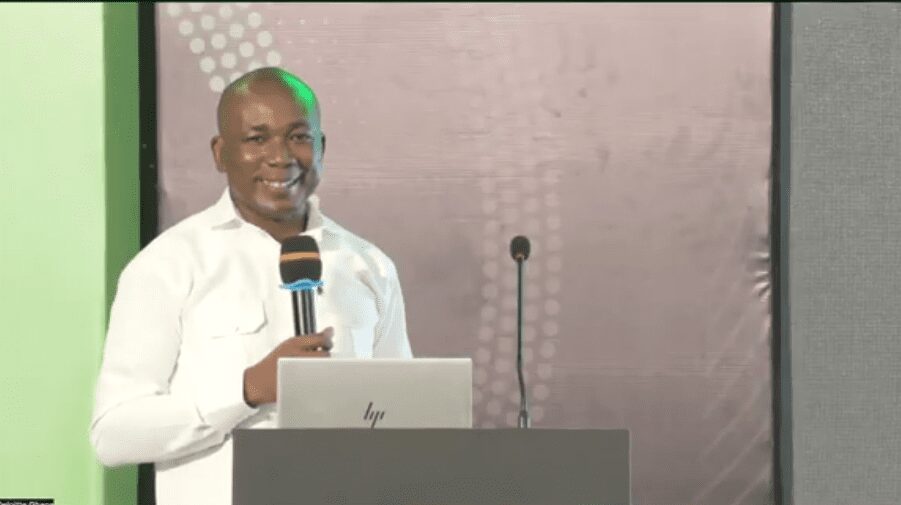
“Where we were, it was difficult to pursue both reform-led growth and job-rich growth. There are trade-offs. The policy that seeks to bring inflation down aggressively, as has been done, will result in a trade-off – cannot have optimal growth at the same time.”
Professor Godfred Bokpin
The government implemented comprehensive structural reforms as the foundational strategy to achieve sustainable, private sector-led growth that inherently generates quality jobs. The core strategy was that macroeconomic stability, a result of these reforms, was a prerequisite for any meaningful, long-term job creation.
The economic decision by the government to reset the economy was a direct response to the severe challenges Ghana faced at the end of 2024, including high inflation (above 23%), high interest rates (over 30%), a depreciating currency, and unsustainable debt levels.
The government’s approach, supported by an IMF Extended Credit Facility (ECF) program, focused mainly on restoring macroeconomic stability. Primary efforts were directed at fiscal consolidation, debt restructuring, and maintaining a tight monetary policy to control inflation and stabilize the Cedi. By the end of 2025, inflation had dropped significantly, and the Cedi appreciated, restoring purchasing power and investor confidence.

Significantly, the one-year reforms were initiated to address deep-seated issues, such as strengthening governance in state-owned enterprises, improving public finance management, and enhancing the efficiency of social protection programs.
The reforms aimed to create a stable and predictable environment conducive to businesses and private investment, which is considered the main engine for job creation. Measures included abolishing certain taxes (e.g., the E-Levy) to ease the cost of doing business and improving the efficiency of public services.
Complementary Approaches to Sustainable, Inclusive Growth
According to analysts, though reform-led growth titles the 2025 Ghanaian economy, underneath was the laying of the job-led growth initiatives. The government used sound, disciplined reforms to create the necessary conditions for a robust, private sector-led economy that could generate sustainable employment opportunities for its growing population.
Within the 2025 budget, the government introduced specific job-creating programs such as the “Big Push“ for infrastructure development, the National Apprenticeship Program, the “Adwumawura“ business start-up policy for youth, and the various programs under the Agriculture for Economic Transformation Agenda (AETA), all within the broader reform framework.
Analysts, therefore, warn that the strict labeling of the government’s first year reform-led over job-led growth will be a false dichotomy, as most economic policy thinkers view the two as interdependent and complementary approaches to achieving sustainable, inclusive economic growth and development. Reforms are generally seen as necessary to create the conditions for the private sector – improving efficiency, productivity, and the overall business environment – to generate quality jobs.

The IMF underscores Ghana’s need for structural reforms to support a private-led growth and job creation for Ghana’s growing population. The Fund stresses the importance of developing a comprehensive strategy on macroeconomic stability, private sector growth in productive sectors, job creation, structural transformation, and skill development.
Achieving Optimal Growth of the Economy
The government’s objective, as revealed by President Mahama, is to achieve a growth trajectory where resources are allocated with maximum efficiency within a sound institutional framework, representing a benchmark rather than a specific strategy.
The strategies being implemented are to propel the economy to achieve its benchmark of an efficient market economy, supporting the sound institutional and regulatory framework that is already in place.
In the optimal state of the economy, according to analysts, the government focuses on maintaining an environment where the private sector thrives through stable institutions, the rule of law, and public goods provision.
This is the state where the Ghanaian economy functions at peak efficiency with no policy-induced distortions. The results of successfully implemented reform-led growth, which the government is still pursuing in 2026, will move the Ghanaian economy closer to its optimal growth path.
The government has revealed that 2026 will build on the foundational reform-led growth for economic expansion.
READ ALSO: Ghana Localizes Gold Value Accumulation Through GoldBod to Boost the Economy