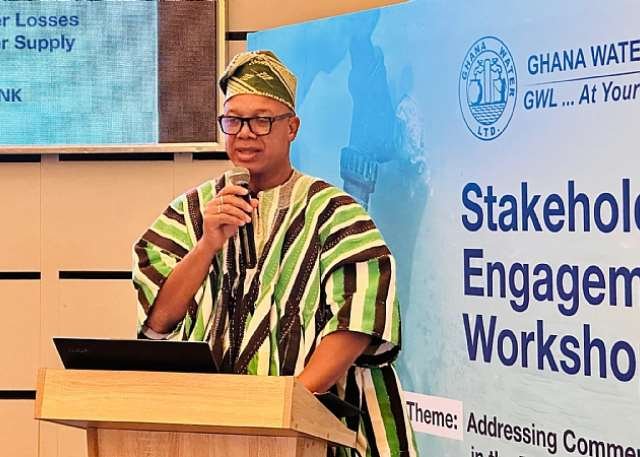
In a decisive move to salvage the financial health of Ghana Water Limited (GWL), Managing Director Adam Mutawakilu has announced the reassignment of 41 district managers across the country – a directive, which takes effect on January 15, 2026 following a rigorous internal performance audit.
Addressing the media about chronic operational lapses, and a disturbing pattern of internal complicity in water theft that was uncovered, Mr. Mutawakilu revealed that the utility company is no longer willing to tolerate “weak supervision,” that has allowed illegal connections to bleed the state of millions of cedis in revenue.
“Any illegal connection has something to do with the staff of Ghana Water Limited. Since this operation started, we have dismissed several staff.
“I gave district managers six months to achieve certain targets; I told them that if they did not achieve them, they would be reassigned. Out of 103 district managers, 41 of them will be reassigned on January 15, 2026. The things happening in their areas are clearly their fault”
Adam Mutawakilu, GWL Managing Director
According to Mr. Mutawakilu By the close of November 2025, these managers had particularly failed in detecting and disconnecting illegal water users within their jurisdictions. He was blunt in his assessment, stating that the days of shielding underperforming staff are over.

Industrial-Scale Theft
The Managing Director noted that the internal shake-up coincides with the success of a high-stakes collaboration with National Security – a specialized Revenue Enhancement Taskforce, established in August 2025, that uncovered illegal water connections valued at approximately GHS 5.5 million in just four months.
The findings are staggering: investigators discovered entire sachet water treatment plants that were siphoning treated water directly from the main pipelines, as well as large-scale commercial entities that had been fraudulently classified – and billed – as domestic consumers.
“We have recovered a little over GHS 1.3 million. The legal department is pursuing the cases in court. With the work of the three taskforce teams, non-revenue water dropped from 52 percent in January to 49.4 percent by November.
“That is encouraging, so we have engaged National Security to expand the task force from three specialized teams 12”
Adam Mutawakilu, GWL Managing Director
This expansion aims to create a permanent, nationwide “detection net,” that will utilize forensic auditing and community intelligence to disrupt the sophisticated bypasses used by industrial-scale thieves of the GWL.
Recovering GHS 916 Million Debt
While the task force targets criminal theft, GWL is simultaneously launching a massive “community offensive,” to recover GHS 916 million in outstanding arrears.
In a strategic departure from traditional office-based debt collection, the company is deploying 200 National Service Personnel (NSP) directly into neighborhoods across the sixteen regions. These personnel have been tasked with identifying long-term debtors and facilitating immediate payment through digital platforms.
“Their primary responsibility is to go after these arrears while also helping customers understand how to use the MoMo app to pay. Without these targeted interventions, it would be difficult for the company to reverse its revenue challenges”
Adam Mutawakilu, GWL Managing Director
The move is also a push toward modernization. Currently, only 20% to 30% of domestic water users utilize digital payment channels, a figure Mr. Mutawakilu aims to double by the end of the 2026 fiscal year.
The National Service Personnel will serve as both debt collectors and digital ambassadors, educating customers on the use of the company’s Mobile Money (MoMo) integration to ensure that future payments are seamless and less susceptible to the “human interface,” that often facilitates corruption.
The reassignment of the 41 managers and the prosecution of sachet plant owners send a clear signal that GWL is undergoing a total cultural reset. Under Mr. Mutawakilu’s leadership, the utility giant is attempting to shift from a reactive state-owned agency to a proactive, revenue-driven utility provider.
As the January 15 deadline approaches, all eyes will be on the incoming managers to see if they can maintain the momentum and further drive down the non-revenue water figures. For the average consumer, the message is simple: the era of the “free bypass,” is coming to a very expensive end.
READ ALSO: Ghana to Improve Its Position in the Global Investment Risk and Resilience Index in 2026