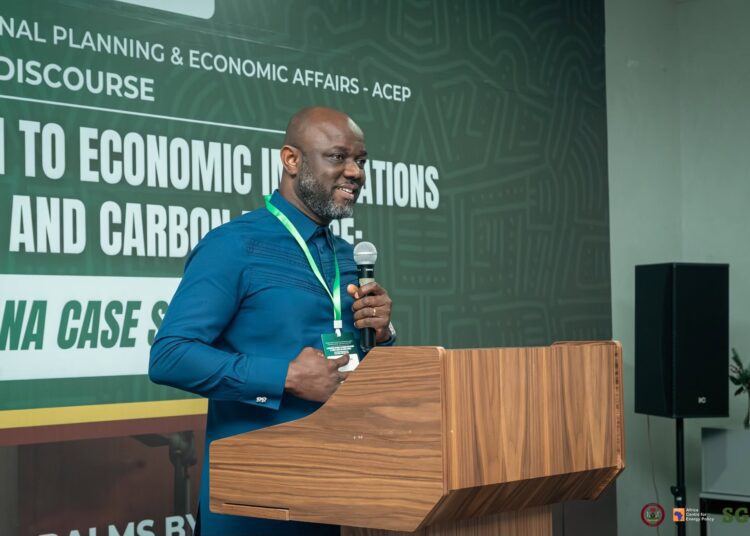
The Africa Centre for Energy Policy (ACEP) has advocated for robust statutory oversight and institutional transparency across the continent to ensure that sub-Saharan sovereign wealth generated from natural deposits translates into tangible socio-economic growth.
During the opening proceedings of the AFREIKH Summer School, energy analysts underscored that strategic governance frameworks are essential to bridging the gap between resource exploitation and long-term domestic development.
The core intent behind this call is to transform traditional extractive operations into catalysts for sustainable economic expansion, ensuring that the host jurisdictions retain maximum value across the entire mineral and hydrocarbon supply chain.
“Beyond understanding how the sectors work, the sessions challenged participants to think critically about how African countries can better manage their resources, capture greater value and navigate the risks that come with extraction.”
Africa Centre for Energy Policy (ACEP)

Policy facilitators emphasized that structural reform must encompass every operational phase of resource management to prevent value leakage and institutional capture.
Effective oversight requires continuous regulatory monitoring, extending from initial seismic mapping and licensing to site decommissioning.
Without stringent legal mechanisms, resource-rich states risk remaining locked in raw commodity export cycles that drain local economies while delivering minimal public returns.
Furthermore, aligning local content policies with international industry standards ensures that host communities secure lasting infrastructure, employment opportunities, and sustained equity.
Decoupling Lifecycle Operations and Mitigating Operational Vulnerabilities
Managing extractive lifecycles requires addressing systemic vulnerabilities inherent to both oil and solid mineral sectors.
Mr. Kodzo Yaotse and Christopher Opoku Nyarko pointed out that exploration, commercial development, active production, and mine closure present distinct socio-technical demands.
Early-stage site exploration often suffers from speculative land acquisition and insufficient environmental baseline assessments, whereas active production phases typically struggle with inadequate community engagement and operational pollution.
When governments fail to enforce clear environmental and social impact benchmarks at each milestone, extraction damages ecological balance and leaves host populations burdened with legacy contamination long after project abandonment.
Addressing these technical complexities requires moving away from fragmented, ad-hoc regulatory practices toward unified state oversight strategies.
Extractive ventures require continuous oversight mechanisms capable of evaluating capital expenditure disclosures, monitoring environmental compliance in real time, and tracking rehabilitation reserve funds.
Integrating comprehensive statutory audits into every stage of development prevents multinational operators from under-reporting output yields or evading decommissioning obligations.
Building such technical capacity inside state ministries protects sovereign interests and ensures host environments are properly restored once reserve basins are depleted.
Re-engineering Fiscal Frameworks and Optimizing Sovereign Revenues
Fiscal design serves as the central foundation determining whether mineral and petroleum discoveries generate long-term national wealth or result in capital flight.
During the summer school proceedings, facilitators examined how poorly structured tax codes, regressive royalty rates, and excessive tax holidays starve public treasuries of vital revenues.
Sub-Saharan resource nations frequently engage in aggressive tax competition, lowering entry barriers to attract foreign direct investment at the expense of national revenue capture.
Developing resilient tax architectures requires balancing competitive investor yields with progressive tax instruments, such as windfall profit levies, index-linked royalties, and ring-fencing provisions.
Optimizing state revenue collection also depends heavily on mitigating complex corporate tax avoidance schemes, such as trade misinvoicing and transfer pricing manipulation within foreign subsidiaries.
When extractive firms artificially inflate operational expenses or transfer assets to offshore low-tax jurisdictions, domestic governments lose billions in potential tax income.
Resolving these fiscal leaks requires national tax authorities to establish advanced audit capabilities, adopt country-by-country reporting standards, and participate in global financial intelligence exchanges.
Safeguard measures ensure earned resource rents are retained domestically to finance public infrastructure, educational institutions, and healthcare systems.
Translating Extractive Wealth into Sustainable Regional Development
Ensuring that non-renewable natural resources fuel long-term development requires shifting national economic planning from primary extraction toward broad-based industrial diversification.
Historical precedent shows that relying solely on raw export receipts leaves developing economies vulnerable to global commodity price shocks and foreign exchange volatility.
Strategic governance requires channeling resource revenues into sovereign wealth funds, regional infrastructure networks, and local manufacturing capabilities.
Establishing regional mineral processing hubs and local refining capacity retains high-value processing steps within host nations, creating industrial employment and stimulating secondary economic sectors.

Ultimately, establishing transparent resource management depends on strong public accountability, active civil society involvement, and open access to state contract terms.
Suppressing information surrounding petroleum agreements, mining licenses, and beneficial ownership structures breeds corruption and weakens public trust in state institutions.
Adopting international transparency protocols, such as mandatory contract disclosure and public registries of ultimate beneficial owners, helps prevent political patronage and elite enrichment.
When citizens possess the legal tools to audit resource revenues and track expenditure flows, governments are held accountable to deploy natural wealth toward building resilient, diversified, and sustainable economies.
READ ALSO: We’ll Consider Review After Reading The Full Ruling— Ofoase Ayirebi MP