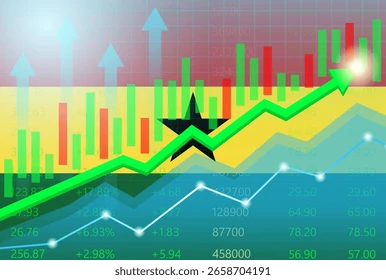
Ghana’s economy is poised for a stronger-than-expected rebound, with growth projected to reach about 6 percent by the end of 2026, exceeding the International Monetary Fund’s earlier average forecast of 4.8 percent.
This optimistic outlook positions Ghana as one of Africa’s economic outliers, at a time when many economies across the continent continue to grapple with global uncertainty and uneven recovery.
The projection was shared by Senior Partner at AB & David, David Ofosu-Dorte, who offered a forward-looking assessment of Africa’s growth prospects and Ghana’s place within them. According to him, while Africa’s overall economic performance remains mixed, a small group of countries are expected to grow faster than the continental average, with Ghana firmly among that group.
Africa’s Growth Picture Remains Uneven
Providing broader context, Mr. Ofosu-Dorte noted that Africa’s average growth outlook remains modest compared to its potential. “When it comes to average growth in Africa, the projection for 2026 is about 4%,” he explained. “But there are outliers.”
These outliers, he said, are countries that have managed to implement structural reforms, diversify their economies, and attract shifting investment flows despite global headwinds. Ghana, Nigeria, Ethiopia, and Kenya were identified as economies likely to outperform the African average over the medium term.
This divergence, he stressed, highlights the reality that Africa’s growth story is not uniform. While some countries are accelerating, others are lagging behind due to policy constraints, limited diversification, or external shocks.



Ghana and Peers Poised to Lead
Breaking down the numbers, Mr. Ofosu-Dorte outlined growth projections for some of Africa’s largest and most dynamic economies. “Nigeria is projected to grow at about 4.2%. Ghana, 5.8% — and I believe Ghana will hit about 6%. Ethiopia is projected at 7.6%, and Kenya at 5.4%,” he noted.
Ghana’s anticipated performance stands out not only because it beats the IMF’s forecast, but also because it signals renewed confidence in the country’s economic direction following recent macroeconomic challenges. Analysts see the potential 6 percent growth as evidence that policy adjustments, fiscal discipline, and sector-specific reforms may be beginning to yield results.
While highlighting Ghana’s positive outlook, Mr. Ofosu-Dorte cautioned against generalizing Africa’s growth trajectory. He pointed to Uganda as a clear exception, recording growth rates that exceed even the continent’s top performers.
“Uganda is actually growing at about eight per cent plus and is projected to hit ten per cent,” he said. He attributed this momentum largely to recent oil discoveries and the Uganda National Oil Company project, while also acknowledging data gaps in certain areas.
Uganda’s case, he suggested, underscores how targeted resource development and strategic projects can significantly alter a country’s growth path within a relatively short period.
Sector-Focused Growth as the Real Opportunity
Beyond headline growth figures, Mr. Ofosu-Dorte emphasized that the real opportunity for Ghana and other fast-growing economies lies in sector-focused strategies rather than broad, one-size-fits-all growth models.
“Africa, in terms of growth, for those who believe in business strategy, should look at various sectors,” he stressed.
He identified agribusiness, education, oil and gas, and the digital economy as critical pillars that could sustain long-term expansion. For Ghana, these sectors align closely with existing strengths and emerging opportunities, particularly in value addition, skills development, and technology-driven services.
Demographics Reshaping Investment Priorities
A key driver of future growth, according to Mr. Ofosu-Dorte, is Africa’s changing demographic profile. The rise of Gen Z and Gen Alpha is reshaping consumption patterns and influencing where capital flows across the continent. “Projects come in when you take into account the rise of Gen Z and Gen Alpha,” he added.
He explained that younger populations are fueling demand in areas such as entertainment, apparel, and digital services, making these sectors increasingly attractive to investors. “That’s why things like entertainment, apparel, and the digital economy are becoming increasingly important.”
For Ghana, with its youthful population and expanding digital adoption, these trends present an opportunity to leapfrog traditional development paths and build competitive advantages in consumer-driven and technology-enabled industries.
As intra-African capital flows intensify and competition for investment grows, Mr. Ofosu-Dorte believes that countries which successfully align policy, investment, and innovation around key growth sectors will be best positioned to sustain above-average expansion beyond 2026.
For Ghana, hitting the projected 6 percent growth mark would signal renewed investor confidence, and the potential for the economy to reassert itself as a regional leader. However, sustaining that momentum will depend on consistent policy execution, strategic sector development, and the ability to harness demographic and technological shifts shaping Africa’s economic future.