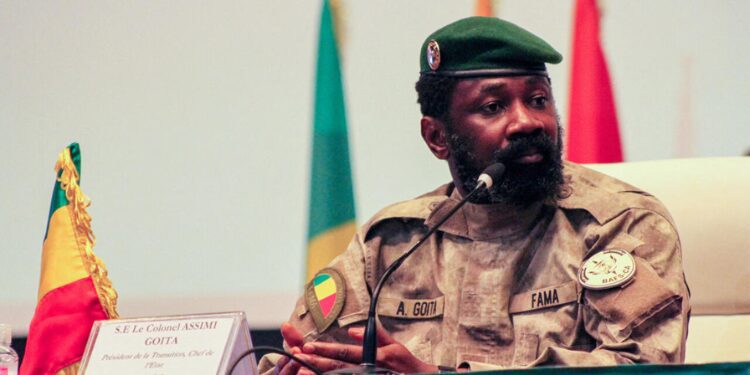
Mali’s military ruler, Colonel Assimi Goïta, has broken his silence following a wave of coordinated insurgent attacks that struck key military and strategic locations across the country, pledging to “neutralise” those responsible as jihadist and separatist groups intensify pressure on the state.
Appearing publicly for the first time since the weekend violence, Goïta sought to reassure the nation in a televised address, declaring that “the situation is under control” while vowing that military operations would continue until the perpetrators were fully eliminated.
The attacks, carried out over the weekend, targeted Mali’s main army base as well as areas near Bamako’s international airport, marking a significant escalation in the ability of armed groups to strike at the heart of the capital.
The offensive involved fighters linked to West Africa’s al Qaeda affiliate and a Tuareg-dominated separatist group, highlighting an unusual level of coordination between factions with differing objectives.
At the same time, insurgents were reported to have pushed Russian-backed forces out of the northern town of Kidal, underscoring the widening geographical scope of the conflict.
Goïta’s reappearance comes after days of uncertainty following the assaults, which not only exposed vulnerabilities in Mali’s security infrastructure but also triggered a scramble for territory across the country’s vast northern regions.
Earlier on this week, Goïta’s office released images of him meeting Russia’s ambassador to Mali, Igor Gromyko, in a sign of continued cooperation between Bamako and Moscow.
According to an official statement, the two leaders discussed the current security situation and reaffirmed their countries’ partnership, with Russia reiterating its commitment to supporting Mali in the fight against what it described as international terrorism.
Furthermore, the violence has taken a significant toll on Mali’s leadership. Defence Minister Sadio Camara was slain in Saturday’s attacks, presenting a serious blow to the administration at a vital time. Reports also indicate that Goïta paid a visit to a hospital treating those injured in the assaults and extended condolences to Camara’s family.
Meanwhile, the al Qaeda-linked group Jama’at Nusrat al-Islam wal-Muslimin (JNIM) has claimed responsibility for the attacks, framing them as retaliation for drone strikes and other military operations carried out by Malian forces.
In a video message released, a spokesperson for the group, Bina Diarra, went further, threatening to impose a siege on Bamako, a city of around four million people. “As of today, Bamako is closed off from all sides,” the spokesperson said, echoing earlier tactics used by the group, including a fuel blockade of the capital last year.
The rhetoric, combined with the scale of the weekend assaults, has heightened fears that insurgent groups are shifting toward more aggressive strategies, including direct pressure on major urban centres.
Bamako, long considered relatively secure compared to the country’s northern regions, now appears increasingly exposed to militant operations.
Russia, which has become a key security partner for Mali following the expulsion of French and United Nations forces after coups in 2020 and 2021, indicated that insurgent forces were regrouping after what it described as a failed attempt to seize key facilities, including the presidential palace.
The Russian Defence Ministry further stated that its forces were conducting reconnaissance operations to locate and destroy insurgent camps and remained prepared to repel further attacks.
Northern Gains and Expanding Insurgent Presence Deepen Crisis
While the attacks near Bamako have drawn immediate attention, developments in northern and northeastern Mali point to a broader and more complex security crisis unfolding across the country.
Armed groups appear to be capitalising on the momentum generated by the weekend’s assaults, seeking to consolidate territorial gains and expand their operational reach.
In the northeastern town of Menaka, near the border with Niger, fighters linked to the Islamic State in the Sahel Province were reported to have entered the area.
According to multiple sources including residents, security analysts, and an official from the Azawad Liberation Front. Although the group did not participate in Saturday’s attacks, its presence signals a parallel effort to strengthen its foothold in a strategically important region.
Residents described militants establishing checkpoints in parts of the town, while Malian soldiers moved to a nearby military camp. One local resident reported seeing fighters travelling in small groups on motorcycles, though there were no immediate reports of gunfire and daily life appeared to continue with some degree of normalcy.
These developments highlight the fragmented yet increasingly dynamic nature of the conflict in Mali. Multiple armed groups, including jihadist organisations and separatist movements, are operating simultaneously across different regions, often pursuing distinct objectives.
However, the apparent coordination seen in the recent attacks suggests that these groups may be willing to collaborate tactically when it serves their interests.
READ ALSO : Ghana Strengthens West Africa Aviation Hub Status With Major Expansion