Author: Kay Codjoe, Market Research Consultant and Volunteer Associate at the IMANI Centre for Policy and Education
The loudest voices in Ghana’s current energy debate are often the same political architects and defenders of the disastrous Power Distribution Services (PDS) scandal who once promised to rescue the country from darkness and stop the bleeding at ECG, a utility reportedly losing billions through inefficiencies and revenue leakages.
Today, many speak as though history began yesterday. It did not. Somewhere inside Ghana’s unresolved energy story still sits the carcass of the PDS deal, the failed 20-year ECG concession under the US$498 million Millennium Challenge Compact, an arrangement that collapsed under disputed guarantees and triggered suspended disbursements, yet still has not produced the level of accountability, prosecution, or forensic closure the public deserves.
A country that politicized darkness but normalized the PDS scandal cannot pretend surprise when confidence in the energy sector begins flickering again. Many Ghanaians have short memories politically, but electricity has a cruel way of restoring historical consciousness.
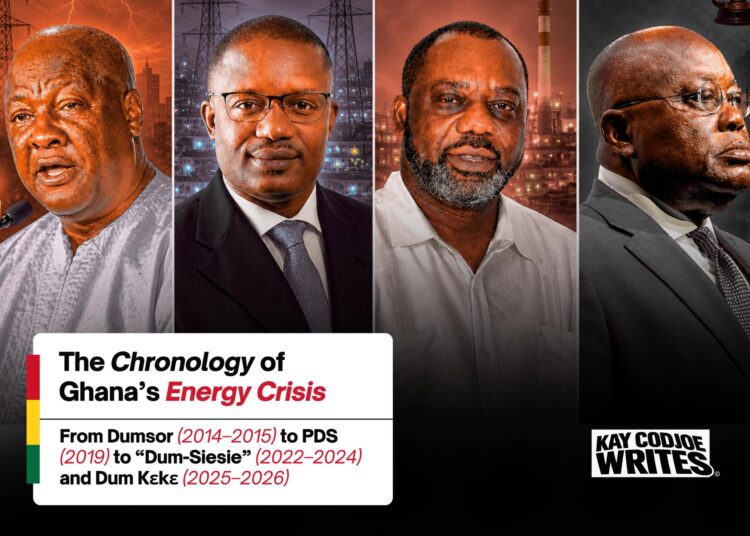
Between 2014 and 2015, under President John Dramani Mahama, Ghana descended into one of the most psychologically exhausting periods in its democratic history. Dumsor became a national humiliation. Homes and businesses disappeared into darkness, and the country began rationing dignity.
The political consequences were devastating. The New Patriotic Party weaponized dumsor with ruthless efficiency. Every blackout became campaign ammunition. The NPP understood something powerful: electricity is emotional governance. Darkness enters the bedroom, invades the kitchen, and humiliates ordinary people directly.
And so in 2016, the electorate wired Mahama out. Then came the government of Nana Akufo-Addo. To be fair, the NPP inherited a traumatized electorate and understood immediately that another full scale dumsor episode would politically destroy them.
Under Energy Ministers including Matthew Opoku Prempeh, who once told Ghanaians to create their own load shedding timetable, the administration pursued generation stabilization, fuel supply improvements, grid investments, IPP renegotiations, and relative operational consistency.
For several years, Ghana largely escaped the nationwide load shedding schedules that defined 2014 and 2015. But then something dangerous happened. The NPP slowly transformed “we stabilized the lights” into “the energy sector is healthy.”
Those were never the same thing. Because beneath the relative stability sat a fragile energy architecture weighed down by mounting debts, ECG losses, distribution inefficiencies, fuel anxieties, and a sector surviving more on political management than deep structural reform.
Then came the PDS scandal. In 2019, the Akufo-Addo administration transferred operational control of the Electricity Company of Ghana to PDS under the Millennium Challenge Compact arrangement. The deal was marketed as a transformational intervention to reduce losses, improve efficiency, attract investment, and modernize electricity distribution.
Instead, it collapsed spectacularly. Questions emerged over the validity of guarantees and insurance documentation underpinning the concession arrangement. The government eventually suspended and terminated the deal after international embarrassment and allegations of irregularities surrounding the transaction.
But beyond the embarrassment, the scandal exposed how politically connected energy reforms could become vehicles of opacity, weak due diligence, questionable procurement decisions, and elite maneuvering around strategic national infrastructure.
Yet years later, accountability still feels incomplete. Then the flickers returned. Not always nationwide or prolonged, but enough to trigger anxiety, enough for generators to begin clearing their throats again, and enough for citizens to instinctively check rechargeable lamps before sleeping.
And suddenly, the same political tradition that once turned every blackout into a funeral procession for Mahama began performing linguistic gymnastics around outages.
What was once called dumsor became “maintenance,” “technical fault,” “temporary disruption,” and “localized challenge.” Then came the street sarcasm: “dum-siesie” — small small dumsor. The irony was brutal.
The same political machinery that taught Ghanaians to interpret darkness as governmental failure now wanted citizens to carefully distinguish intermittent outages from historic load shedding.
But ordinary people do not experience electricity technically. Darkness is darkness. By 2025, Mahamudu Bawumia, with NAPO as his running mate, lost the elections, and Mahama returned to power carrying both the burden of history and the irony of political resurrection.
Now, sixteen months into the new administration, anxiety around the energy sector is rising again. The fire outbreak at the GRIDCo Akosombo substation triggered national panic and renewed fears about the stability of Ghana’s power infrastructure.
Dumsor is now a political memory. Which is why both the National Democratic Congress and the NPP are trapped by it. This is what happens when suffering is weaponized instead of solved. Eventually, propaganda collides with infrastructure.
And electricity is one of the few things in governance that refuses propaganda for long. When the lights go off, ideology disappears instantly. What remains is heat, sweat, silence, and frustration.
And the terrifying realization that Ghana may have spent more than a decade arguing over who caused the darkness while never fully building immunity against its return.
READ ALSO: Ghana Must Shift to Regime Accountability in Corruption Fight – CDD Fellow