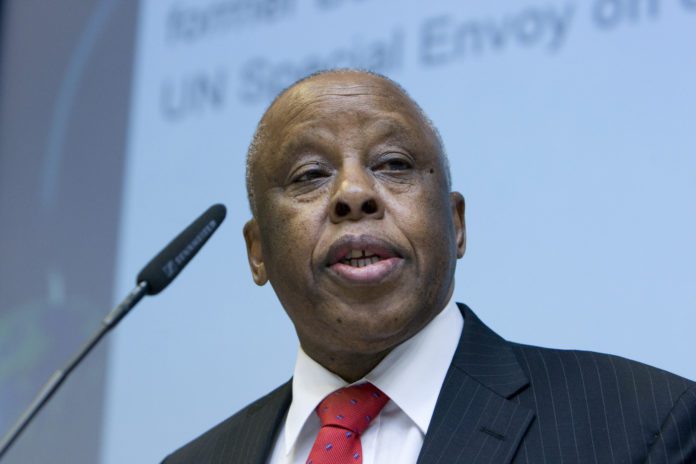
Botswana’s Former President, Festus Mogae, who led the diamond rich nation for a decade and is credited with strengthening Botswana’s economy and guiding the country through one of Africa’s worst HIV/AIDS crises, has passed on at the age of 86.
President Duma Boko announced Mogae’s death, describing him as a devoted statesman whose leadership helped shape Botswana’s modern democratic and economic identity.
“Today Botswana mourns a distinguished statesman and patriot whose life was devoted to the service of his country.”
Duma Boko
Festus Mogae, who led Botswana from 1998 to 2008, had reportedly been in ill health for some time. Last month, the government confirmed he was receiving medical treatment at a hospital in the capital, Gaborone, although officials did not disclose the nature of his illness.
Mogae, Botswana’s third president since independence, is widely recognised for overseeing a period of economic stability and institutional development during years of rapid growth fuelled largely by diamond revenues. His administration earned international praise for fiscal discipline, democratic governance and prudent economic management at a time when many African economies faced instability.
In a national address following the announcement of his death, Boko praised Mogae’s leadership and his role in strengthening Botswana’s international reputation.”Under his leadership, Botswana earned its international respect for principled governance,” Boko said.He also described the late leader as someone who “stood firmly for discipline, good governance, economic prudence and the advancement of our nation.”
The government has therefore declared three days of national mourning in honour of the former president, with flags ordered to fly at half-mast across the country.
Before becoming president, Mogae held several senior government positions, including finance minister and later vice-president, roles through which he helped shape Botswana’s economic policies during its post-independence development.
He also became internationally known for leading Botswana’s response to the HIV/AIDS epidemic during a period when the country faced one of the highest infection rates in the world. Under his administration, Botswana introduced one of Africa’s most ambitious antiretroviral treatment programmes, significantly reducing infection rates and improving access to life-saving medication.
Even after leaving office, Mogae remained active in public health advocacy across Africa, campaigning for wider access to HIV treatment, including free antiretroviral therapy and programmes aimed at preventing mother-to-child transmission of the virus
Beyond Botswana, he later participated in several international advisory initiatives and peace mediation efforts across the continent.
In 2008, Mogae received the prestigious Ibrahim Prize for Achievement in African Leadership, recognising his democratic leadership and peaceful transfer of power after leaving office. The award is regarded as one of Africa’s highest honours for governance and leadership.
Botswana remains one of Africa’s most politically stable democracies, having maintained regular multi-party elections and avoided military coups since gaining independence in 1966.
Festus Mogae Remembered for Decades of Public Service and Economic Leadership
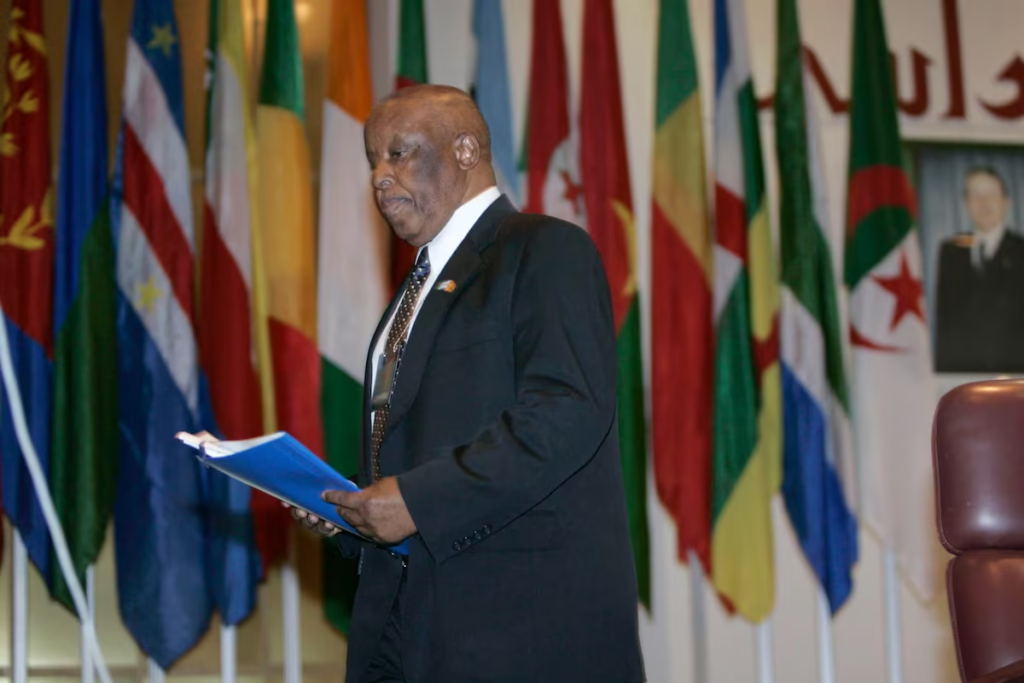
Festus Mogae built a long career in public service before becoming Botswana’s third president, serving in several influential economic and political positions that helped shape the country’s development after independence.
Born on August 21, 1939, in Serowe, Mogae trained as an economist at the Universities of Oxford and Sussex in the United Kingdom before returning to Botswana to begin a career in government service.
He started as a planning officer in 1968 and steadily rose through the ranks to become Director of Economic Affairs and later Permanent Secretary in the Ministry of Finance and Development Planning. During the 1970s, he represented Botswana in several major international financial institutions, including the International Monetary Fund, the African Development Bank and the International Bank for Reconstruction and Development.
Mogae also held leadership positions across a number of state institutions and corporations linked to Botswana’s growing economy. He served on the boards of organisations involved in housing, water utilities, meat exports, banking and mining, including the De Beers Botswana Mining Company and the Bank of Botswana.
From 1976 to 1980, he worked in Washington, D.C. as Alternate and Executive Director at the International Monetary Fund for Anglophone Africa before returning home to serve as Governor of the Bank of Botswana.
His public service career later expanded into senior political administration, including positions as Permanent Secretary to the President, Secretary to the Cabinet and Supervisor of Elections.
In 1989, he was appointed Minister of Finance and Development Planning before becoming vice-president in 1992.
Mogae assumed the presidency on March 31, 1998, serving until March 31, 2008. During his political career, he also chaired the Southern African Development Community Council of Ministers between 1992 and 1996 and represented Botswana in several international parliamentary and development organisations.
Beyond government, Mogae remained active in community and social development initiatives. He supported organisations focused on conservation, research, disability advocacy and youth development, while also serving as Chairman of Botswana’s National AIDS Council after its launch in 2000.
READ ALSO: Starmer Takes Responsibility After Labour Suffers Heavy Election Losses