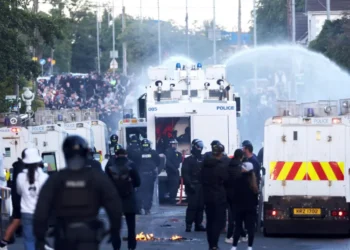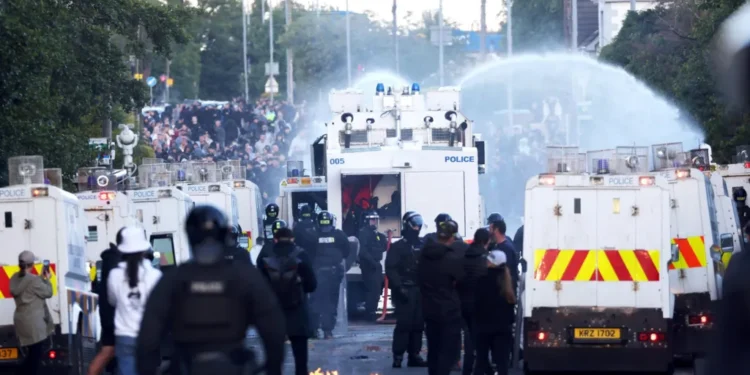
Belfast has awakened to a fragile calm after a second consecutive night of violent disorder saw twelve (12) police officers injured and sixteen (16) arrests made during clashes between riot police and masked protesters, amid growing concerns over racially motivated attacks and the spread of unrest across Northern Ireland.
The latest figures, confirmed by Northern Ireland Secretary Hilary Benn, highlights the intensity of Wednesday night’s disturbances, when police deployed a water cannon to disperse crowds at the Sandyknowes roundabout in Glengormley, approximately 13 kilometres northwest of Belfast city centre.
Police Officers came under sustained attack from groups of black-clad protesters who hurled bricks, bottles, pieces of wood and other missiles during confrontations that stretched into the night.
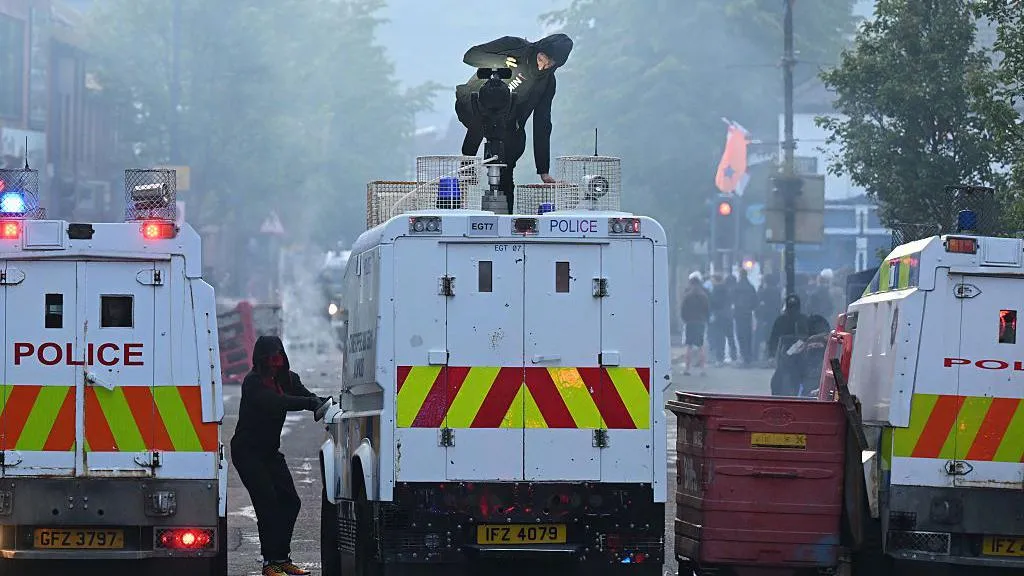
Footage from the scene showed dozens of individuals wearing face coverings tearing apart sections of driveways, fences and roadside infrastructure to use as projectiles.



Fires burned along key routes as bins were set alight and a Department for Infrastructure vehicle was engulfed in flames. In some instances, rioters reportedly attempted to ignite a derelict building while throwing petrol bombs towards police lines.
Although Wednesday’s violence was not as widespread as Tuesday’s earlier outbreak, when homes, cars and a bus were torched and families forced to flee, the renewed clashes confirmed that tensions remain volatile in several parts of Northern Ireland.
The unrest has been unfolding in the wake of a serious knife attack in north Belfast on Monday night that left Stephen Ogilvie, a man in his 40s, with life-changing injuries, including the loss of his left eye and severe damage to his right eye. Police arrested Hadi Alodid, a 30-year-old Sudanese national, at the scene. He later appeared in court charged with attempted murder and remains in custody.
Authorities have stressed that the investigation remains ongoing and have repeatedly stated there is no evidence linking the attack to terrorism. However, the incident has triggered widespread anger and protests across several communities, with some demonstrations escalating into violence and targeted attacks on homes occupied by ethnic minorities.
The scale of Tuesday night’s disorder saw multiple families displaced after groups reportedly went door-to-door targeting foreign nationals. A two-month-old baby was among those rescued from affected areas, while emergency services worked through the night to evacuate residents from burning homes.
By Wednesday night, Belfast city centre had largely emptied as businesses closed early and public transport services were suspended amid fears of further escalation. Schools also shut ahead of schedule in several areas as authorities attempted to reduce public exposure to potential violence.
Political leaders across the UK and Northern Ireland have condemned the unrest and warned against attempts to exploit the incident to inflame racial tensions or encourage further disorder.
Deputy First Minister Emma Little-Pengelly described the violence as “appalled and horrified absolutely everyone,” drawing a clear distinction between peaceful protest and criminal behaviour.
“Some peaceful protesters do have legitimate concerns, others seem determined to cause violence, thuggery and disorder.
“That is absolutely wrong. We of course have been united in calling for that to stop immediately.”
Emma Little-Pengelly
She also strongly condemned any actions motivated by racism, warning that such violence ultimately damages the very communities it claims to represent.
Moreover, Northern Ireland Secretary Hilary Benn indicated that the recent events had left many people frightened. “There is no justification for that, and nothing can explain it away, and it’s left a lot of people terrified,” Benn added.
Police Warn Against Online Incitement as Pressure Mounts on Security Services
As authorities attempt to restore order, attention has increasingly turned to the role of social media in spreading misinformation and fuelling unrest.
Police Service of Northern Ireland Chief Constable Jon Boutcher urged the public not to be influenced by the “tide” of online narratives and warned against external voices shaping local tensions.
He noted that, people should not get “carried away with a tide” of views online or be “persuaded by people who know nothing about Northern Ireland.”
Police have also raised concerns over social media posts allegedly sharing personal addresses, warning that such activity may constitute a criminal offence and has already left families feeling unsafe and distressed.
The Northern Ireland Policing Board confirmed that officers are operating under significant strain. Chair Brendan Mullan added that, the police service is stretched, with 6,300 officers currently in place against a recognised requirement of 7,500, limiting operational resilience during periods of sustained unrest.
In an effort to stop any escalation, Scotland Police has provided support, including specialised dog units, to help control public order.
Meanwhile, the family of Stephen Ogilvie has reiterated its appeal for calm, stressing that the violence in the streets is not being carried out in their name and urging the public not to use the attack to justify hostility or division.
READ ALSO: 3% NPP Gain Masks Rising Voter Volatility as NDC Falls 9% in Ashanti Region