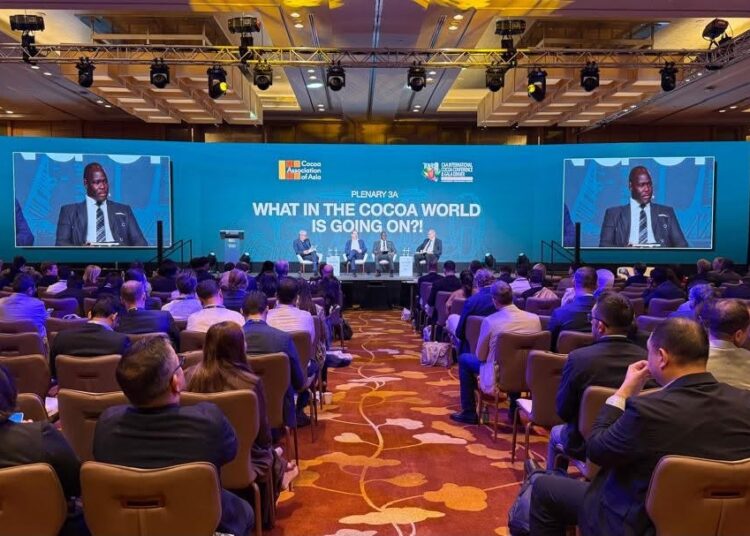
A call for a fundamental shift in how the global cocoa industry approaches sustainability took centre stage at the 4th CAA International Cocoa Conference 2026 in Singapore, where Ghanaian cocoa sector leader Wisdom Dogbey urged stakeholders to put the farmer at the centre of every serious conversation about the future of the crop.
Addressing traders, grinders, manufacturers, investors, government representatives and other players across the cocoa value chain at the high level conference, Mr. Dogbey said the industry can no longer discuss sustainability, supply security and long-term growth without confronting the economic reality of the millions of smallholder farmers who produce the beans.
“For me, this is not simply a welfare conversation. It is a commercial imperative,” he told delegates at the Singapore conference. His message, which has since drawn attention within the global cocoa community, was direct and deliberately framed as a business case for farmer prosperity.
The conference, organized by the Cocoa Association of Asia (CAA), is one of the world’s leading gatherings for the cocoa trade, bringing together stakeholders from producing and consuming countries to deliberate on market trends, sustainability, regulation, and the future of cocoa.
This year’s edition, held in Singapore, comes at a critical time for the industry. Global cocoa prices have experienced unprecedented volatility over the past 18 months, driven by supply deficits in West Africa due to disease, climate stress and aging farms, coupled with strong demand and speculative trading.
While high prices have benefited some actors in the value chain, many farmers in producing countries continue to struggle with low productivity, high input costs and limited access to finance. It is against this background that Mr. Dogbey made his intervention.
Put The Money Back into The Farm
In a keynote contribution that focused on the economics of production, Mr. Dogbey argued that the adversarial posture that sometimes characterises relations between producers and buyers misses the real challenge facing the industry.
According to him, volatility in prices, in weather, in disease outbreaks, and in policy remains the single biggest threat to the long term viability of cocoa. And the most effective way to tame that volatility, he argued, is to invest directly in the productive base.
He explained that without a healthy, well-resourced and economically viable farming population, talk of sustainable supply would remain theoretical. “There can be no sustainable global cocoa value chain without an economically sustainable cocoa farmer,” he stressed.
Mr. Dogbey challenged industry actors to move beyond a transactional approach of merely sourcing cocoa from producing countries, and instead commit to deliberate, long term investment at origin.
“Traders, grinders, manufacturers, investors, governments, and consuming markets must look beyond simply sourcing cocoa from producing countries. We must also invest in the productive base itself.”
Mr. Dobgey
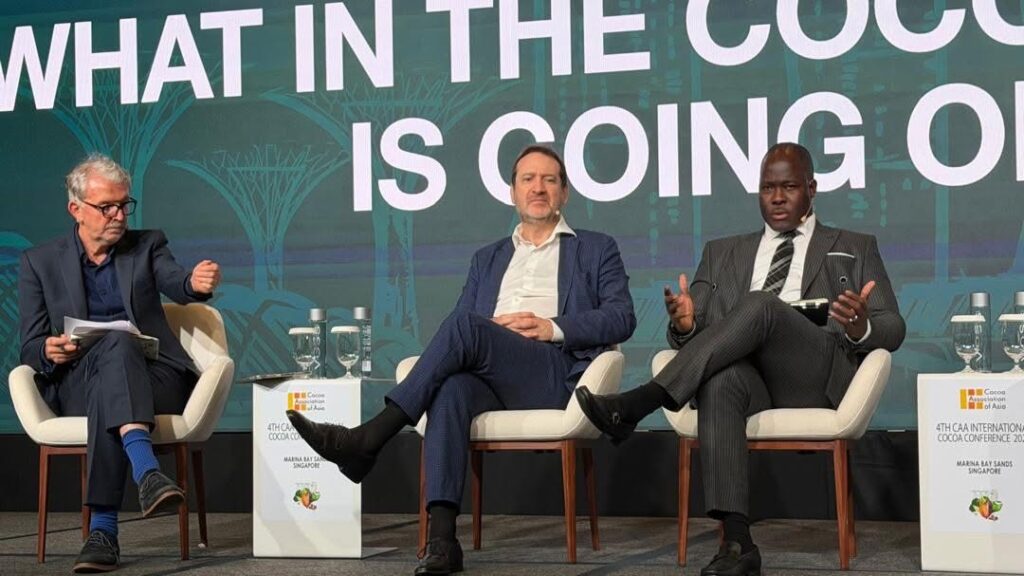
He listed key areas requiring urgent investment as farm rehabilitation, disease management, productivity enhancement, accessible finance for farmers, irrigation, responsible new planting, and expansion of local processing and value addition.
Ghana’s New Legal Framework on Ghana Cocoa Board
Mr. Dogbey also used the global platform to highlight reforms underway in Ghana, the world’s second largest cocoa producer. He drew attention to Ghana’s new Ghana Cocoa Board Act, 2026, which he said strengthens the legal framework around farmer protection and sector sustainability.
According to him, the new Act is designed to modernize the governance of Ghana’s cocoa sector, provide stronger safeguards for farmer incomes and welfare, enhance transparency and accountability in the cocoa trade, and create a more enabling environment for investment in productivity and value addition.
The law, which has been described by policymakers in Accra as a landmark reform, comes as Ghana seeks to reposition its cocoa sector to better respond to global market dynamics, climate change, and new regulatory requirements in major consuming markets such as the European Union’s Deforestation Regulation (EUDR).
Mr. Dogbey noted that Ghana remains committed to working with international partners to ensure that sustainability standards do not become barriers that exclude smallholder farmers, but rather tools that support shared prosperity.
Dogbey’s Push for Profitable Farming to Secure Future Cocoa Supply
A Commercial Imperative Industry analysts say Mr. Dogbey’s framing of farmer welfare as a commercial imperative rather than a charity case reflects a growing consensus within the trade. With cocoa farms in West Africa aging, average yields still far below potential, and young people reluctant to take up cocoa farming due to low returns, the long-term supply of cocoa is at risk unless farming becomes more profitable and attractive.
Investment in rehabilitation of diseased and overaged farms, access to improved planting materials, extension services, affordable credit, and irrigation have been identified as critical to reversing the decline in productivity.
In Ghana and neighbouring Côte d’Ivoire, which together account for nearly 60 percent of global cocoa supply, recent outbreaks of Cocoa Swollen Shoot Virus Disease (CSSVD) and Black Pod disease have devastated farms, underscoring the need for coordinated investment in disease control.
Mr. Dogbey’s call in Singapore is therefore seen as a timely reminder that price rallies alone do not translate into farmer wealth if structural challenges at farm level are not addressed.
The conference continues with sessions on market outlook, logistics, sustainability standards and innovation in cocoa processing. For Ghana, the intervention reinforces its long-standing advocacy for fairness and shared value in the cocoa trade.
Mr. Dogbey concluded, the future of chocolate cannot be secured in trading rooms and factories in Europe and Asia alone. It must be secured on the farms of Ghana, Côte d’Ivoire, Ecuador, Cameroon and other producing countries where the economic sustainability of the farmer will determine the sustainability of the entire industry.
READ ALSO:GHS Director-General Calls for Hospitals to Share Medical Resources