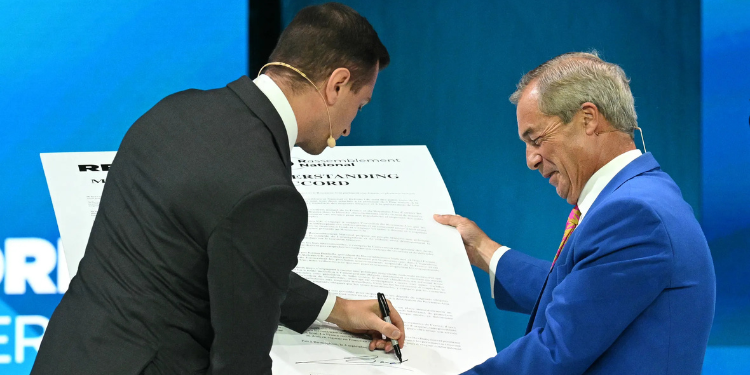
Nigel Farage and France’s hard-right National Rally (RN) have agreed to work together on a proposed system for returning migrants who cross the English Channel in small boats, in a deal that could reshape UK-France migration cooperation if both parties secure power.
The agreement, signed at Reform UK’s annual conference in Birmingham, commits a future Reform UK government and an RN administration to cooperate on stopping small boat crossings and returning migrants intercepted in British territorial waters to France.
Under the proposed arrangement, France would “ordinarily accept” people returned by Britain after their boats had been intercepted, before repatriating them to their countries of origin in accordance with French law.
RN President Jordan Bardella joined Farage at the Reform conference to unveil the memorandum of understanding, presenting the agreement as the beginning of closer cooperation between the two countries on migration.
Bardella informed Reform delegates that an RN government would “do everything in its power to ensure that France is no longer the gateway for illegal migration into the United Kingdom.“
He also hailed Farage as UK’s next Prime Minister and pledged to work with a potential future Reform government to tackle illegal migration.
According to the MOU, “The United Kingdom will intercept boats which have launched from French shores and entered British territorial waters and will return the persons on board to France. France will ordinarily accept these persons, who will be repatriated to their home country in accordance with the law in force in France concerning expulsion.”
The wording, however, leaves open questions about how the proposed returns would operate in practice. Asked at a news conference whether the word “ordinarily” meant France could refuse to accept some migrants, Farage dismissed the concern as “legalese.“
He argued that the policy would remove the financial incentive for migrants to pay people smugglers to make the dangerous Channel crossing.
Farage indicated that the proposals would mean there was “no incentive” to pay a trafficker to cross the Channel, and “in very, very short order the business model is broken”.
The Reform leader described the agreement as a “historic document” and claimed it would “stop the boats forever.“
Ending small boat crossings within the first 100 days of a Reform UK government is one of the party’s key political pledges. The latest agreement with the RN is intended to provide a mechanism through which migrants intercepted in British waters could be returned to France rather than remaining in Britain.
However, the proposed arrangement would depend heavily on the ability of both parties to secure national power and overcome the legal, diplomatic and operational barriers surrounding migrant returns.
Under the proposals, migrants who successfully reach Britain from France would be immediately detained and deported to their home countries rather than returned to France. This forms part of Reform UK’s wider migration policy, which seeks to reduce the number of people making the Channel crossing by making the journey less attractive to prospective migrants.
The deal also comes as migration remains one of the most politically sensitive issues in Britain and France, with successive governments facing pressure to reduce irregular arrivals while balancing border enforcement with domestic and international legal obligations.
The latest pact also comes at a time when the RN is positioning itself for a potentially historic breakthrough in France, while Reform UK is seeking to establish itself as a major political force in Britain.
Both parties have made immigration and national sovereignty central themes of their political platforms, creating a shared agenda around tighter border controls and restrictions on irregular migration.
Meanwhile, Labour has argued that closer cooperation with French authorities has contributed to a decline in small boat crossings. Its approach has included deploying additional officers to French beaches and providing further funding aimed at preventing boats from reaching the Channel.
Last year, the British government also reached a “one in, one out deal” with France, under which Britain can return some people who arrive by small boat while accepting an equivalent number of people from France who are considered to have legitimate claims to come to the UK.
The Reform-RN proposal would represent a considerably tougher approach, with the emphasis placed on interception, return and repatriation.
Farage and Bardella Declare a ‘New Entente Cordiale’
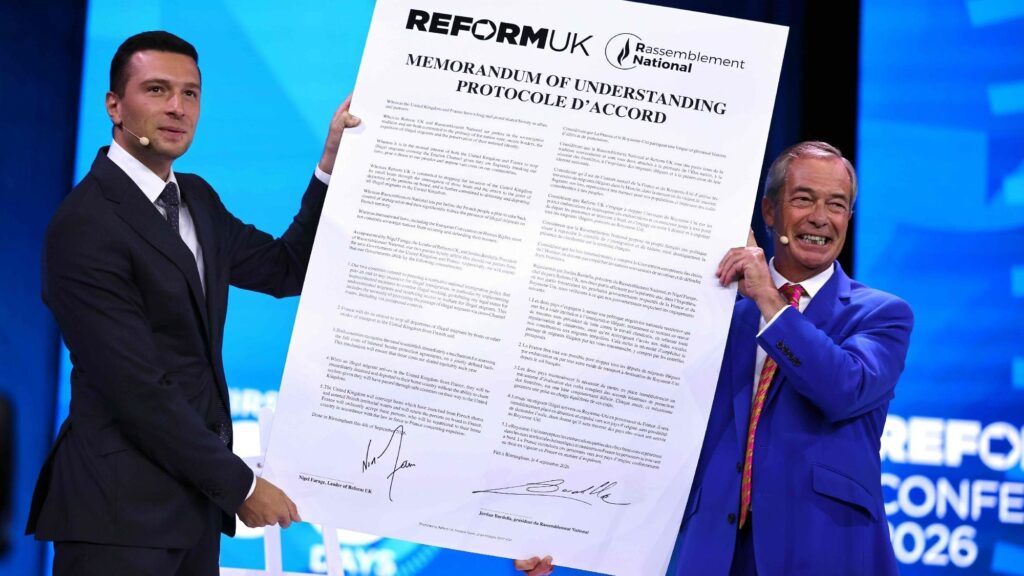
Moreover, Farage described the arrangement as a “new Entente Cordiale” invoking the series of agreements signed between Britain and France in 1904 that helped establish closer diplomatic relations between the two countries.
Standing alongside Bardella, Farage stated the new arrangement could mark the beginning of a fundamentally different approach to cross-Channel migration if Reform UK and the RN eventually enter government.
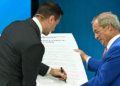
The two politicians then signed a large mock-up of the memorandum to cheers from Reform members, with one member shouting “Vive la France!”.
Bardella had used his conference appearance to frame the migration issue as one requiring cooperation between Britain and France rather than action by either country alone.
The agreement also strengthens Bardella’s relationship with Farage, whom he has increasingly portrayed as a political ally in the effort to reshape Europe’s approach to migration.
READ ALSO: US Sanctions Turkish Bank Over Iran Ties