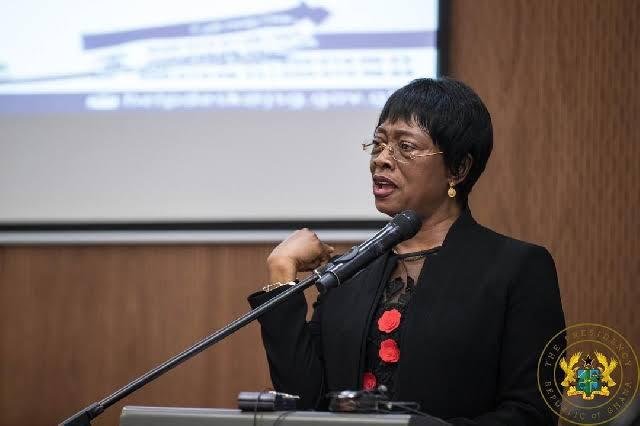
Justice Sophia Akuffo, a Distinguished Fellow at the Institute of Economic Affairs (IEA) and former Chief Justice of Ghana, has championed the adoption of a non-partisan framework grounded in sound financial governance for managing Ghana’s mineral wealth.
In an interview with The Vaultz News, the former Chief Justice expressed concern over the ‘back and forth’ in the GoldBod-BoG loss claims that continue to destabilize the national macroeconomy.
She further questioned why the extractive sector lacks a regulatory blueprint equivalent to the Petroleum Revenue Management Act. She pointed out that building statutory mechanisms to oversee solid minerals is an urgent necessity to safeguard public funds and smooth out fiscal volatility.
“…And it’s important that now we go about financial and economic governance with wisdom rather than with passion and anger and party politics. It has to be purely result-orientated and the result is what? The result is every Ghanaian, the average Ghanaian’s pocket being reasonably full after a decent day’s work.”
Justice Sophia Akuffo,
Addressing the operations of the Bank of Ghana regarding national gold reserves, Akuffo emphasized that institutional changes must proceed under strict objective and result-oriented principles rather than political rhetoric.
She asserted that structural reforms within the central bank’s gold management strategy require absolute economic discipline to protect the state’s financial stability.
Rather than allowing partisanship or emotional debates to dictate mineral governance, every strategic shift must produce tangible economic outcomes that directly improve the daily living conditions of average citizens.
The Case for a Mineral Revenue Management Framework
The call by the former Chief Justice highlights a glaring gap in Ghana’s natural resource governance.
Justice Sophia Akuffo,
While the petroleum sector operates under a legal mechanism designed to capture, manage, and distribute revenues transparently, the solid minerals sector particularly gold remains exposed to ad-hoc allocation and volatile commodity market swings.

The IEA Fellow described the ongoing cyclical instability as “nauseating,” emphasizing that the nation “cannot continue like that” when managing critical state assets.
Enacting a dedicated Mineral Revenue Management Act would establish statutory buffers, legally binding savings funds, and strict rules for capital expenditure.
This structural shield would prevent sudden drops in global mineral prices from triggering emergency balance-of-payments crises or destabilizing domestic fiscal planning.
Depoliticizing Extractive Sector Governance
Madam Akuffo’s insistence on replacing political passion with economic pragmatism points to a widespread issue in natural resource administration.
Historically, policy shifts within the extractive domain have been influenced by political transitions, frequently leading to inconsistent long-term planning, compromised state negotiation positions, and inefficient resource exploitation.
By advocating for a governance model rooted in “economic and financial wisdom,” she calls for technical expertise to take precedence over partisan point-scoring.
A streamlined, depoliticized institutional framework guarantees that state actions, such as domestic gold purchasing and reserve accumulation programs, remain focused on macroeconomic resilience rather than short-term political gains.
Focusing on Citizen-Centric Economic Outcomes
The ultimate goal of natural resource governance must be measurable improvement in the standard of living for the public.
Madam Sophia Akuffo argued that state wealth strategies fail if they do not translate into filled pockets for average workers following a decent day’s labor.
Moving away from party politics ensures that mineral rents fund sustainable infrastructure, economic diversification, and structural stability rather than temporary consumption spikes.
Establishing a non-partisan mineral revenue framework creates a direct link between Ghana’s resource wealth and long-term socio-economic progress, ensuring that national gold reserves serve as a stable foundation for equitable growth across generations.
READ ALSO: GCB Bank, Police Tighten Security as Fraudsters Go Digital