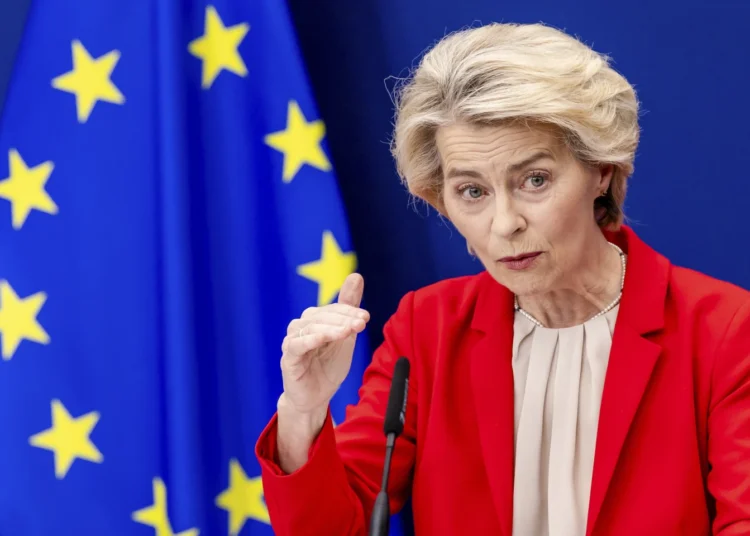
European Commission President, Ursula von der Leyen has warned that recent incidents involving Russian-linked military activity in Denmark and Lithuania are part of a wider pattern of aggression and provocation against Europe, as tensions continue to rise across the continent.
Von der Leyen asserted that the events in the two NATO-member states were “not isolated incidents,” describing them as “part of a broader pattern of Russian aggression and provocation against Europe, testing our readiness and our resolve.”
Her comments followed two separate incidents in the Baltic region. In Denmark, a Russian warship fired two emergency flares near a Danish military helicopter during what Copenhagen described as a routine monitoring operation. In Lithuania, NATO fighter jets shot down a drone believed to have originated from Belarus, with Italian authorities saying it most probably came from Russia.
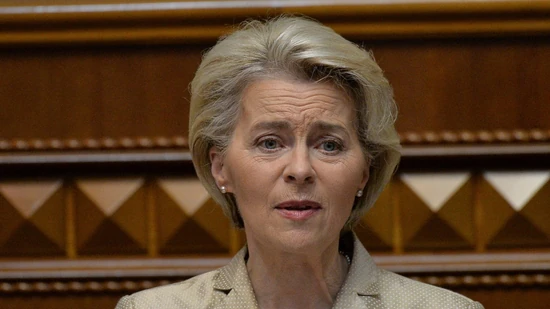
Von der Leyen condemned what she described as “reckless and dangerous Russian behaviour,” warning that Europe’s response would become stronger.
“Russia will find our resolve only growing stronger. We are reinforcing our collective deterrence and defence, together with Nato. And we are stepping up the pressure on Russia.”
Ursula von der Leyen
The Danish incident occurred during a routine overflight of a Russian frigate in the Baltic Sea. Denmark subsequently summoned Russia’s Ambassador to explain the incident, which Copenhagen regarded as a serious provocation involving its military.
Danish Prime Minister, Mette Frederiksen described the incident as “Reckless action from Russia towards Danish military during a routine overflight yesterday,” adding that Russian actions were intended “to intimidate and divide.” “They will not succeed. We will not waver,” Frederiksen said.

Danish Foreign Minister, Lars Løkke Rasmussen also described the Russian frigate’s behaviour as “completely unacceptable.”
Defence Minister Jeppe Bruus disclosed that there had been no warning or radio communication from the Russian vessel before the flares were fired towards the Danish helicopter. He said that one of the flares passed “within a matter of meters” of the aircraft.
According to Bruus, the incident demonstrated Russia’s growing willingness to take risks as part of what he characterised as increasingly aggressive behaviour.
The episode came as European countries continue to strengthen their security posture amid Russia’s war in Ukraine and a growing number of reported military and drone incidents around NATO territory.
NATO Jets Shoot Down Drone Over Lithuania
Separately, NATO fighter jets deployed on the alliance’s eastern flank shot down a drone over Lithuania after it entered the country’s airspace.
Lithuanian President, Gitanas Nausėda said the incident demonstrated the importance of maintaining strong regional readiness as Russia intensifies its war against Ukraine. “With Russia intensifying its aggression against Ukraine, such readiness is vital for our region,” Nausėda said.
Lithuanian Foreign Minister, Kęstutis Budrys said that he had informed NATO allies about the incident and indicated that Lithuania would seek discussions at both the EU and NATO levels.
“We will be requesting discussions on these topics both in the EU and Nato, because it is obvious that we all still have a lot of homework to do.”
Kęstutis Budrys
Italy’s Defence Ministry confirmed that Italian fighter jets participating in a NATO mission were responsible for shooting down the drone. Italian Defence Minister, Guido Crosetto said that the aircraft most probably originated from Russia.
The drone came down in a rural area near Lake Kaunas in central Lithuania. Lithuania, Latvia and Estonia, which are all NATO members and share borders with Russia, have regularly reported drone incursions since Moscow launched its full-scale invasion of Ukraine in 2022.
Russia Responds To Danish Summons
Russia, meanwhile, has responded cautiously to Denmark’s accusations, with its Ambassador to Copenhagen, Vladimir Barbin, saying that Moscow would examine the circumstances surrounding the helicopter incident. “The Russian side will carefully study all the circumstances of the incident,” Barbin said in comments to a Russian state news agency.
However, the Russian Ambassador also appeared to shift responsibility towards Denmark, saying that Copenhagen should take steps to prevent similar incidents from occurring in the future.
The response comes as European officials increasingly frame military encounters in the Baltic region as part of a broader security challenge. With NATO strengthening its eastern flank and European governments calling for greater coordination, incidents involving aircraft, drones and military vessels are likely to remain closely watched as the conflict in Ukraine continues.
READ ALSO: Accra-Kumasi Expressway to Be Delivered in 24 Months, Project CEO Says