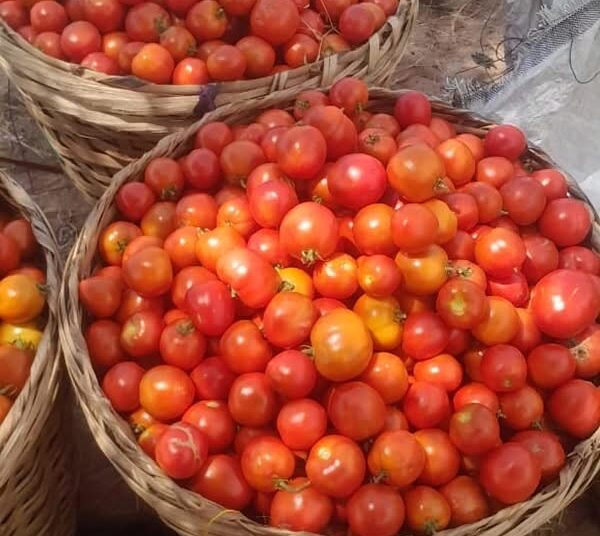
Tomato farmers in the Anloga-Avume area of the Anloga District in the Volta Region have raised an urgent appeal for buyers, as tonnes of ripe tomatoes rot on farms due to acute crate shortage and lack of ready market.
The farmers say the area has recorded a bumper harvest this season, capable of supplying major markets in Anloga, Keta, Accra, Kumasi and beyond, and potentially easing Ghana’s reliance on tomato imports from Burkina Faso.
The appeal is led by Daniel Kad, a farmer and Assembly Member for the area, who describes the situation as a national emergency that threatens food security, rural employment and family livelihoods.
He says the abundant harvest represents more than income for individual farmers, but employment for young people engaged in loading, transporting and selling farm produce, and a lifeline for families who depend on the crop for school fees, medical bills and daily survival.
According to Mr. Kad, the immediate cause of the crisis is an acute shortage of crates needed to harvest the tomatoes, compounded by allegations that the few available crates are being controlled by ‘load boys’ who allegedly demand bribes before releasing them to farmers.
The situation has forced many farmers who borrowed heavily to finance the season, spending on seeds, fertiliser and labour, to watch helplessly as their produce deteriorates on the farm beds, because they cannot afford the additional illegal charges being demanded for the crates.
Farmers say the crisis has persisted since the previous week, with fresh quantities of tomatoes rotting daily in the absence of buyers, storage facilities or cold rooms to preserve the produce while a market is found.
“We are issuing an urgent appeal to buyers, market women, processing companies and exporters across the country and beyond to visit Avume immediately. Our tomatoes are ready for harvest but risked being completely lost without swift intervention.”
Daniel Kad, Farmer
Financial Challenge: The Negative Impact
The farmers disclose that several of them took loans in anticipation of proceeds from the harvest and now face the prospect of defaulting on their debts, losing their farmlands, and being unable to finance subsequent farming seasons.
They are calling for immediate action from the Ministry of Food and Agriculture, the Anloga District Assembly, the Volta Regional Minister and the Feed Ghana Programme, and want intervention within the week to prevent the total collapse of the Avume tomato economy.
The farmers emphasize that failure to act swiftly will result in huge losses in terms of the commodity and to farmers because of debts incurred for production. They say it is sad that Ghana continues to import tomatoes despite having the local capacity to produce enough to meet its demand.
This is not the first time Anloga-Avume has faced this cycle. The enclave, which includes towns like Savietula, Whuti, Anloga, Woe and Tegbi, has in previous seasons recorded similar gluts where heaps of ripe tomatoes decay along the roadside due to lack of market access.
Young men and women have been observed discarding vegetables into the bush, choosing to salvage empty baskets as an act of resignation.
3,506 Kilograms Lose of Tomato Annually
Research and reports indicate that individual farmers in the area lose an average of 3,506 kilograms annually valued at thousands of cedis, primarily from rot and bruising caused by unavailability of reliable markets and storage infrastructure.
At the same time, price volatility worsens their plight, with boxes previously worth GH₵1,050 selling for as little as GH₵70 to GH₵200 during glut periods.
The current crisis exposes deeper systemic challenges. Farmers point to the absence of adequate storage facilities and cold rooms, which worsens the situation as they have limited options for preserving tomatoes while waiting for buyers.
The lack of processing plants means there is no guaranteed off-taker during bumper harvests. The irony, farmers say, is that Ghana continues to spend hundreds of millions of dollars annually importing tomatoes.
National data shows Ghana spends over $400 million annually on tomato imports, with previous estimates putting tomato imports from Burkina Faso alone at about GH₵4 billion annually.
The Anloga-Avume farmers question why local produce is allowed to rot while foreign exchange is used to import the same commodity.
The appeal comes just days after the Minister for Food and Agriculture, Mr. Eric Opoku, and other dignitaries on the national launch of Ghana’s tomato self-sufficiency initiative, the Ghana Tomato Self-Sufficiency Initiative (GHATSI), at the Anloga Anseco Park.
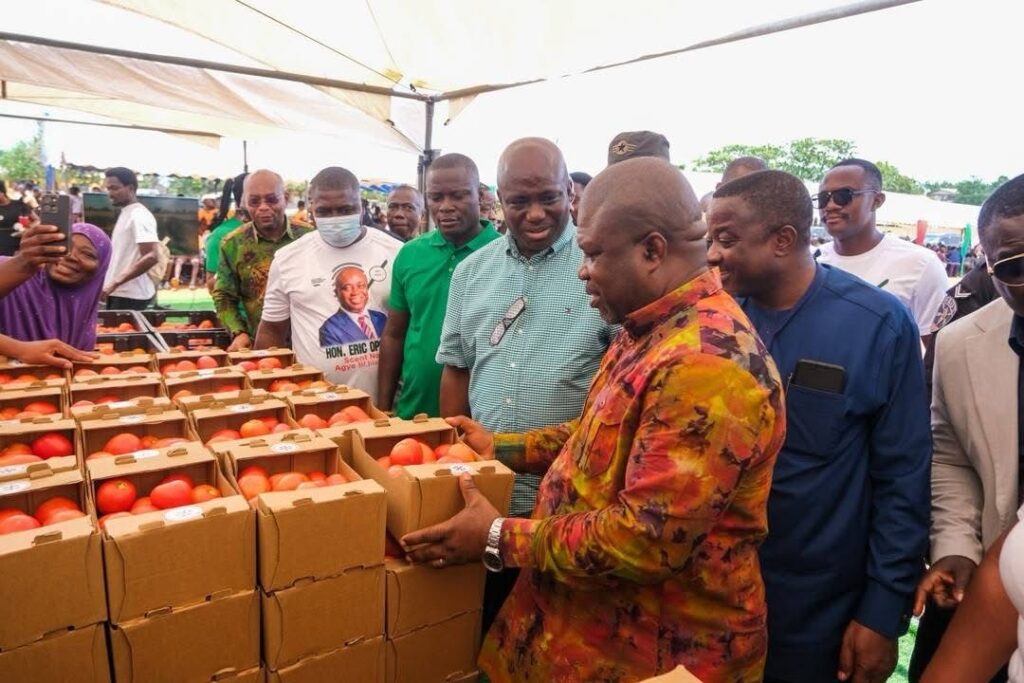
The initiative is intended to transform tomato farming into a more profitable and predictable venture for farmers in Anloga and the entire country. Under GHATSI, government in partnership with Farmmate Ghana Limited.
Farmmate targets an initial production of 100,000 tonnes of fresh tomatoes across 10,000 hectares in the 2026-2027 season, with processing factories planned in the Volta Region to absorb excess produce.
National Launch Project to Safeguard Farmers
The Anloga District Chief Executive, Sandra S. Kpedor, has said the district’s agricultural potential makes it suitable for the national launch, as farmers in the district produce tomatoes, okra, pepper, shallots, spring onions, lettuce and carrots.
However, farmers say the initiative must move quickly from launch to farm-level intervention. Mr. Kad and his colleagues want the Feed Ghana Programme and MoFA to immediately facilitate buyers, provide harvesting crates, and deploy trucks to evacuate produce.
The Volta Regional Minister, James Gunu, has acknowledged the need for a tomato factory in the Volta Region to cut post-harvest losses, noting that government is working to construct irrigation dams and rehabilitate existing ones to support year-round farming.
He has also described recent disruptions in regional tomato trade as both a challenge and an opportunity for Ghana to accelerate self-sufficiency. For now, the farmers in Avume say they are counting losses daily.
They appeal to market queens in Accra, Kumasi, and Takoradi, processing companies, exporters, and even individuals who can buy in bulk, to come to Avume immediately.
They also call on government to enforce regulation of crate distribution, stop extortion by intermediaries, invest in aggregation centres and cold chain facilities, and fast-track the establishment of the promised processing factories.
READ ALSO:Government Launches Phase I of Major Tomato Production Initiative in Volta Region