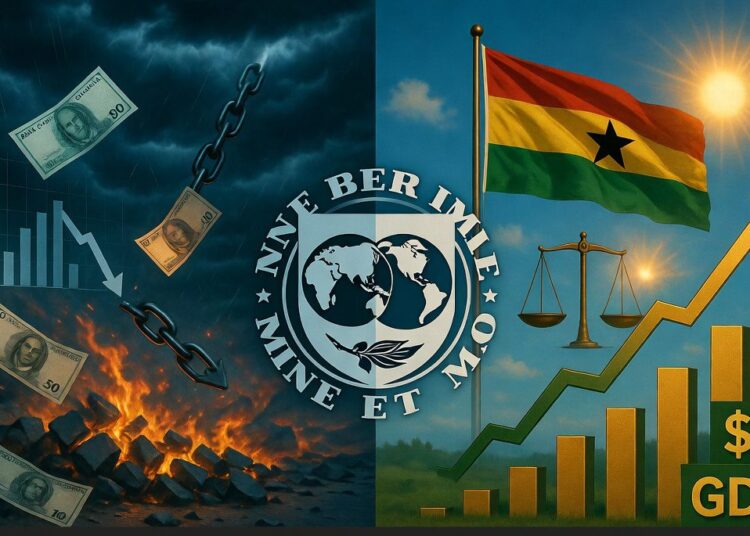
The International Monetary Fund has delivered a striking upward revision to Ghana’s economic prospects, lifting the 2026 growth forecast to 5.7 percent.
That figure stands a full 1.1 percentage points higher than the 4.6 percent the Fund projected only months earlier in April. The update landed as officials gathered in Bangkok for the Annual IMF and World Bank Meetings, and it has quickly drawn attention across Accra’s policy circles and financial markets.
The new projection rests on several concrete developments. Ghana’s sustained focus on fiscal discipline has played a central role. Targeted public spending aimed at stimulating activity has also helped. Strong earnings from gold exports have provided further support, strengthening the trade balance and allowing the country to build useful economic buffers. Ghana’s progress under the Policy Coordination Instrument programme has added another layer of credibility to the revised numbers.
These elements combined to produce an outlook that exceeds the government’s own estimate of 4.8 percent contained in the 2026 Budget. The IMF’s more optimistic assessment suggests that recent policy choices and external earnings are translating into stronger momentum than previously expected.
Inflation Outlook Softens Sharply
Alongside the growth upgrade, the Fund has sharply lowered its inflation forecast. It now expects Ghana to end 2026 with inflation at 4.8 percent, down from the 7.9 percent projected in April. That revised figure sits comfortably below the government’s and the Bank of Ghana’s target band of 8 percent plus or minus 2 percentage points, which runs from 6 to 10 percent.
September inflation already stood at 5.2 percent. The IMF’s year-end projection therefore points to further easing in price pressures in the final months of the year.
Bank of Ghana internal projections had anticipated some rise in September yet still expected the year-end rate to remain inside the target band. Should the IMF forecast materialise, Ghana would record single-digit year-end inflation for a second consecutive year after a similar outcome in 2025.
Recent Economic Performance Provides Context
Data from the Ghana Statistical Service already show solid recent activity. The economy expanded by 6.0 percent in the second quarter of 2026, bringing first-half growth to 6.2 percent. These numbers align with the broader improvement captured in the Fund’s latest outlook.
Meanwhile, the IMF expects growth to moderate to 5.2 percent in 2027. The World Bank, in its Africa economic update released in October 2026, has kept its own 2026 growth forecast for Ghana unchanged at 4.8 percent and projects 4.9 percent for 2027. The Bank points to support from the services sector, a recovery in oil and gas activity, and continued progress with structural and fiscal reforms.
It described second-quarter activity as robust even as growth moderated slightly, noting that investment rose by 53.0 percent and domestic demand increased by 11.2 percent.
Gold Dependence Draws Caution
While the upward revision reflects genuine strengths, sources close to the Fund have voiced concern about Ghana’s heavy reliance on gold exports. They have urged the government to diversify export earnings so the economy becomes less vulnerable to swings in a single commodity.
The strong contribution of gold to the trade balance and to the building of economic buffers remains clear, yet the call for broader sources of foreign exchange earnings has been noted in discussions surrounding the new forecasts.
The improved IMF outlook arrives at a moment when Ghana has also received upgrades to its credit ratings from Moody’s and Standard & Poor’s. Stronger growth prospects and lower projected inflation can support efforts to attract foreign direct investment and additional assistance from development partners.
Ghana’s continued participation in the Policy Coordination Instrument programme offers further reassurance about the government’s commitment to fiscal discipline. These developments together may ease borrowing conditions and potentially reduce the cost of future financing, including any eventual return to the international capital market.
Global Backdrop Remains Mixed
The Fund’s assessment of the wider world economy provides useful context. Global economic activity has shown resilience, helped by the technology upturn, existing buffers and adjustments that have cushioned the effects of geopolitical disruptions.
Still, the IMF projects global growth will slow to 3.1 percent in 2026 before recovering to 3.4 percent in 2027. Global headline inflation is expected to rise to 4.7 percent in 2026 and then ease to 4.1 percent in 2027. Energy-importing economies outside the technology value chain face the most challenging outlook.
Risks remain tilted to the downside. Further escalation of conflicts, a reassessment of expectations around artificial intelligence, renewed trade tensions and fiscal vulnerabilities could weaken activity. On the positive side, stronger investment in artificial intelligence, associated productivity gains and a sustained easing of geopolitical and trade tensions could support faster growth.
The Fund has also called for stronger fiscal frameworks that can respond to disruptive shocks and rebuild policy room through revenue measures.
A Moment of Noticeable Progress
The combination of a substantial growth upgrade, a markedly lower inflation path and recent credit rating improvements places Ghana in a more favourable light than earlier in the year. The 1.1 percentage point hike in the 2026 growth forecast stands out as the most eye-catching element of the latest IMF report.
It reflects measurable progress on fiscal targets, the contribution of commodity exports and the early results of policy efforts under the current programme. At the same time, the reminder about export diversification and the more cautious stance taken by the World Bank keep the picture balanced.
Officials and market participants will now watch how the remaining months of 2026 unfold against these revised benchmarks. The gap between the IMF’s 5.7 percent projection and the government’s 4.8 percent estimate, together with the softer inflation path, will shape conversations about policy priorities and external engagement in the period ahead.
READ ALSO: Majority Accuses Asarfo-Adjei of Personal Vendetta Against Ablakwa