Vice President Professor Jane Naana Opoku-Agyemang has announced a 2030 target to significantly improve foundational literacy, numeracy and psychosocial development among children aged four to eight in public and low-fee private schools across Ghana.
The target forms part of the government’s 2026–2040 Foundational Learning Agenda, which seeks to address persistent learning gaps and ensure that children acquire essential skills during their formative years.Speaking at the launch of the agenda in Accra on Wednesday, November 11, 2026, the Vice President stressed that improving foundational learning was critical to strengthening Ghana’s education system and preparing children for future opportunities.
“A fundamental truth is that our education system cannot succeed if our children cannot read, write or count confidently,” she stated. The agenda was launched under the theme, “Foundational Learning: The Bedrock of Ghana’s Sustainable Future,” with participation from education authorities, development partners and other stakeholders.
Ghana’s 2030 Foundational Learning Target Addresses Early Education Gaps
Prof. Opoku-Agyemang explained that although successive governments had invested considerably in expanding access to education, improving school infrastructure and developing teachers, enrolment alone did not guarantee meaningful learning outcomes.
She argued that equal attention must be given to the knowledge and abilities children acquire as they progress through school. The Vice President identified the ages of four to eight as particularly important for developing language, literacy and numeracy skills that enable children to learn independently and engage with more complex subjects.
She noted that children’s language development begins long before they can speak, making it important for education systems to nurture their natural curiosity through appropriate teaching methods and learning support.The emphasis on foundational learning reflects wider concerns about educational quality in Ghana.
A 2025 UNICEF Education Budget Brief reported that more than 60 per cent of children failed to achieve basic literacy and numeracy by the end of primary school.The new agenda therefore seeks to shift attention beyond school enrolment towards measurable improvements in what children actually learn.
Ghanaian Languages Proposed for Early Literacy Instruction
As part of the proposed reforms, the government is considering curricular revisions that would give Ghanaian languages a stronger role in early literacy instruction. Prof. Opoku-Agyemang expressed support for the approach, explaining that children were better positioned to develop essential language and literacy skills when learning was connected to languages they understood.
She indicated that the proposed programme would undergo a pilot phase before wider implementation, subject to Cabinet approval. The proposal aligns with ongoing discussions about the role of mother-tongue instruction in improving early childhood learning and supporting children’s transition into formal education.
The Vice President also stressed that the agenda must address differences in children’s learning environments, noting that some entered school with access to books, educational materials and parental support, while others depended largely on their schools for such opportunities.
She reiterated that improving foundational education would help reduce the extent to which a child’s future opportunities were determined by their family background or socioeconomic circumstances.The 2030 target is expected to measure progress across gender, geographical location, ability and socioeconomic conditions to promote more equitable learning outcomes.
Foundational Learning Linked to Ghana’s Economic Ambitions
Beyond improving classroom performance, Prof. Opoku-Agyemang connected foundational education to Ghana’s broader economic transformation agenda. She explained that industrial development, agricultural processing, enterprise growth and better employment opportunities required a population capable of learning, reasoning, adapting and applying knowledge to practical situations.
“An economy that produces more of what it consumes, processes more of its agricultural outputs and develops competitive industries requires people who can learn, reason, adapt and apply knowledge in practical ways,” she stated.
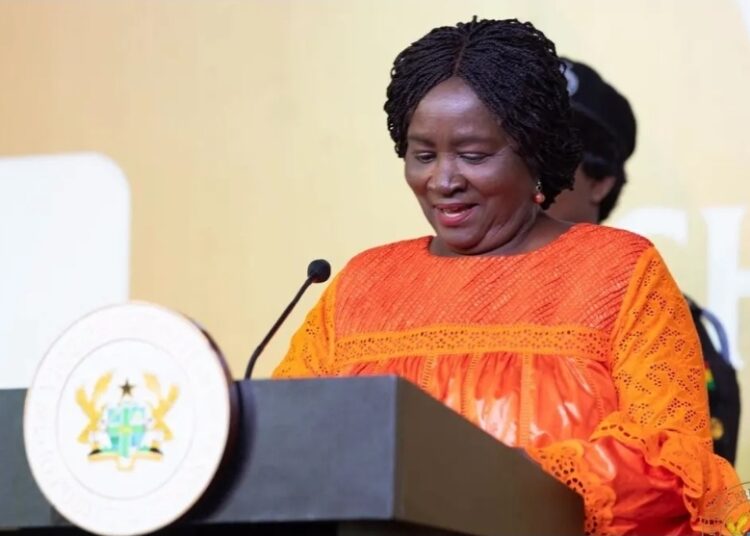
Vice-President Professor Jane Naana Opoku-Agyemang
Her remarks highlighted the relationship between early education and long-term workforce development, particularly as Ghana seeks to strengthen domestic production and expand its industrial capacity. She further urged the Ministry of Education, led by Minister Haruna Iddrisu, to coordinate implementation effectively, build on successful interventions and address existing gaps without unnecessarily duplicating programmes.
The Vice President called for continuous monitoring of learning outcomes to identify schools and learners requiring additional support and ensure that implementation strategies respond to emerging challenges.
New National Framework Introduced to Guide Implementation
The launch featured the unveiling of the Foundational Learning Ecosystem Framework and accompanying strategic documents, alongside the handover of learning materials and inauguration of the National Foundational Learning Working Group. A National Foundational Learning Compact was also signed to reinforce stakeholder commitment to the agenda.
The two-day event is expected to strengthen coordination among government institutions, teachers, parents, researchers and development partners in advancing the country’s foundational education priorities. The National Foundational Learning Working Group is expected to support coordination and collaboration among relevant stakeholders, while the accompanying framework provides a structure for aligning interventions towards shared learning outcomes.
Prof. Opoku-Agyemang urged education authorities and development partners to sustain their commitment to implementation, stressing that achieving the 2030 target would require consistent monitoring, institutional cooperation and adequate support for schools and teachers. The 2026–2040 agenda ultimately seeks to establish stronger educational foundations for Ghanaian children, ensuring that essential skills acquired during the early years translate into improved academic performance and greater opportunities throughout their lives.
READ ALSO: GNPC Targets Greater Control Across Ghana’s Petroleum Industry