The Executive Director of the Peasant Farmers Association of Ghana, Bismark Nortey, has raised concerns over the government’s delivery of agricultural commitments in the 2026 Budget, warning that farmers have not experienced the improvements promised in roads, irrigation, mechanisation and livelihood support.
Speaking on farmers’ expectations ahead of the upcoming budget and the proposed “New Economy”, Nortey argued that weak implementation has left producers grappling with low incomes, mounting post-harvest losses and unsold produce, despite improvements in the country’s macroeconomic outlook.
“Farmers have arguably benefited the least from the country’s economic recovery, as many continue to struggle with low incomes, unsold produce and persistent challenges in the agricultural sector.”
Executive Director of the Peasant Farmers Association of Ghana, Bismark Nortey
Nortey explained that the upcoming 2026 Budget had raised expectations among farmers because it outlined several interventions intended to strengthen agricultural production and protect livelihoods. These included improved roads in farming communities, mechanisation equipment, expanded irrigation infrastructure and measures to support farmers.
However, he maintained that implementation had fallen short of the commitments presented by the finance minister, leaving longstanding challenges unresolved and worsening conditions for some producers.
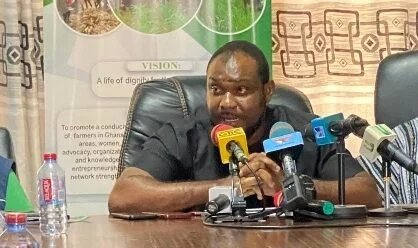
He observed that although the government had been credited with maintaining relative macroeconomic stability, farmers had struggled to benefit from the turnaround.
According to him, low market prices and high post-harvest losses had significantly reduced incomes, while many producers remained unable to sell their harvests.
Agricultural roads and service centres lag behind
A major concern for the association is the slow progress on the proposed construction of about 1,000 kilometres of roads in farming communities. Nortey questioned whether the promised roads had been built and whether the government’s Feed Yourself programme and related interventions had moved beyond the planning stage.
He disclosed that work undertaken by the association showed limited progress in road construction as of September 2026. He was particularly concerned that the Ministries of Finance, Food and Agriculture, and Roads had identified roads for the interventions only about nine months after the budget presentation.
With the year approaching its end, he had expected at least 800 kilometres of the planned roads to have been completed, leaving fewer than 200 kilometres outstanding. However, he indicated that he had yet to see significant progress towards that target.
The association has also raised questions about the government’s commitment to establish 50 Farmer Service Centres. Nortey disclosed that, based on information available to him, only about 12 centres were under construction, making it unlikely that all 50 would be completed before the end of the year.

Irrigation projects and Pwalugu dam concerns
Nortey further identified delays in major irrigation infrastructure as another area requiring attention. He pointed to the Kpong and Vea irrigation schemes, alongside other large facilities earmarked for significant construction work, but indicated that progress appeared to have stalled.
He also expressed concern about the limited government interventions relating to the Pwalugu Multipurpose Dam, which he described as a major campaign promise.
For the association, these projects are important to improving agricultural productivity and reducing farmers’ vulnerability to changing conditions. Nortey’s assessment was that the government had not performed well in delivering several of the commitments outlined in the 2026 Budget.
Nkoko Nkitinkiti programme needs better targeting
Beyond infrastructure, Nortey questioned the implementation of the Nkoko Nkitinkiti programme, which he understood was designed to promote local poultry production and consumption.
Under the intended arrangement, government would identify poultry businesses and small and medium-sized enterprises for support with day-old chicks, vaccines and feed. After rearing the birds, the beneficiaries were expected to distribute them to selected households, which would rear some, consume others, sell some and repay the support.
However, he argued that the criteria used to select households did not always identify beneficiaries with the capacity to rear the birds and generate income. Consequently, some recipients consumed the poultry rather than using the support to build sustainable production.

He questioned the selection process and the orientation provided to beneficiaries, stressing that the programme’s purpose must be clearly communicated and understood.
“If the government plans to continue the programme, I think it should learn lessons from what happened this year,”
Executive Director of the Peasant Farmers Association of Ghana, Bismark Nortey
Nortey urged authorities to select beneficiaries more deliberately, prioritising those capable of adding value to the initiative while widening opportunities for others to benefit.
His concerns place implementation and accountability at the centre of farmers’ expectations for the upcoming budget and the proposed New Economy programme.
READ MORE: Eastern Region Targets 134,774 for Onchocerciasis Drug Campaign