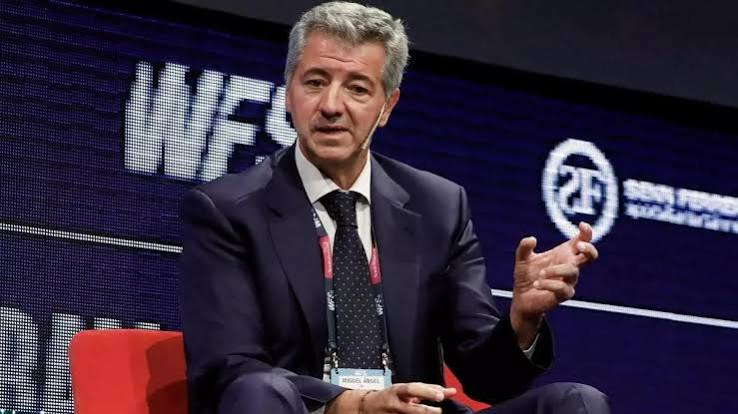
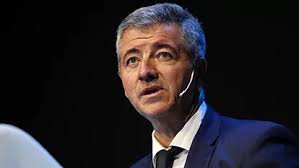
Atlético Madrid Chief Executive, Miguel Ángel Gil Marín, has resigned as LaLiga’s first vice-president and a member of its board amid growing tensions over the Spanish league’s alleged financial support for the Union of European Clubs (UEC).
Gil Marín announced his departure during Tuesday’s meeting of LaLiga clubs in Madrid, bringing an end to his near seven-year spell in one of the most influential positions within Spanish football’s governing structure.
His resignation comes against the backdrop of mounting dissatisfaction among Spanish clubs following revelations that LaLiga president Javier Tebas had been financing and driving the activities of the UEC, an organisation seeking to strengthen the representation of smaller and medium-sized clubs in European football.

Reports indicate that the financial support allegedly provided by LaLiga exceeds €1 million, with the development prompting considerable anger among clubs and raising questions about the league’s involvement in an organisation operating outside its domestic competition structure.
The circumstances surrounding Gil Marín’s departure have consequently attracted attention, particularly because of his involvement with both LaLiga and the European football organisations at the centre of the dispute.
Ownership Changes and Possible Explanation
The timing has also fuelled speculation about the relationship between Gil Marín’s resignation and Atlético Madrid’s recent ownership restructuring.
In November 2025, Atlético Madrid announced an agreement with Apollo Sports Capital to become the club’s majority shareholder. The investment was designed to support the club’s long-term development, with Gil Marín expected to remain chief executive and continue playing a leading role in its administration.
LaLiga is expected to present the departure as an administrative consequence of the ownership changes at Atlético Madrid, rather than an outcome of disagreements over the UEC funding.

However, no definitive public explanation linking the resignation exclusively to the change in ownership had emerged at the time of reporting.
The distinction is significant because Gil Marín had occupied the first vice-presidency since March 2020, following the departure of Clemente Villaverde. He also served on LaLiga’s Delegated Commission, an influential body involved in the organisation’s decision-making.
His departure therefore represents a notable change in the league’s leadership structure.
Clubs Consider Their Next Move
The controversy extends beyond the circumstances of Gil Marín’s resignation, with the alleged funding arrangement raising questions about transparency, governance and the use of LaLiga’s financial resources.
The UEC was established in 2023 to represent clubs seeking a more balanced distribution of revenues and greater influence in European football governance. It argues that the existing structures give established European giants disproportionate influence over decisions affecting the wider football pyramid.
The organisation has 138 member clubs across 22 countries, while the European Football Clubs (EFC), formerly known as the European Club Association, represents more than 900 clubs.
The distinction between the two organisations is particularly relevant because Gil Marín sits on the executive committee of EFC, placing him in a prominent position within an organisation whose interests are central to the debate over European club representation.
The tensions have also developed alongside a broader dispute over football governance. On November 16, the UEC lodged a formal complaint with the European Commission, alleging that UEFA’s agreement with EFC breached European Union competition rules by giving the latter excessive influence over key decisions in European club football.
Meanwhile, Spanish clubs are reportedly examining their legal options following Tebas’ admission about his involvement in the UEC and the alleged financial backing provided by LaLiga. The extent of any potential legal action remains unclear, but the growing dissatisfaction could place further pressure on the league’s leadership.
Gil Marín’s resignation now adds another dimension to an already sensitive dispute, with questions likely to persist over the justification for the funding, the decision-making process behind it and whether LaLiga’s resources were appropriately deployed.
For Tebas, who has maintained a strong position within Spanish football administration, the growing discontent presents a potentially difficult challenge as clubs seek greater clarity over the league’s relationship with the UEC.
The coming days could prove crucial in determining whether Gil Marín’s exit remains an isolated development or signals a wider breakdown in confidence among LaLiga’s member clubs.
READ ALSO: Fitch Warns $5.05bn Debt Repayments Could Trigger Cedi Slump in 2027