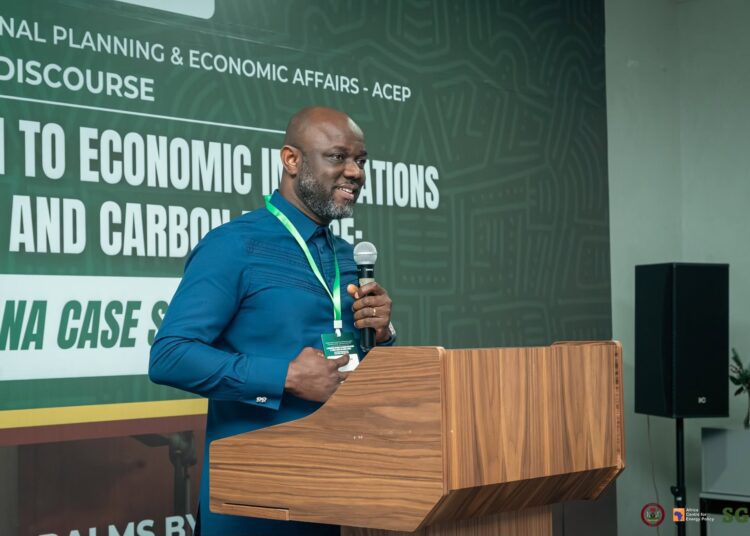
Benjamin Boakye, Executive Director of the Africa Centre for Energy Policy (ACEP), has called on authorities to publicly disclose the tax contributions of every operator across Ghana’s gold value chain.
The demand seeks to establish an unambiguous empirical record of how much financial value the nation retains from its bullion sector and identify which specific industry participants account for those fiscal inflows.
Expanding on his call for radical fiscal transparency, Mr. Boakye argued that corporate social responsibility initiatives and localized community projects must never be treated as substitutes for statutory tax obligations or used to cloud public audits of mining revenues.
He maintained that the state should retain sole responsibility for designing and executing national development priorities, while extractive firms focus on fulfilling their tax duties and strengthening domestic supply chains through local procurement and indigenous participation.
“Perhaps we should publish the tax contributions of all participants in the gold value chain to provide a clearer picture of how much value Ghana captures from its gold and from whom. If we want to know whether Ghana is getting enough from its gold, we must be prepared to interrogate the numbers and understand what it takes to engage in mining.”
Benjamin Boakye
Closing the Information Gap Across Ghana’s Bullion Ecosystem
Ghana’s gold industry has experienced historic export growth, yet public visibility into disaggregated tax payments remains fragmented across the production, aggregation, refining, and export tiers.
According to Bank of Ghana economic data, gold generated US$20.9 billion in export earnings between January and October 2026 alone accounting for more than two-thirds of the country’s record US$30.4 billion total export receipts over the ten-month period.
Similarly, the Ghana Gold Board (GoldBod) recorded US$11.6 billion in artisanal and small-scale mining (ASM) gold exports by late October 2026, underscoring the massive scale of capital moving through both large-scale multinational mines and domestic small-scale aggregators.

Despite these surging export volumes, reconciled fiscal reporting has historically lagged behind real-time trade flows.
Reports from the Ghana Extractive Industries Transparency Initiative (GHEITI) show that while the extractive sector accounts for roughly two-thirds of merchandise exports, its direct contribution to total government revenue hovers near 10 percent.
Publishing granular, entity-by-entity tax data across mining leaseholders, licensed gold buyers, refineries, and service contractors would allow policymakers and citizens to verify whether statutory royalties, corporate income taxes, and withholding levies match production output.
Separating Fiscal Accountability from Social Licence Spending
A central pillar of Mr. Boakye’s intervention addresses the growing tendency within the extractive industry to conflate voluntary community spending with statutory fiscal compliance.
In mining host districts across the Western, Ashanti, and Oti regions, companies routinely publicize investments in clinics, boreholes, and scholarships as evidence of national economic impact.
While acknowledging that such interventions help firms secure operational goodwill, the ACEP Executive Director warned against allowing discretionary projects to distort public accounting.

“Community investments are important for maintaining a social licence to operate, but they should not obscure, complicate or substitute for a clear assessment of the fiscal contribution,” Mr. Boakye stated, emphasizing that “the primary responsibility of mining companies is to pay their taxes and contribute to building a domestic value chain through local input sourcing and participation.”
By drawing a strict boundary between corporate philanthropy and treasury receipts, regulators can prevent companies from using localized social projects to bargain for tax exemptions, stability agreements, or royalty concessions.
Anchoring Resource Governance in Empirical Rigor
Beyond demanding open tax ledgers, the policy recommendation challenges both state regulators and civil society critics to ground resource nationalism in rigorous financial analysis rather than political rhetoric.
Interrogation of the gold value chain requires balancing revenue mobilization against the capital intensity, geological risk, and rising operational costs inherent in modern extraction.
When tax records are shrouded in confidentiality clauses, public debate frequently oscillates between unsubstantiated accusations of illicit capital flight and unchecked industry claims of excessive taxation.

As Mr. Boakye noted, determining whether the country captures an equitable share of its mineral endowment demands a willingness to “interrogate the numbers and understand what it takes to engage in mining.”
Transparent publication of disaggregated tax filings spanning corporate income taxes, mineral royalties, dividend payments, and local content procurement spend would equip Parliament, the Ghana Revenue Authority, and independent researchers with the baseline evidence needed to calibrate fiscal regimes.
Ultimately, institutionalizing full-chain tax disclosure remains essential to converting Ghana’s multi-billion-dollar gold output into verifiable, state-led economic transformation.
READ ALSO: Six in Ten Women in DRC Report Rising Abuse Amid Ebola Outbreak — UNICEF