The Chinese government has put in place strict Covid- 19 sanctions and measures in a district in Zhengzhou city which is home to the largest iPhone factory in China.
The lockdown is set to last for seven days and this may affect the production of the new iPhone 14 which is made at Foxconn’s plant in the city, as well as other Chinese businesses. This has caused business owners and citizens to grapple with the President’s rigid zero-Covid policy.
According to BBC, the local authorities of China declared the lockdown of the Zhengzhou Airport Economy Zone which was ending on November 9th, 2022. As a result of this lockdown process, public transport has been suspended and people have been advised to work from home according to an official notice that was given on social media.
Officials of China noted that they would “resolutely crack down on all kinds of violations and regulations.” Thus, sanctions will be met by people who defile or violate the regulations put in place.
Zhengzhou is a capital city in the central part of China, and home to about 10 million people.
Zero Covid Strategy Affecting Chinese
China remains one of the countries that is still affected by the pandemic and as a result, officials of the country have implemented a “Dynamic zero-Covid” strategy. The People of the Republic of China have expressed their displeasure with this policy, and this may affect Xi Jiping’s political motives as well.
The President and his officials’ motive behind the Dynamic zero-Covid strategy is to have China in a stable and top state when delegates meet in the capital, Beijing to usher Xi Jiping into a historic third term of power. The people of China have been confined to their homes due to the imposition of the lockdown across the country and this is putting political pressure on the President of the Republic of China.
Hospitals have fortunately not been swamped due to the strict lockdowns, mass testing, constant scanning of health codes and travel restrictions, but this came at a cost of the increase in youth unemployment.
Despite this massive economic and societal pressure, the government still refuses to resort to the one thing that may quicken the termination of the crisis- vaccination. The government of China has failed to push people to take the vaccinations, limiting its vaccines to only locally produced ones, which are not as effective as the ones produced internationally.
Although the country is getting by normally, nearly a fifth of the people are one way or the other confined in one place and their livelihoods seem to be slowly deteriorating. China’s zero Covid strategy is affecting people in dire ways including difficulty in sourcing food and medicine.
The outbreak has also affected the famous Apple company, as workers of the company’s largest factory in China flee from the factory due to an outbreak of Covid 19 in the factory, although the number of cases of Covid in the factory have not been identified.
A worker who was able to flee complained about the conditions and said that “it was total chaos in the dormitories.” Workers also claimed that the areas around the plant were on lockdown for days and workers who tested positive for Covid were confined and subjected to daily testing and quarantines to try and contain the pandemic.
The Presidential Advisor on Health, Dr. Anthony Nsiah-Asare, has intimated that everything with regards to plans to establish and produce vaccines in the country is going very well.
According to Dr. Nsiah-Asare, the nation is very much on course with the timelines set for the vaccine manufacturing. He disclosed that the committee in charge has a timeline being followed on daily and weekly basis to ensure the project meets the set out completion time. “So far so good, we are working together with our development partners, GIZ and everything is going on well.”
“As I speak now, there is a group who are in town who are making sure that we have a bankable business plan for the facility to be put up. It’s a very expensive project so we need an amount of money. Government is not the one putting up the money. We want to use the private sector to bring in the money and government will facilitate everything for it [production] to happen.”
Dr. Anthony Nsiah-Asare
AstraZeneca Vaccine
Touching on the progress so far, he indicated that the committee is working together with BioNTech, the producers of Pfizer vaccine to ensure the project comes to fruition. He stated that the team visited the manufacturing company and took advantage to look at vaccination centres, manufacturing centres and also research and development centres because it does not want to just do “fill and finish” with the vaccine production but rather have one that will still be in existence in the next ten years.
The Presidential Health Advisor explained that this was done because if the nation wants to have its own vaccine, there should be very strong and robust research and development so that the nation can get the pathogens and develop it into the drug substance and the drug product. He disclosed that there is also the need to have a strong regulatory body like the Food and Drugs Authority (FDA) which is very strong but will see some improvement.
“So, we have done all those things and Ghana is working through the private sector. We are also there with the private sector that we want to start with, they’ve learnt and seen what is happening and what it involves.”
Dr. Anthony Nsiah-Asare
COVID-19 Vaccine
Vaccine manufacturing, serious and expensive
According to Dr. Nsiah-Asare, manufacturing of vaccines is a very serious, high intensive and expensive business. As such, he indicated that the nation must ensure that it has good manufacturing practices which when the vaccines are produced and the FDA releases it, it will be acceptable by the whole world, by the World Health Organization (WHO) who will give it qualification because the FDA has attested that it’s good.
“We hope that the market is so large. If you think only about your country, vaccines are very restricted drugs but if there are other countries; other low-middle income economies and developing countries who all buy from India, we are going to compete. We have to also look at the market.”
Dr. Anthony Nsiah-Asare
The Presidential Health Advisor averred that he strongly believes that Ghana should be a vaccination hub so that it can make its own vaccines not only for Ghana but for the sub region and Africa as a whole. He added that through this, he believes the nation can become self-sufficient in vaccines not only COVID vaccines but other vaccines.
France authorities have begun lifting COVID-19 restrictions, including mandatory outdoor mask-wearing today, Wednesday, February 2, 2022, in the country’s bid to ease citizens’ daily lives.
The decision has brought about difference of opinions, following the surge in COVID-19 case infection in the previous month.
Limits to audience capacity for concert halls, sporting matches among other events have also been removed.
In the case of home-working, authorities have said it is no longer mandated, however, it is still recommended.
The move begins a two-part relaxation of curbs announced at the end of January 2022, despite the country’s hard-hitting record levels of daily cases last month (January) and comes as England and Denmark are also easing their restrictions.
France “will be able to lift most of the restrictions taken to curb the epidemic in February” thanks to the new vaccination pass, which replaced the health pass, Prime Minister, Jean Castex said in January.
Since last month, proof of inoculation records has been required for the new passes, needed to access everything from bars and restaurants to long-distance public transport.
Previously, the health pass could also be obtained with a recent negative COVID-19 test, a possibility the government used in its quest to convince more people to get COVID jabs.
The second stage of the curb-lifting will see nightclubs, shut since December, reopen from February 16, 2022, and standing areas will again be allowed at concerts, sporting events and bars.
Eating and drinking will also be permitted in stadiums, cinemas and public transport from thereof.
Paris has not made the easing of restrictions conditional on the progress of the health situation.
Authorities view the threat of the Omicron variant as limited and less dangerous than previous strains of the virus, even though it is more contagious.
“We have seen a weak reversal of the trend over the past few days, with fewer cases declared each day than seven days earlier.”
Government Spokesman, Gabriel Attal, said in an interview with the media
France COVID-19 Situation
An average of 322,256 cases were recorded over the previous seven days, according to the latest figures, compared with 366,179 a week ago.
Attal called it a “very encouraging signal” but said officials “remain cautious” because of a “very contagious” sub-variant of Omicron that appears to have delayed the peak of infections in other countries.
France, by far, has recorded over 19 million cases of COVID-19 since the virus broke globally, with 120 thousand deaths.
About the Omicron Variant
On November 24, 2021, South Africa told the World Health Organization (WHO) that amid a recent increase in COVID-19 cases, it had identified a new variant, which was later named omicron.
The omicron variant contains a high number of mutations, raising concerns that it could spread more easily than other variants of the coronavirus.
Following this was South Africa’s health minister, Joe Phaahla, who said the variant had been identified in South Africa, Botswana and a person who had travelled from South Africa to Hong Kong.
The WHO on November 26, 2021, labelled it a “variant of concern,” meaning it could be associated with an increase in transmissibility or virulence or a decrease in the effectiveness of vaccines.
The National Insurance Commission (NIC) is on the verge of revoking the licences of some insurance companies that failed to meet the recapitalisation deadline set by the commission.
As a result, many Ghanaians who work in the affected insurance companies are set to lose their jobs.
By not meeting the new GH¢50 million capital requirement set by NIC, the insurance sector regulator noted that the companies have also failed to move their capital adequacy ratio (MCR) to 150%, as required by an earlier directive.
NIC has therefore, given the affected companies up to February 6, 2022, to cough up the funds or close their shops and hand over their operations.
The new directive, as communicated to the affected insurance companies, suggested that such companies are now on verge of collapse, mass layoffs, loss of investments and disruptions in a financial sector that is recovering from the recent clean-up exercise.
As an avenue for patient capital, the insurance sector employs thousands of people as permanent employees or contract staff or agents who sell insurance products.
Uncompromising Position of NIC and What the Law Says
According to Experts, the order to cease operation, which was signed by the Commissioner of Insurance, Dr Justice Ofori, and the uncompromising position of the NIC in the midst of the devastating effects of the COVID-19 pandemic on businesses, could cause panic among the insuring public, send hundreds back home, and worsen the hardship situation in the country.
Given the notice issued to the affected companies, the industry regulator indicated that the companies that were unable to raise the capital have breached Section 59 of the Insurance Act 2021 (Act 1061).
“Pursuant to Section 178 of the Insurance Act, the Commission, by this letter, issues a one-month notice of enforcement to [name withheld] effective January 12, 2022. For the purposes of protecting your policymakers, the entire insurance industry and the general public. You will be placed under enforcement with effect from February 10, 2022.”
NIC Notice
Affected Companies to Stop Selling Their Products
The notice further warned affected companies not to enter into new contracts with any class of business, renew any existing contracts, vary contracts or engage in any marketing activities. It also ordered the firms to stop their staff and agents from selling their products.
However, the notice added that payments must only be for claims, salaries, statutory requirements and other essential management expenses, but with prior approval from the NIC. “You are, however, required to service existing policies until expiry.”
It also warned the boards and management of the companies that they would be held liable for liabilities resulting from new contracts entered into.
The directive to insurance companies to recapitalise from GH¢15 million to GH¢50 million was issued in 2019 and meant to elapse in June 2021. It was, however, shifted to the end of January 2022 as a result of the impact of the COVID-19 pandemic on businesses.
The new directive will raise the stakes on the impact of joblessness and disruptions to the insurance sector and the financial sector in the country.
The Deputy General Secretary of the Ghana Medical Association (GMA), Dr. Titus Beyuo, has intimated that his outfit is, drawing the attention of the various authorities to prosecute persons who flouted the COVID-19 protocols at Sir John’s funeral.
Speaking in an interview, he stated that the GMA’s main concern has to do with the fact that, the footages from the event circulating shows that there was complete disregard for the COVID protocols.
“To the extent that people have been prosecuted for flouting this rule, we thought that we needed to draw attention of the authorities to investigate and prosecute anybody found culpable for the event that took place.
“At the initial stage, we saw what looked like some observance of the protocols. But as the program went on, the number of people exceeded the two metres allocation and the program went beyond the time frame.”
Dr. Beyuo
The gathering at the Late Sir John’s funeral
The Ghana Medical Association (GMA) yesterday, June 8, 2021 in a statement expressed disappointment over the total disregard for COVlD-19 protocols during the final funeral rites of the former Chief Executive officer of the Forestry Commission of Ghana, Lawyer Kwadwo Owusu Afriyie also known as Sir John.
Dr. Beyuo further averred that since social distancing was not observed, it makes the event a super spreader of the virus. He further described the violation of COVID protocols as unacceptable.
“Remember you don’t need the entire program to spread this pandemic. If you get such number of people gathered without many people wearing mask [and with] no observance of social distancing, the risk of transmission is high. And this program went on for more than two hours, so you can imagine the risk.”
Dr. Beyuo
Large gatherings could result in another surge
Moreover, Dr. Beyuo stated that such gatherings could result in the surge of the virus as it happened in early months of the year. He attributed the surge in January and February to all events that occurred during the Election and Christmas period.
“From the point of view of the epidemiological association,;if you follow the period in which political activities took place, you will know the rate of spread of this pandemic. So, if you get a surge at a certain time, you can play back to when the transmission is taking place that allowed the disease to propagate.”
Dr. Beyuo
Touching on the new surge of the virus as warned by the WHO, he indicated that,;the virus may spread based on the fact that a low population of African countries have been vaccinated. He also noted that most African countries have not been able to vaccinate more than 2.2% of its population,;which puts citizens at a higher risk.
“According to the WHO, this new surge may spread and they are also appealing for people to donate vaccines to Africa so that we can also vaccinate our population. So, with this in the background and with the effort government is making and not getting vaccines for everyone,;it is unconscionable that we will throw our own protocols to the dogs and then do whatever we want.” prosecute
A group of more than 170 former world leaders and Nobel laureates has called on US President, Joe Biden, to waive US intellectual property rules in order to make COVID-19 vaccines more readily available to the rest of the world.
In an open letter shared by Oxfam, the signatories also urged Biden to support a proposal spearheaded by South Africa and India, demanding for the World Trade Organization (WTO) to temporarily waive COVID-19 vaccine patents.
The measure, the group says, would allow vaccine manufacturing to ramp up globally as public health experts have raised concerns that low-income countries are left behind without access to critical coronavirus jabs.
“At the current rate, the world’s poorest nations will have to wait until at least 2024 to reach mass immunization. We believe this would be an unparalleled opportunity for the US to exercise solidarity, cooperation and renewed leadership.”
The signatories of the letter include former UK Prime Minister, Gordon Brown, ex-French President, François Hollande and Muhammad Yunus, winner of the Nobel Peace Prize.
In an Oxfam statement accompanying the group’s open letter, Nobel laureate in medicine,;Françoise Barré-Sinoussi suggested that waiving the patent is the only way to end the pandemic.
“We will not end today’s global pandemic until rich countries;– most especially the US – stop blocking the ability of countries around the world to mass produce safe and effective vaccines.”
Hollande, the former French president, was also hopeful that “the Biden administration is considering waiving patents”.
“That the Biden administration is considering waiving barriers related to intellectual property rules offers hope for the international community. If the United States supports the lifting of patents, Europe will have to take its responsibilities.”
Opposition to patent waiving
A vaccine patent waiver would allow WTO members to suspend the intellectual property rights;currently enjoyed by the likes of Pfizer, Moderna, and Johnson & Johnson, enabling developing countries to produce vaccines and treatments;without fear of reprisal.
Last year, South Africa and India submitted a proposal to the WTO;seeking such a suspension “until widespread vaccination is in place globally.”
However, resistance to the proposal has been fierce. In March, the US, UK, and the European Union all voted to block such a waiver from being granted. They argued that they need to preserve an economic incentive for the development of new medical technologies.
Biden, who has made tackling the pandemic a central goal of his presidency, has said the US would share any surplus of vaccines with other countries;once all US citizens are vaccinated.
Countries say they are assisting gloal vaccination through COVAX scheme.
The US Chamber of Commerce also called such proposals “misguided” and a “distraction” from efforts already underway to share vaccines with the developing world. America has already committed $4bn to the COVAX programme, which aims to help lower-income countries acquire vaccines.
The International Federation of Pharmaceutical Manufacturers & Associations likewise argued that a waiving of IP protections would be “counterproductive,” undermine confidence in a for-profit system that helped develop several highly effective vaccines. world leaders
The 8th Bioenergy Week and Study Tour for Capacity Building forum has concluded its three-day deliberations, calling for strong engagement of the private sector in bioenergy investment
Panelists at the forum expressed the need for bold measures to boost investments in sustainable bioenergy. And the bioenergy supply value chain development with the private sector at the heart.
The forum was convened virtually. And in participation were high-level speakers across governments, African Union, United Nations, leading policy influencers, innovators, the private sector and investors.
The organization of the forum was by the Global Bioenergy Partnership (GBEP). In collaboration with the United Nations Economic Commission for Africa (UNECA), the Food and Agriculture Organization of the United Nations (FAO) and the African Energy Commission (AREC) of the African Union Commission.
The discussants dialogued on existing and emerging issues relating to bioenergy. Focus directed towards ways of fully unlocking the potential of renewable energies in Africa.
The state of Bioenergy in Africa
The demand and use of energy is a growing phenomenon in Africa, owing to several factors. These include population growth, economic development, industrialization, climate change and trade.
However, there still remains majority of African countries who do not have access to modern energy services. Bioenergy serves as a source of energy for households and industries. Nonetheless, its current use is mainly within unsustainable systems which have negative impacts on lives and livelihoods.
The Covid-19 pandemic has made it even the more urgent, to address the deficit in access in Africa. Without secure and reliable power supply, health systems cannot function optimally as well as other related infrastructure.
To build back better, African economies need to prioritize facilitating the development of the bioenergy sector in Africa.
Notable addresses at the Forum
UNECA’s Executive Secretary, Vera Songwe, represented by William Lugemwa, Director of the Private Sector Development and Finance Division, addressed the event.
She highlighted the role the renewable energy sector plays in a Covid-affected world. Specifically, she adduced that the renewable energy sector plays a major role in leading the fight against the devastating effect of the Covid-19 pandemic. Also, other crisis situations through strategic investments in sustainable energy.
“Access to reliable and sustainable energy is a crucial need. And is even more important today for supporting essential services during the time of crises. Africa’s private sector would be central in leading the much-needed ambitious energy transition,” she noted.
Other addresses at the forum
Furthermore, David Phiri, FAO Sub-regional Coordinator for Eastern Africa and Representative to the AU and UNECA indicated that, currently food systems consume 30 percent of the world’s energy.
However, there is a gradual move towards a period where more food will need to be delivered with less and cleaner energy, he argued. Therefore, sustainable energy sources are important in achieving food security and better nutrition.
“Among the sustainable development goals (SDGs) to be reached by 2030, the world has committed to ensuring access to affordable, reliable, sustainable and modern energy for all, under SDG7.
“It is worth mentioning that FAO takes SDG7 seriously. As it considers the key enabling role of energy in achieving food security and better nutrition. Thus, contributing to the attainment of the SDG2 on Zero Hunger. Moreover, energy prices influence food prices directly,” he stressed.
Luiz Eduardo de Aguiar Villarihno-Pedroso, the Ambassador of Brazil to Ethiopia and representative of the GBEP co-Chair commended Africa on the tremendous efforts directed towards increasing energy supply to its populations and economies.
“The government of Brazil will continue to support African nations to access affordable, reliable, sustainable, and modern energy. To enable them drive their socio-economic development as foreseen in the SDG7. An agenda where bioenergy plays an essential role in ensuring that this goal is achieved,” he added.
Also, Amani Abou-Zeid, Commissioner for Infrastructure and Energy at the African Union Commission highlighted the advantages of using renewable energies. He underscored the fact that renewable energies are cost-effective, viable and an attractive option to tackling climate change.
The lies about this COVID-19 vaccine are just too much
Typically, conspiracy theories start off benefiting a clear side. In the case, I dare say most of us peddling lies about this COVID vaccine are merely mal-articulating their innate fears and concerns as well-thought out concepts in an effort to keep up appearances as not quaking in their boots. Their so-called “evidence” is forced, desperate and made to fit some story they need you to believe in order for them to fully believe. COVID-19 vaccine
But facts will remain facts whether we accept them or not. Luckily, accurate data can nowadays almost instantly be confirmed through one google search and a quick read on a trusted website, like that of the WHO.
Still, these lies exist because even after you systematically prove them wrong, you are seen as being part of the conspiracy, leaving you a slim chance of making your case successfully. Even this article will have some pushback and be seen as propaganda towards a certain agenda. I know because when I asked a few people I know to go get the vaccine, they asked if they’ll get the “real” vaccine from America, the fruit juice that was pumped into Nana Akufo-Addo’s arm or the synthetic version they sent to Ghana. Kim said that. Stanley and Wilfred also said similar.
How do I even respond to something like that?!
Social media especially has been a very efficient channel for those spreading lies about these COVID-19 vaccines that Ghana has been very lucky to have. Many more people around you have or have had COVID-19 but you just don’t know it. They just won’t tell you. Everyone suddenly has malaria now smh.
Last week, I was a speaker in the ever-popular Ghanaian Lounge Clubhouse Room with moderators like Bev Danquah, Moe Diggs, Kumi, Kwadwo Benko and a couple others. I believe that was the first time I had witness the concerns and worries about this COVID-19 vaccine being discussed on social media in an unbiased manner.
How do we stop spreading these lies?
The key to stopping the spread of misinformation is through education and awareness. Read this whole article and educate yourself. Afterwards, be aware of the lies out there and do not be quick to take in any data from just anywhere as true. Verify things for yourself. Your life might actually depend on it.
I will admit that there’s no sure way to identify and curb all the misleading information out there. The hardest part is that those perpetuating these lies are mostly friends and family who have been already mislead and scared to believe a couple “if’s”.
“What if I grow a tail when I get this new vaccine?”COVID-19 vaccine
Well what if you die if you don’t take this COVID vaccine? Because yeah, you might just die just like millions of other people have. It is the best chance you have to protect you and your loved ones from a pandemic that has killed so many people like you across the world and continue to spread very quickly in Ghana.
Read the full article and educate yourself on what COVAX is, how the Oxford-AstraZeneca works, and even more reasons to be more afraid of not taking the vaccine than you should be about taking it.
The AstraZeneca vaccine was given Emergency Use Listing (EUL) by the WHO this month. AstraZeneca and SII will together work with the COVAX facility to begin supplying the vaccine globally.
Under the COVAX program, over 2 billion doses of COVID-19 vaccines are expected to be delivered by the end of 2021.
What is COVAX?
The COVAX program is led by the vaccine alliance GAVI, the World Health Organisation (WHO) and the Coalition for Epidemic Preparedness Innovations (CEPI) in partnership with UNICEF, vaccine manufacturers and the World Bank, among others. The aim is to ensure equitable distribution of COVID-19 vaccines globally in what is being called the largest vaccine procurement and supply operation in history.
The program wants to vaccinate roughly 20 per cent of the population in the 92 Advance Market Commitment (AMC) countries, which include middle and lower-income nations that cannot afford to pay for COVID-19 vaccines. This means countries with a Gross National Income (GNI) per capita of less than US $4000 and some other countries which are eligible under the World Bank International Development Association (IDA).
As vaccines receive approval, they will be bought by the COVAX facility, which will then try to provide the doses for an average of 20% of each of the eligible country’s population free of cost. Out of its target of 2 billion vaccine doses, 1.3 billion doses will be delivered to the AMC countries.
The funding target for this program for 2021 is about US $6.8 billion, of which it has raised about US $4 billion. The funding is partly coming from high and middle-income countries that will also receive a share of the vaccines produced for COVAX. The US has pledged to give US $2 billion to COVAX and make available further funding of $2 billion over the course of the next two years.
An editorial published in the journal Nature in January said that COVAX is key to vaccinating the world’s poorest people and ending the pandemic.
Which vaccines are included in COVAX programme?COVID-19 vaccine
Oxford-AstraZeneca became the first vaccine manufacturer to sign up under the programme in June 2020, and has guaranteed to supply 300 million doses. In January, COVAX announced that it had signed an agreement with Pfizer-BioNTech to purchase up to 40 million doses of their vaccine. In addition, the program has a Memorandum of Understanding (MoU) with Johnson and Johnson for 500 million doses of their single-dose vaccine, which the US Food and Drug Administration (FDA) declared to be safe and effective recently. COVAX also has existing agreements with SII for 200 million doses.
Why you should get the COVID-19 Vaccine
We understand that some people may be concerned about getting vaccinated now that COVID-19 vaccines are available in Ghana. While more COVID-19 vaccines are being developed as quickly as possible, routine processes and procedures remain in place to ensure the safety of any vaccine that is authorized or approved for use. Safety is a top priority, and there are many reasons to get vaccinated.
Can a COVID-19 vaccine make me sick with COVID-19?
No. None of the COVID-19 vaccines contain the live virus that causes COVID-19 so a COVID-19 vaccine cannot make you sick with COVID-19.
Below is a summary of the benefits of COVID-19 vaccination based on what we currently know.
COVID-19 vaccination will help keep you from getting COVID-19
The COVID-19 vaccine currently available in Ghana has been shown to be highly effective at preventing COVID-19.
All COVID-19 vaccines that are in development are being carefully evaluated in clinical trials and will be authorized or approved only if they make it substantially less likely you’ll get COVID-19.
Based on what we know about vaccines for other diseases and early data from clinical trials, experts believe that getting a COVID-19 vaccine may also help keep you from getting seriously ill even if you do get COVID-19.
Getting vaccinated yourself may also protect people around you, particularly people at increased risk for severe illness from COVID-19.
Experts continue to conduct more studies about the effect of COVID-19 vaccination on severity of illness from COVID-19, as well as its ability to keep people from spreading the virus that causes COVID-19.
COVID-19 vaccination is a safer way to help build protection
COVID-19 can have serious, life-threatening complications, and there is no way to know how COVID-19 will affect you. And if you get sick, you could spread the disease to friends, family, and others around you.
Clinical trials of all vaccines must first show they are safe and effective before any vaccine can be authorized or approved for use, including COVID-19 vaccines. The known and potential benefits of a COVID-19 vaccine must outweigh the known and potential risks of the vaccine for use under what is known as an Emergency Use Authorization (EUA).
Getting COVID-19 may offer some natural protection, known as immunity. Current evidence suggests that reinfection with the virus that causes COVID-19 is uncommon in the 90 days after initial infection. However, experts don’t know for sure how long this protection lasts, and the risk of severe illness and death from COVID-19 far outweighs any benefits of natural immunity. COVID-19 vaccination will help protect you by creating an antibody (immune system) response without having to experience sickness.
Both natural immunity and immunity produced by a vaccine are important parts of COVID-19 disease that experts are trying to learn more about.
COVID-19 vaccination will be an important tool to help stop the pandemic
Wearing masks and social distancing help reduce your chance of being exposed to the virus or spreading it to others, but these measures are not enough. Vaccines will work with your immune system so it will be ready to fight the virus if you are exposed.
The combination of getting vaccinated and following WHO’s recommendations to protect yourself and others will offer the best protection from COVID-19.
References
National Center for Immunization and Respiratory Diseases (NCIRD), Division of Viral Diseases (2021), Benefits of Getting a COVID-19 Vaccine, accessed 5th March 2021, <https://www.cdc.gov/coronavirus/2019-ncov/vaccines/vaccine-benefits.html>.
The Indian Express Explain Desk (2021), Explained: What is COVAX, the scheme to distribute Covid-19 vaccines around the world?, accessed 5th March 2021, <https://indianexpress.com/article/explained/explained-covax-scheme-to-distribute-covid-19-vaccines-around-the-world-7204738/>.
Maxwell Ampong is an Agro-Commodities Trader and the CEO of Maxwell Investments Group. He is also the Official Business Advisor to Ghana’s General Agricultural Workers Union (GAWU) of TUC Ghana, the largest agricultural trade union in Ghana. He writes about trending and relevant economic topics, and general perspective pieces.
Ghanaian reggae artist and media personality, Blakk Rasta, has asserted that it is an unwise decision for Ghanaian leaders to be jubilating over the free COVID- 19 vaccines that is currently being administered.
Speaking on an Accra-based radio station, Blakk Rasta further registered his displeasure stating that Ghana as a country is not “serious”, since the country is always interested in receiving aid rather than also looking for avenues to be of help to others.
“I think it’s a useless thing…that is the unwise country we live in and it’s quite unfortunate. COVID vaccines are in and we are jubilating; it tells you how unwise a country this is. Last year you were talking about this herb and how potent it was in killing the coronavirus. All of a sudden, you have boxed it… and you are hailing something that is from another country that racked its brains to make these vaccines. I think that we are not being serious as a country. I think that we are a country that is always receptive and never giving. We always want to receive and never give. Is it not a shame that my children and children’s children will grow up in a country that is tagged as a very poor country?”
Blakk Rasta
Blakk Rasta continued to fume about the current state of the country emphasizing that if Ghana has been “impoverished”, then it is through the actions of the Ghanaian leaders.
“How can you say you are poor when you have gold and diamond? How can you say you are poor when you’ve discovered oil? If you were a poor country, will all these Chinese and Indians be rushing into this country? It hurts me so much that I live in this country, with brainless people.
“You call me a poor country, a country that has a King sitting on top of gold, and we call him ‘Otumfour oti korkorsu Nana’. It’s sad that we all don’t care about the poor country label that is slapped on us, I feel sad”.
Blakk Rasta
Ghanaian artist and media personality, Blakk Rasta.
When asked if the leaders in Ghana are leading properly, he answered in the negative noting that there are so many unresolved issues such as the ‘Agyapa’ deal. According to him, it a “shame” as well as “a scum of leadership”.
“When you have old men and old women in power that is what happens. In this country you can never be president till you are old and dying…we believe amongst us that the old are wiser. They forget that fools also grow old”.
Blakk Rasta
He further lamented that since Nana Addo became the President, he has shown no concerns about human rights, and the responsibilities of safeguarding the ordinary citizen seem to be the least of his problems.
Recall that it was earlier reported by The Vaultz Media (TVM), that Ghana received 600,000 COVID-19 vaccine doses and this raised several controversies, when some American publication firm, touted Ghana as one of the poorest countries in the world.
That notwithstanding, this morning the President, Vice President, and some other government officials took their jabs of the COVID-19 vaccines.
The impact of the COVID-19 pandemic on various economies will definitely go down in history to have been a period full of economic mysteries than any other period— especially in comparison to the 2007/2008 global financial crisis, although triggered by different proximate causes.
The fast spread of the COVID-19 virus everywhere across the globe, early in 2020 was veiled with a plethora of uncertainties— ranging from the unknown cause of the virus to the unknown means of spread of the virus.
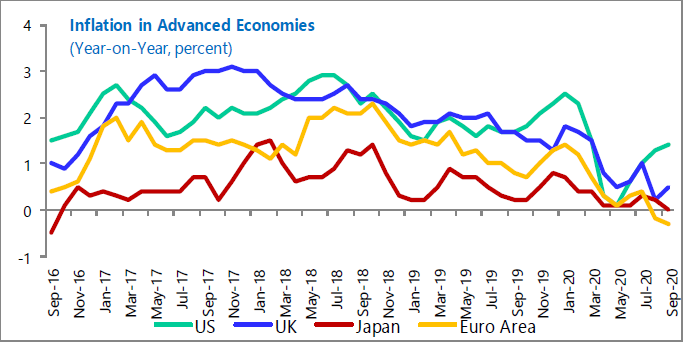
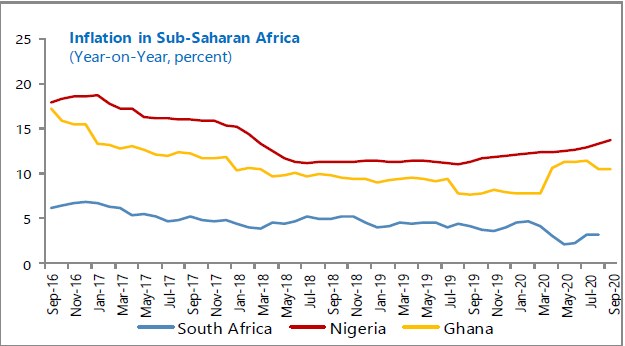
Although, these uncertainties lingered, one thing was certain; the possibilities of a slowdown in economic activity leading to a potential recession. While expectations of a recession in both the developed and developing world occurred as projected, inflation forecasts assumed divergent behaviors (i.e. average inflation rate kept falling below targets in developed economies like the US, and most of Europe and remained consistently above target in developing economies, especially in most sub-Saharan countries like Ghana) from March to September 2020.
Inflation Trends in Advanced Economies
Source: Bank of Ghana, Third Quarterly Bulletin 2021
Inflation Trends in Sub-Saharan Africa
Source: Bank of Ghana, Third Quarterly Bulletin 2020
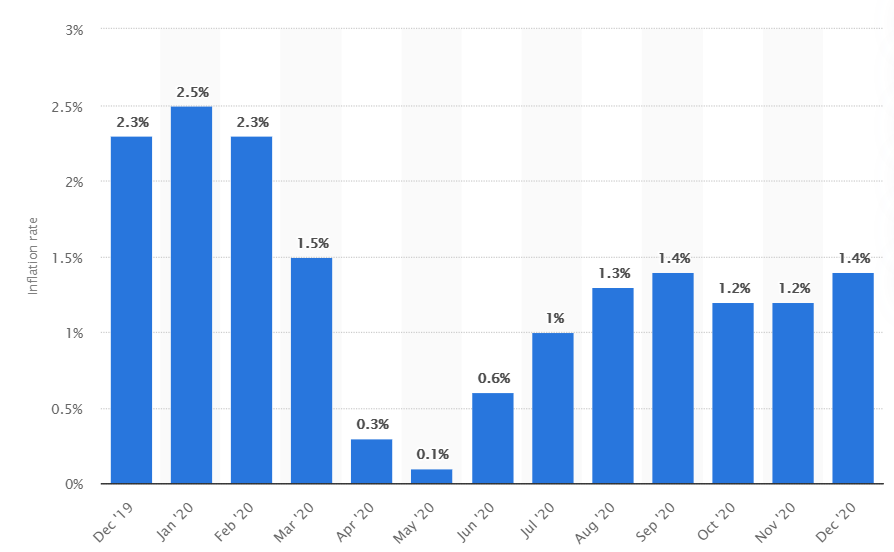
However, inflation kept falling in the US, Japan and Euro area, for example, even to negative rates (deflation) in some months when lockdowns were eased, especially in the Euro Area. US annual inflation rate fell in March 2020 by 1.5 percent and also to a near 0 percent in May 2020. Average inflation rate between March 2020 and September 2020 dropped by 0.9 percent, a figure below the Fed’s inflation target of 2 percent in September 2020.
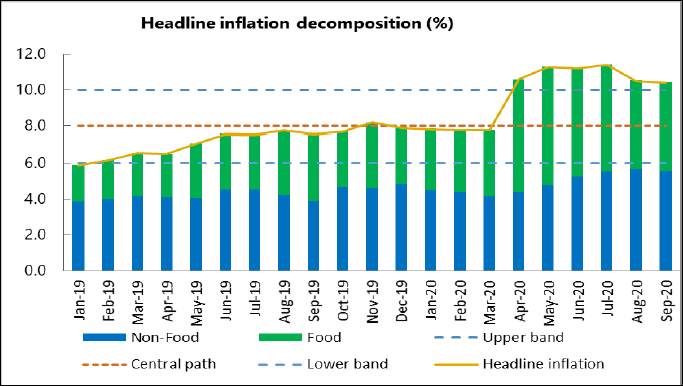
This was not so, compared with the behavior of inflation in Ghana. From the onset of the lockdown in March 2020 to September 2020, inflation trended upwards averaging 10.5 percent, a little above the higher band of 10 percent. Inflation rate increased to a record high of 11.4 percent in July 2020.
Obvious concerns during periods of recession just as last occurred during the 2007/2008 global financial crisis, warranted unusual responses from Central Bank’s and Governments, both in developed and developing economies. These actions were to stimulate the rather falling economic activity in those economies that were badly hit.
Similarly, in 2020, stimulus packages by governments were provided to support businesses and households, Central Banks trimmed down interest rates. The US Fed cut interest rates to zero while interest rate was eased to 14.5 percent by the Bank of Ghana among other monetary and fiscal responses. Therefore, almost similar actions were taken across the world to reduce the impact of the pandemic on economies. These responses coupled with the ease in lockdown triggered a gradual rebound in economic activity earlier than anticipated in Ghana and kept inflation still high, but not so for the US and other developed economies.
Chart of Inflation in the US
Source: Statista
Chart of Inflation in Ghana
Source: Bank of Ghana, Third Quarter Bulletin 2020
Again, we find divergent outcomes in trends of inflation and economic activity due to three major differences between the developed (US) and developing countries (Ghana) namely; expectations of inflation, structural factors and uncertainties due to resurgence of virus spread.
Inflation Expectations
The relation between inflation and economic activity declined due to inflation expectations. Although, monetary stimulus was high in the US, inflation expectations was relatively low due to the fact that inflation had stayed relatively low over the decade, hence, consumers anticipated that inflation would continue trending downwards. Also, this was due to the credibility of the Fed to keep short term interest rates below the inflation target. However, in Ghana, inflation was above the target largely due to the expected supply shocks when the lockdown was instituted. Albeit, after the lockdown was eased, these supply-side shocks persisted thus leading to moderately high expectations in inflation on the average.
Structural factors
The low inflation was also due to structural factors in the US. The dominance of market shares by large firms with high profit margins in developed economies meant that they could absorb higher costs without raising prices. Therefore, Covid-induced costs were largely not translated to consumers. However, in Ghana, where most businesses are mainly MSME’s, COVID induced costs were going to be transferred to consumers thus the averagely high inflation. Also, volatility in oil prices and supply shocks due to border closures contributed to the relatively high inflation rates. Also, the governments’ uncontrolled spending during the period after the lockdown also contributed to the moderately high inflation.
Resurgence of Virus spread
Uncertainties pertaining to the resurgence of the COVID-19 pandemic, and the unavailability of vaccines kept consumer spending low in developed economies thus leading to the persistent fall in prices. In developing economies such as Ghana, an ease in the lockdown was simply a time for hard-hit households to catch some breadth again by going about their activities without much expectation of a resurgence within the period after the lockdown was eased. While supply chains were disrupted, thus food materials were priced high during the period leading to the rise in inflation.
As the developed world gets vaccinated, uncertainties that surrounded the spread of the virus have begun to wane and thus economic activity has begun picking up. This trend is likely to increase prices, and even beyond target levels in the developed world. In developing countries, where COVID vaccines are yet to be made available, these difficulties highlighted are yet to be contained. Better handling of new strains of the COVID-19 virus and the arrival of the vaccine accompanied with prudent macroeconomic measures will lead to a much more stable inflation in 2021.