
• About
  • Advertise
  • Privacy Policy
  • Contact
Monday, May 11, 2026
  • Login
The Vaultz News
  • Top Stories
  • News
    • General News
    • Education
    • Health
    • Opinions
  • Economics
    • Economy
    • Finance
      • Banking
      • Insurance
      • Pension
    • Securities/Markets
  • Business
    • Agribusiness
    • Vaultz Business
    • Extractives/Energy
    • Real Estate
  • World
    • Africa
    • America
    • Europe
    • UK
    • USA
    • Asia
    • Around the Globe
  • Innovation
    • Technology
    • Wheels
  • Entertainment
  • 20MOBPL2DNew
  • Jobs & Scholarships
    • Job Vacancies
    • Scholarships
No Result
View All Result
The Vaultz News
  • Top Stories
  • News
    • General News
    • Education
    • Health
    • Opinions
  • Economics
    • Economy
    • Finance
      • Banking
      • Insurance
      • Pension
    • Securities/Markets
  • Business
    • Agribusiness
    • Vaultz Business
    • Extractives/Energy
    • Real Estate
  • World
    • Africa
    • America
    • Europe
    • UK
    • USA
    • Asia
    • Around the Globe
  • Innovation
    • Technology
    • Wheels
  • Entertainment
  • 20MOBPL2DNew
  • Jobs & Scholarships
    • Job Vacancies
    • Scholarships
No Result
View All Result
The Vaultz News
No Result
View All Result
in Africa

Ethiopian households to allocate nearly 35% of budget to food in 2025

M.Cby M.C
October 6, 2021
Reading Time: 3 mins read
Saudi

Ethiopian households will allocate a projected 34.8 per cent of their household budgets to food in 2025, a decrease when compared to 42.9 per cent in 2017, Fitch Solutions affirms.

This indicates a diversification of household budgets as Ethiopian consumers increase their spending on other items beside food. Ethiopia’s GDP per capita is projected to reach US$1,048 in 2025, increasing from US$721.

According to Fitch, Ethiopian consumer’s incomes are low, therefore making them price-sensitive, even when spending on food products.

Based on this, Fitch Solutions forecasts food spending to grow by an average of 18.7 per cent over a forecast period of 2017-2025. Compared with inflation, food spending is 2.7 per cent higher, as inflation forecast averages 15.4 per cent over 2017-2025.

ADVERTISEMENT

Moreover, Ethiopia’s food spending will mainly be concentrated on five food spending categories which are meat and poultry, bread, rice and cereals and fresh vegetables. This makes up 89 per cent of total food spending, increasing from 87.5 per cent in 2017.

“We project meat and poultry to make up 39.6 per cent of total food spending in 2025, increasing from 37.9 per cent in 2017 while fresh vegetables spending will increase to 15.5 per cent in 2025 from 14.3 per cent in 2017.”

Fitch

Meat is a key part of Ethiopia’s local diet. Spending for meat and poultry are forecast to reach US$12.3 billion in 2025 from US$7.9 billion in 2017. This represents an annual growth rate of 20.5 per cent over 2017-2025.
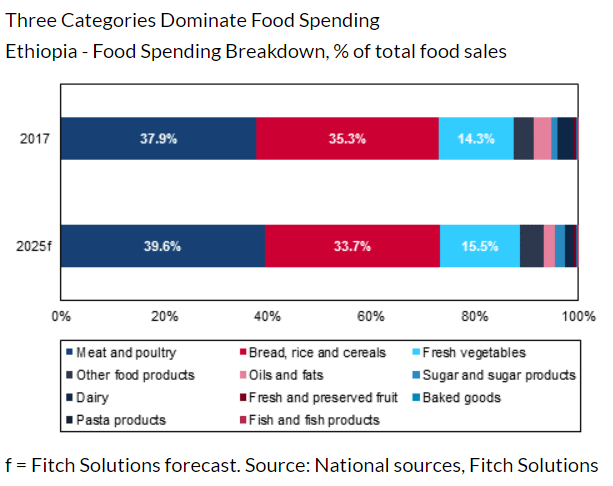
ethiopia
Source: Fitch Solutions
Staples to become popular food in 2025

Fitch projects poultry and pork to post the fastest spending growth over 2017-2025 with each of the categories expanding by 20.8 per cent. Spending on beef will also be strong, growing by 20.7 per cent over 2017-2025. 

Furthermore, staples in bread, rice and cereals category will remain highly popular due to their affordability reaching US$10.5 billion in 2025 from USD7.3billion in 2017. This indicates an average annual growth rate of 17.6 per cent.

However, growth within this category will be slower than headline food spending growth of 18.7 per cent. Spending on this category is quite low, as a majority of these items are made at home, Fitch Solutions averred.

Additionally, sugar and sugar products category will outperform all other categories, expanding by an average annual growth rate of 23.7 per cent over the forecast period. In monetary terms, this volume spending will translate into spending value of US$546million in 2025 compared with US$235million in 2021.

Within the sugar and sugar products spending category, sugar dominates spending and will make up 95.4 per cent of total spending in 2025, increasing from 93.5 per cent in 2017. Sugar production in Ethiopia has historically been under the control of the government. However, the Ethiopian government has announced plans to privatize 10 out of its 13 sugar production facilities.

This will see further growth of Ethiopia’s sugar industry over the coming years. Likewise, Fitch notes that Ethiopia’s confectionery market is largely untapped and this presents significant opportunities for investors over the coming years.

READ ALSO: Existing Subnational Governance System to Delay Dev’t of Mining Comm’ties for Another ‘100 Years’


Sign Up to Our Newsletter

Fresh updates, Straight to your inbox

Tags: budgetEthiopiaHouseholdsMeatpoutlrystaple
Share2Tweet2ShareSendSend
Please login to join discussion
Previous Post

BOG educates public on Dud Cheques

Next Post

African cinema could create 20 million jobs- UNESCO

Related Posts

AfDB Strengthens Women Entrepreneurship Through $61 Million Strategic Financing
Africa

AfDB Strengthens Women Entrepreneurship Through $61 Million Strategic Financing

May 8, 2026
Botswana's Former President, Festus Mogae
Africa

Botswana’s Former President Passes On at 86

May 8, 2026
Arrested
Africa

Suspected Nigerian Drug Syndicate Figure Held in Switzerland

May 7, 2026
MV Hondius Cruise Ship
Africa

South Africa Confirms Two Human-to-Human Hantavirus Cases Linked to Ship

May 6, 2026

Sign Up to Our Newsletter

Fresh updates, Straight to your inbox

Recent News

Captain Ronald Araujo lifts the La Liga title in front of the Camp Nou crowd

Barcelona Beat Real Madrid to Defend La Liga Title

May 10, 2026
Justin Kodua Frimpong, The General Secretary of National Patriotic Party

NPP Launches Reorganisation Agenda Following 2024 Electoral Defeat

May 10, 2026
Hon. Emelia Arthur, Minister for Fisheries and Aquaculture Development, Meets Regional Directors of the Fisheries Commission

Fisheries Commission Directors Ordered To Finalize Inland Strategy

May 10, 2026
Hearts of Oak play out 13th goalless draw of the season

Hearts’ Goal Scoring Struggles Continue, Kotoko Return to Winning Ways

May 10, 2026
GCB Bank Customers Land Dream Trips Abroad

GCB Bank Customers Land Dream Trips Abroad

May 10, 2026
Next Post
African cinema could create 20 million jobs- UNESCO Africa’s Film Industry could see a quadruple rise in revenues to 20 billion dollars and create an extra 20 million jobs in creative industries, according to a report by the United Nations Educational, Scientific and Cultural Organization (UNESCO) about cinema on the continent. According to UNESCO, “the booming film industry in Nigeria, Nollywood is the world’s second largest film industry in terms of output – and Senegal were examples of African countries with defined business models and growing avenues for local film productions, which are increasingly sought after by television and streaming services such as Netflix and Disney+”. Most creative industries in Africa are grossly underserved, in part due to the failure of policymakers and local authorities to protect and invest in audio-visual industries, and there was the potential to add 20million jobs across African countries, according to the report. UNESCO’s Director-General, Audrey Azoulay said, the report which assessed the capacity and shortcomings of each country’s film and audio industries, “showcases the great potential of Africa’s audio-visual sector both in terms of creativity and growth”. “We need to strengthen international cooperation to enable film-makers of all countries to express themselves and develop viable and competitive cultural and creative industries”. The latest report was commissioned after a meeting of Africa’s culture ministers in 2019 where they considered ways that largely low-income countries could boost growth in creative industries. The findings and recommendations will be discussed at a meeting of key stakeholders in film and creative industries across Africa at the Pan-African Festival of Cinema and Television in Ouagadougou, Burkina Faso, later this month, October. While countries across Africa are adopting a range of models for growing their film industries, from providing digital services to hosting festivals, most are struggling to attain sustainable growth, the report said. According to UNESCO’s report, Africa is by far the most underserved continent with regard to cinemas, with only one screen per 787,402 people. In Nigeria, the number of cinemas has doubled since 2015, although locations remain scarce. Ernesto Ottone, UNESCO’s Assistant Director-General for culture noted that a significant concern was that much of the money generated by African film industries does not go back into the local economies. Two-thirds of African countries acknowledged that more than half of proceeds were lost to illegal avenues such as piracy. “Creatives do not receive copyright payment in return for their work. There needs to be much stronger legislation”. According to the report, 30 of Africa’s 54 countries lacked national film commissions or recognized audio-visual institutions that can champion creatives and fair usage rules, making reforms hard to achieve. Ottone said: “We are in a moment where if those countries don’t engage quickly with these challenges, they will keep losing film-makers, who flee to other countries like Nigeria and Senegal”. Ottone further mentioned that despite their size and low income, Mauritius and Cape Verde have seen relative success, driven by private sector support and banks offering credit for short films and documentaries. Cape Verde’s industry has “made a very big jump” in the past five years. Only 19 African countries offer any kind of financial support to film-makers, most often in the form of small grants or subsidies. For many in Nigeria’s film industry, the stunning rise of Nollywood, a near billion-dollar industry producing about 2,500 films each year, has come largely without significant support from successive governments. In Ivory Coast and Senegal, significant investments by international television corporations such as Canal+, has boosted locally produced television productions, but in many countries, investment have been lacking. While the coronavirus pandemic has severely hit television advertising and cinema industries, the crisis has also spurred exciting change, the report added. “In countries like Kenya, Rwanda, Ethiopia and Senegal, new generations of directors can now live off the income generated online by their work,” the report revealed, because digital cinematographic equipment has become more affordable. Platforms like YouTube, Netflix and local mobile video services offer new ways of distributing and monetizing live content. These changes, it said, had spurred “the emergence of a new economy for African content creators, who are now doing without traditional players”. Read also:

African cinema could create 20 million jobs- UNESCO

The Vaultz News

Copyright © 2025 The Vaultz News. All rights reserved.

Navigate Site

  • About
  • Advertise
  • Privacy Policy
  • Contact

Follow Us

Welcome Back!

Login to your account below

Forgotten Password?

Retrieve your password

Please enter your username or email address to reset your password.

Log In
No Result
View All Result
  • Top Stories
  • News
    • General News
    • Education
    • Health
    • Opinions
  • Economics
    • Economy
    • Finance
      • Banking
      • Insurance
      • Pension
    • Securities/Markets
  • Business
    • Agribusiness
    • Vaultz Business
    • Extractives/Energy
    • Real Estate
  • World
    • Africa
    • America
    • Europe
    • UK
    • USA
    • Asia
    • Around the Globe
  • Innovation
    • Technology
    • Wheels
  • Entertainment
  • 20MOBPL2D
  • Jobs & Scholarships
    • Job Vacancies
    • Scholarships

Copyright © 2025 The Vaultz News. All rights reserved.

This website uses cookies. By continuing to use this website you are giving consent to cookies being used. Visit our Privacy and Cookie Policy.

Discover the Details behind the story

Get an in-depth analysis of the news from our top editors

Enter your email address