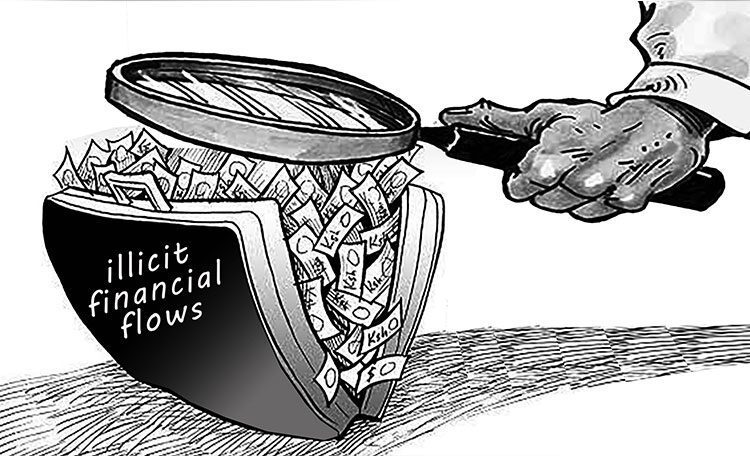
The African Union (AU) has sounded an alarm over the staggering losses Africa suffers every year due to illicit financial activities. According to the AU, an estimated US$88 billion (€76 billion) leaves the continent annually through tax evasion, money laundering, and corruption.
In 2015, the figure stood at US$50 billion (€43 billion), showing a sharp and troubling rise. Analysts warn that this outflow of capital deprives African governments of vital revenue that could otherwise be invested in healthcare, education, and infrastructure.
Christoph Trautvetter, coordinator of the German organization Network for Tax Justice, explained the scale of the problem, noting that Africa’s wealth is being drained away by both international corporations and local elites. “Digital corporations and commodity traders shift their profits to tax havens and corrupt elites stash money in anonymous offshore accounts,” he said.
He stressed that the damage goes beyond financial losses. “The direct damage is even greater because this system promotes corruption and crime and weakens states that are supposed to ensure development,” Trautvetter warned, adding that the “rich and powerful in both Africa and the global North ultimately benefit from this system.”
The tax justice expert acknowledged there has been some progress in recent years, though much still needs to be done. More than 100 countries agreed in 2017 to automatically exchange information on bank account holders, a step that could help curb tax evasion.
“This means that banks in many tax havens now automatically report information about account owners to the tax authorities in their home countries.”
Christoph Trautvetter
However, he noted that many African nations are still in the process of implementing this agreement, so complete data remains unavailable.
AU Pushes For Stronger Anti-Corruption Mechanisms
Despite the gaps, Trautvetter remains cautiously optimistic. “This will definitely lead to significant improvements in the coming years,” he said. Another milestone has been the United Nations’ global framework agreement, implemented in August, which seeks to address issues from “global tax justice and the taxation of large digital corporations, to the detection of illegitimate financial flows.”
Still, the AU report emphasizes that Africa faces even greater vulnerabilities due to global geopolitical shifts in the past decade. The economic fallout of the COVID-19 pandemic, the war between Russia and Ukraine, rising government debt, climate change pressures, and the strategic rivalry between the United States and China have all weakened African economies further.
In response, the AU has introduced several tools aimed at reducing illicit financial activities. These include a pan-African cooperation platform, working groups dedicated to recovering stolen assets abroad, and stricter oversight of vulnerable sectors such as mining, which has often been linked to undeclared exports. On the national level, some countries have created specialized tax authorities and financial investigation units. But the AU’s findings indicate these institutions have so far fallen short of their objectives.
Idriss Linge, Advocacy Officer for the Tax Justice Network (TJN) in the United Kingdom, described the problem as especially devastating for Africa. “Illegal financial flows exist worldwide, but Africa is the most affected because budgets are already stretched,” he said. He explained how extractive industries and opaque systems worsen the problem.
“Multinationals exploit extractive industries, tax havens enable them to underpay tax, and lack of transparency hides it all. Illegal financial flows are like a life-threatening condition, draining Africa’s blood.”
Idriss Linge
He pointed to resource-rich nations such as Nigeria, Angola, and the Democratic Republic of Congo as being the most exposed. In Nigeria alone, billions of dollars are thought to have been lost due to profit shifting in the oil sector.
“That money could provide clean water for 500,000 people, sanitation to 800,000, schooling for 150,000, and could save over 4,000 children through better healthcare. Illegal financial flows are not abstract – they deny people their rights.”
Idriss Linge
Although the AU has placed the continent’s total loss at around US$88 billion each year, Linge believes the real number is much higher. He cautioned that the official figures are likely “a severe underestimation.”
READ ALSO: Judge Rules Against Trump’s Use Of National Guard In Los Angeles