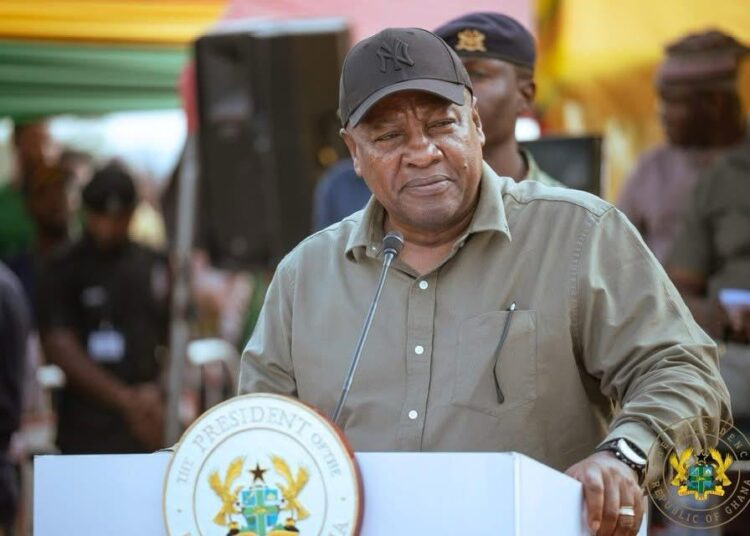
President John Dramani Mahama has reaffirmed his government’s commitment to strengthening Ghana’s agricultural sector, announcing that the long-promised Farmers’ Service Centers will begin rolling out immediately, with Guli among the beneficiary communities.
The president made the assurance during the sod-cutting ceremony for the construction of the Wa–Tumu–Han Big Push Project, where he highlighted significant government interventions aimed at supporting farmers and transforming food production systems nationwide.
“In Guli Naa’s speech, he spoke about tractor services. I wish to assure him that the promise we made for the setting up of farmer service centers is about to be fulfilled.”
His Excellency John Dramani Mahama, President of the Republic of Ghana
According to the president, fifty sites across key food-growing zones have already been identified for the establishment of these centers.
The Farmers’ Service Centers, he explained, will be equipped with modern mechanized tools essential for boosting productivity and easing the burden of manual labor that continues to hinder many farmers.

“Each farmer service center would have tractors, combined harvesters, maize chalets, ploughs, harrows, tractor trailers, and all the machinery and equipment that you need for farming.” President Mahama stated, stressing that the centers have been designed to meet farmers’ practical needs throughout the production cycle.
The president also revealed that financing arrangements for the initiative have been finalized. He said the 2026 national budget will mark the beginning of implementation.
“The Minister of Finance is going to read his budget, and in next year’s budget, he has made provision for the first 11 of the farmer service centers to begin.”
His Excellency John Dramani Mahama, President of the Republic of Ghana
This, he added, will ensure that farmers receive the “support they need” to improve yields, reduce production costs, and adopt more efficient farming methods.

Highlighting the broader vision behind the agricultural reforms, President Mahama underscored the urgent need for Ghana to shift from its dependence on a single farming season—an issue he described as one of the country’s most significant food security challenges.
“One of the major problems with food security in Ghana is that we have a single farming season. We prepare the land before the rains open up. And after the rains are gone, we have to sit again for another six months until next year’s rain comes.”
His Excellency John Dramani Mahama, President of the Republic of Ghana
He contrasted Ghana’s agricultural cycle with global best practices, noting that many countries maximize productivity by planting immediately after harvesting.
“It is not the same in other countries. In many countries, when they harvest, they are planting again. When they harvest, they are planting again. That is the kind of agriculture we want to encourage in Ghana.”
His Excellency John Dramani Mahama, President of the Republic of Ghana
To drive this shift, the President revealed that the government has made provisions for establishing new irrigation sites across the country as part of efforts to ensure year-round farming.
The investment, he said, is intended to enable farmers to cultivate crops continuously rather than relying solely on the rainy season.
“We’re going to invest in irrigation sites, and we expect our farmers to take advantage of it so that they can do all-year farming rather than waiting for a single rainy season to bring them rain,” he stated.

The announcement received enthusiastic support from the gathering, especially farmers who have long expressed concern about unreliable rainfall patterns, unpredictable weather conditions, and lack of modernized mechanization support.
The proposed Farmers’ Service Centers, together with irrigation investments, form a central component of the Mahama administration’s broader agenda to modernize agriculture, promote food security, and stimulate rural economic growth.
President Mahama emphasized that the Wa–Tumu–Han Big Push Project, within which the commitment was reiterated, is not only a major infrastructure undertaking but also a signal of the government’s long-term development strategy for the Upper West Region.
He urged communities to monitor the progress of the farmers’ centers and the irrigation sites, assuring them of continued government engagement and partnership.
The President’s pledge signals a renewed focus on practical, community-based agricultural reforms that aim to address long-standing constraints within Ghana’s food production chain.
With the first eleven centers set to commence next year, farmers across the identified sites—including Guli—are positioned to benefit from expanded mechanization, improved productivity, and enhanced resilience against climate variability.
READ ALSO: NPA’s 2025 Consumer Week Promotes LPG as Sustainable Energy for Ghana’s Future