The Tree Crops Development Authority (TCDA) has advanced its international investment mobilization drive, positioning the national oil palm sub-sector as a primary frontier for major bilateral industrial alignment in a high-profile diplomatic and regulatory engagement with a senior economic delegation from Thailand at the institution’s headquarters.
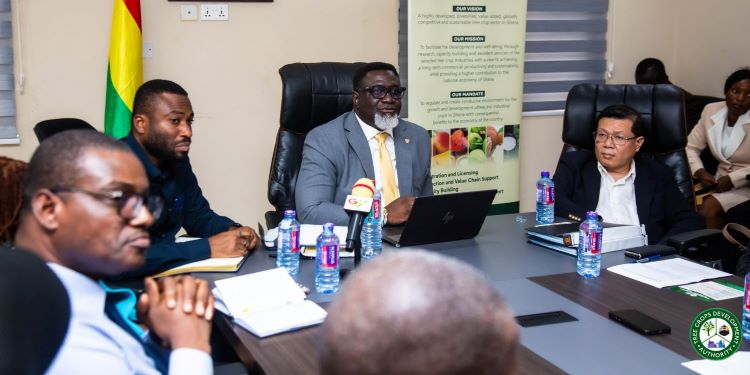
The Chief Executive Officer of the Authority, Dr. Andy Osei Okrah, received the visiting transnational mission led by Mrs. Urasa Mongkolnavin, the Director-General of the Department of South Asian, Middle East and African Affairs at the Ministry of Foreign Affairs of Thailand, who was accompanied by H.E. Mr. Thirapath Mongkolnavin, the Ambassador-Designate of Thailand to the Republic of Ghana.
According to the TCDA, the consultation underscores a deliberate effort to harness foreign direct investment (FDI) to transform Ghana’s domestic supply capabilities and reshape the broader West African agribusiness landscape.
“During the meeting, Dr. Osei Okrah formally introduced the mandate and strategic objectives of the TCDA, highlighting the Authority’s role in regulating and developing Ghana’s tree crops sector and facilitating investment opportunities across key value chains. The discussions focused primarily on potential investment opportunities in Ghana’s oil palm industry”
Tree Crops Development Authority
The meeting centered on the systemic integration of international capital with domestic agricultural infrastructure, with an emphasis on exploring untapped commercial pathways within the oil palm value chain.

Detailing how the institution works to standardize market operations, protect smallholders, and de-risk incoming capital, leadership effectively demonstrated how the Authority serves as a secure institutional gateway for global agricultural financiers looking to establish a permanent footprint on the African continent.
The primary operational highlight of the dialogue focused on a massive, concrete agricultural development proposal submitted by the Thai commercial contingent, looking to leverage Ghana’s rich agro-ecological landscape and favorable cultivation zones.
The delegation expressed interest in supporting the establishment of a massive twelve-thousand-hectare oil palm plantation within the country. The scale of this proposed enclave represents a major commitment to high-volume corporate farming setups to maximize crop yield, optimize land-use efficiency, and establish a steady, highly predictable supply of raw oil palm fruits.
The execution of such extensive enclaves relies heavily on highly organized grid systems and dedicated transport corridors to ensure efficient harvesting. The Government of Ghana, through the Tree Crops Development Authority, warmly welcomed this blueprint, framing the international initiative as a timely intervention.
Dr. Osei Okrah pointed out to the Thai delegates that the creation of a twelve-thousand-hectare plantation aligns perfectly with the urgent, ongoing efforts of the state to fix a critical supply crisis in the domestic market, noting that Ghana currently grapples with a steep, destabilizing domestic palm oil production gap that stands at approximately 150,000 metric tonnes annually.
Securing deep international partnerships to establish localized, high-yield agricultural enclaves is a non-negotiable step to close this deficit and achieve long-term food security.

Downstream Processing Capacity
More importantly, discussions extended far beyond the boundary of primary agricultural cultivation, as time was dedicated to mapping out advanced secondary industrial operations. The Thai delegation stated that their proposed investment model couples the twelve thousand hectare plantation with the construction of an ultra-modern, high-capacity processing mill facility.
For the TCDA, the inclusion of localized milling infrastructure as an indispensable upgrade is required to eliminate traditional processing inefficiencies, minimize post-harvest crop loss, and maximize the overall volume of refined palm oil products rolling out of local production zones.
The heavy industrial piping and complex processing machinery of a modern milling facility underscore the technological jump required to transition from basic farming to high-yield industrial output. This integrated approach to agribusiness infrastructure mirrors the TCDA’s insistence on localized value addition across the entire tree crop value chain.
Ensuring that raw palm fruits are processed immediately within the domestic economy rather than shipped out as primary commodities, the government aims to protect and retain maximum economic value within Ghanaian borders.
Furthermore, the dialogue explored formal pathways for advanced technology transfer and broader agronomic cooperation between the agricultural experts of Ghana and Thailand, allowing local technicians to study and adopt the world-class processing methodologies perfected by Thai agribusiness giants over decades of market leadership.
To solidify the investment commitments and assure the smooth execution of the multi-tiered agricultural project, the TCDA leadership placed heavy emphasis on the unique sovereign advantages that make the country a premier destination for international capital, highlighting Ghana’s celebrated, long-standing record of deep political stability and its highly predictable, transparent, and investor-friendly institutional framework.

The Authority assured the Thai delegation that the state is unreservedly committed to executing profound agricultural transformation, offering continuous administrative backing and regulatory safety to shield their long-term capital investments from bureaucratic friction or market distortions.
READ ALSO: A-Plus: Mahama Deserves Over 100% Approval for Use of Military in Accra–Kumasi Expressway Project