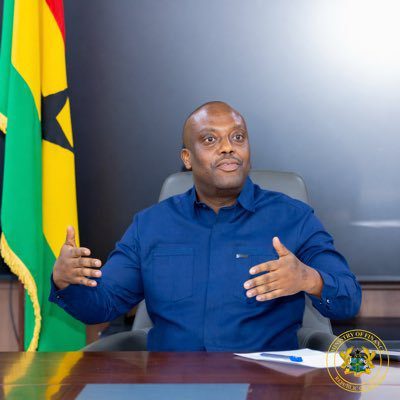
The government has announced plans to introduce another budgetary allocation in the 2027 Budget to continue the recapitalisation of the Bank of Ghana (BoG), signalling a renewed commitment to rebuilding the financial strength of the central bank after recent balance sheet pressures.
The announcement, made by Deputy Finance Minister Thomas Nyarko Ampem, highlights the government’s determination to implement a long-term recapitalisation strategy expected to run until 2032.
According to Mr. Ampem, the move forms part of a broader economic reform agenda designed to protect the independence of the Bank of Ghana, strengthen confidence in monetary policy and support Ghana’s ongoing economic recovery.
Speaking during the official transition of Rural and Community Banks into Community Banks, the Deputy Finance Minister said the government believes a financially strong central bank remains critical to maintaining economic stability.
Government Targets Stronger BoG Balance Sheet
The Bank of Ghana has faced significant financial challenges in recent years, including losses that weakened its capital position and raised concerns about the institution’s balance sheet strength.
In response, the government has launched a phased recapitalisation programme aimed at restoring the central bank’s financial capacity.
Mr. Ampem disclosed that the first major step was taken in March 2026 when the government issued a GH¢5 billion bond to support the recapitalisation exercise.
“Government has backed that commitment with action. In March this year, government issued a GH¢5 billion bond for the recapitalisation of the Bank of Ghana,” he stated.
He explained that the bond issuance represents the beginning of a wider strategy that will involve continued financial support through successive national budgets.
The Deputy Finance Minister stressed that the programme will continue until the Bank of Ghana’s financial position is fully restored by 2032.
2027 Budget To Provide Additional Support
The government’s latest announcement means the 2027 Budget will include another allocation specifically targeted at strengthening the central bank.
“In next year’s budget, we will make another allocation to further recapitalise the central bank,” Mr. Ampem revealed.
The planned allocation demonstrates government’s commitment to ensuring that the Bank of Ghana has adequate financial resources to execute its mandate effectively.
A stronger balance sheet is expected to improve the central bank’s ability to manage monetary policy operations, respond to economic shocks and maintain confidence among investors and financial market participants.
Economic Stability Gains Boost Government Confidence
Mr. Ampem said Ghana’s economic fundamentals are showing signs of improvement, crediting stronger coordination between fiscal authorities and the central bank for recent gains.
He noted that improved cooperation between the Ministry of Finance and the Bank of Ghana has helped reinforce macroeconomic stability through disciplined fiscal management and a supportive monetary policy direction.
“Ghana’s economic fundamentals are strengthening. Improved coordination between the Ministry of Finance and the Bank of Ghana has reinforced macroeconomic stability through disciplined fiscal policy and a complementary monetary policy stance.”
Thomas Nyarko Ampem
The Deputy Finance Minister explained that government’s fiscal discipline, combined with monetary policy measures by the central bank, has helped reduce economic pressures following a difficult period marked by high inflation, exchange rate volatility and fiscal constraints.
Central Bank Independence Remains Key Priority
The recapitalisation programme is not only focused on improving the Bank of Ghana’s finances but also on strengthening confidence in the institution’s independence.
A financially stable central bank is considered essential for effective monetary policy implementation, particularly in maintaining price stability and managing inflation expectations.
Mr. Ampem argued that restoring the central bank’s financial strength will help safeguard Ghana’s financial sector and improve investor confidence.
He added that a stronger Bank of Ghana will be better positioned to promote a sound financial system and support sustainable economic growth.
Community Banking Reforms Take Centre Stage
The announcement came during Ghana’s 50th anniversary celebration of rural banking, which also marked the official conversion of Rural and Community Banks into Community Banks.
The reform, introduced under a new regulatory framework by the Bank of Ghana, is expected to modernise the operations of community-based financial institutions across the country.
The transition aims to improve governance structures, strengthen operational efficiency and expand access to financial services, especially in communities that remain underserved by traditional banking institutions.
Community Banks are also expected to play a greater role in supporting agriculture, small businesses and local economic development.
The government believes the reforms will deepen financial inclusion and create stronger financial institutions capable of contributing to grassroots economic transformation.
Long Road Ahead For BoG Recovery
The continued recapitalisation of the Bank of Ghana represents one of the government’s major financial sector interventions aimed at restoring confidence after years of economic difficulties.
With additional allocations planned beyond 2026, authorities are signalling that rebuilding the central bank’s financial foundation will require sustained commitment and careful implementation.
As Ghana continues its economic recovery programme, the strength of the Bank of Ghana will remain central to efforts to maintain inflation control, protect financial stability and support long-term growth.
The 2027 Budget allocation is therefore expected to become another significant milestone in the government’s broader mission to restore the central bank’s resilience and credibility.
READ ALSO: Economic Growth Alone Cannot Save Ghana, NDPC Warns