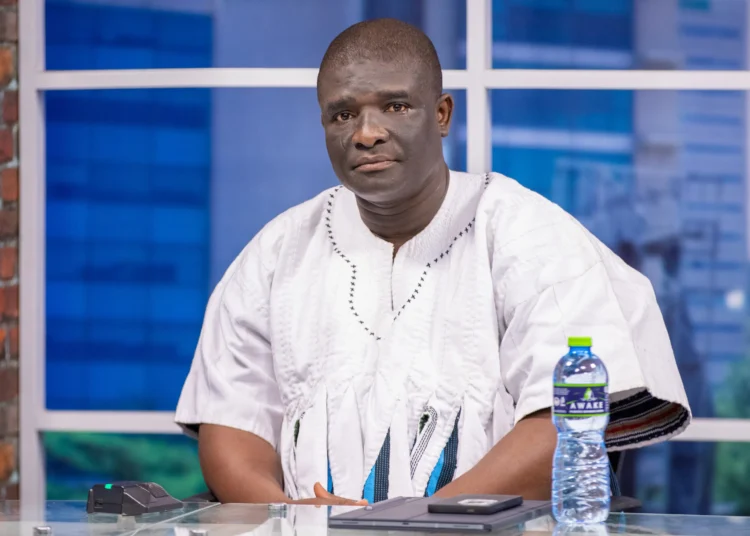
Deputy National Communications Director of the New Patriotic Party (NPP), Alhaji Kamal-Deen Abdulai, has described the Minority’s decision to walk out during the vetting of Chief Justice nominee, Justice Paul Baffoe-Bonnie, as a necessary act of principle that underscores the importance of dissent in Ghana’s democratic process.
Speaking on the incident, Alhaji Kamal-Deen acknowledged that while the walkout attracted mixed reactions, it serves as a critical learning moment for both the Legislature and the public. He argued that dissent, when guided by principle, strengthens democracy and deepens respect for institutional processes.
“All we have to do is caution ourselves. Sometimes it is important and decent to listen to dissenting views. I believe many may not see it today – the Minority’s principle that we took and dissented – but tomorrow they will come to appreciate the principle we stood on. The Minority’s walkout was appropriate; if you have a principle, you stand by it”
Alhaji Kamal-Deen Abdulai, NPP Deputy National Communications Director
The Minority in Parliament, led by Minority Leader Hon. Alexander Afenyo-Markin, had disputed the vetting of Justice Baffoe-Bonnie by the Appointments Committee, citing pending legal challenges over the removal of former Chief Justice Gertrude Araba Esaaba Sackey Torkornoo.
Justice Baffoe-Bonnie’s nomination follows the controversial removal of Justice Gertrude Torkornoo on September 1, 2025. They argued that proceeding with the vetting “undermined judicial independence” while the legality of Justice Torkornoo’s dismissal remained unresolved before the courts.

The former Chief Justice was dismissed after a constitutional committee found her guilty of misconduct, including misuse of public funds. Her removal, approved by President John Dramani Mahama, has since been challenged in court, with Justice Torkornoo describing the process as unconstitutional.
Tensions escalated during the Appointments Committee’s sitting on Monday, November 10, when a heated exchange broke out between the Minority Leader and Majority Leader Hon. Mahama Ayariga over whether or not to proceed with Justice Baffoe-Bonnie’s vetting.
The disagreement forced a brief suspension of proceedings, after which the Minority boycotted the session entirely.
The Appointments Committee, however, proceeded with the vetting in their absence. Alhaji Kamal-Deen described the incident as a reminder that political disagreements, though inevitable, must always respect democratic norms. “We must all take a cue from it,” he said.
Questionable Judgement
Meanwhile, Alhaji Kamal-Deen also took issue with Justice Baffoe-Bonnie’s justification for the 70-year jail term handed to convicted armed robber Ataa Ayi, describing the explanation as “very low” and inconsistent with judicial ethics.

“A judge who is supposed to be the head of affairs of the judicial system of our country said he had to give somebody 70 years because he was afraid to die when he came out – that the person would attack him and his family. I was surprised”
Alhaji Kamal-Deen Abdulai, NPP Deputy National Communications Director
According to the NPP deputy spokesperson, such reasoning undermines the integrity of the judiciary and contradicts the judicial oath, which demands that justice be administered without fear or favour.
“Your own judicial oath tells you to ensure that you work within the tenets of the law, and you tell me that for fear you gave somebody 70 years because you didn’t want to give 30 years for him to come and attack you? The rationale he gave was flat”
Alhaji Kamal-Deen Abdulai, NPP Deputy National Communications Director
Justice Baffoe-Bonnie, however, defended his decision during the vetting, explaining that the sentence was necessary to ensure deterrence and safeguard the public. He said that while sentencing should reflect justice, it must also prioritise safety and accountability in cases of violent crime.
Ataa Ayi, Ghana’s most notorious armed robber in the early 2000s, led a series of high-profile robberies across Accra before his capture in 2005. His conviction and sentencing became symbolic of Ghana’s fight against violent crime, but Kamal-Deen insists the reasoning behind the sentence raises concerns about judicial impartiality.

“The judiciary must not only be fair but must also appear fair. Fear cannot be the basis for justice,” he warned. The New Patriotic Party’s deputy communications director maintained that while dissent in Parliament is healthy for democracy, the judiciary must be guided strictly by principle and law.
He noted that as Ghana continues to refine its democratic systems under President Mahama’s administration, institutions must learn to balance accountability with independence.
READ ALSO: Adapt or Die: BoG Governor Warns Central Banks to Embrace Digital Finance Revolution