
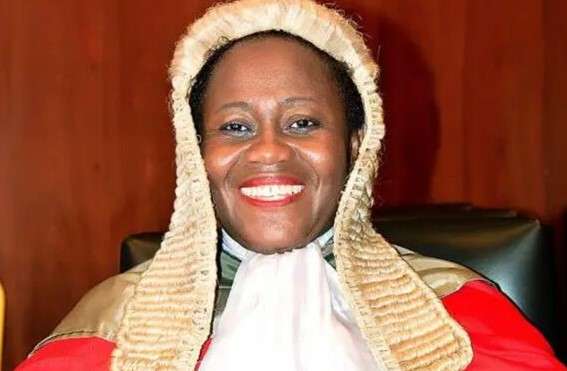
The former Chief Justice Gertrude Araba Esaaba Sackey Torkonoo has suffered another legal setback as the ECOWAS Community Court of Justice dismissed her application for interim measures, adding yet another blow to her efforts to challenge her suspension and removal from office.
The decision adds to a growing list of unsuccessful attempts by the former Chief Justice to secure temporary relief while her substantive cases proceed in multiple courts.
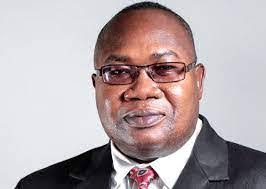
The development was confirmed by Deputy Attorney-General and Minister for Justice, Dr. Justice Srem Sai, who disclosed that the Court delivered its ruling early in the morning of Monday, November 19th, 2025, concluding that the application lacked the urgency and legal grounds required for the grant of interim measures.
According to Dr. Srem Sai, the ECOWAS Court found that Justice Torkonoo had failed to meet the essential criteria for the relief she was seeking. He quoted the Court’s emphatic finding that “the application did not satisfy the criteria for a grant of interim measures.”
The decision centred heavily on the Court’s assessment that the applicant did not demonstrate any imminent or irreparable harm that justified an urgent intervention. The Court stressed that, based on her own conduct, Justice Torkonoo’s claim of imminent danger was unconvincing.

“The Applicant’s own conduct defeats her claim of imminent and irreparable harm. The Court is, therefore, satisfied that the Applicant has not demonstrated the existence of imminent or exceptional circumstance that will justify the urgency of the application filed almost 3 months after the act complained of.”
Deputy Attorney-General and Minister for Justice, Dr. Justice Srem Sai
Delay in Application Filing
According to the Deputy Attorney General, the former Chief Justice’s delay in filing the application became a focal point for the Court, which noted that the almost three-month gap undermined her arguments about urgency.
It concluded that without fulfilling the requirement of urgency, there was no need to examine the remaining criteria for provisional measures, as all conditions must be satisfied cumulatively. The Court therefore dismissed the application in its entirety: “The request for provisional measures as outlined by the Applicant, same not substantiated, is therefore dismissed.”
Justice Torkonoo’s latest legal hurdle forms part of a broader and complex challenge she has mounted against the Ghanaian state following her suspension and subsequent removal by President John Dramani Mahama earlier this year.
Her removal followed the recommendations of an Article 146 Committee of Inquiry chaired by Justice of the Supreme, Gabriel Pwamang Scott, which examined allegations brought against her.
In July, the former Chief Justice turned to the ECOWAS Court to contest what she describes as unconstitutional and premature actions by the government, accusing the state of violating her fundamental human rights.
Her case in Abuja runs parallel to multiple suits she has filed within Ghana’s own judicial system—an unusual and aggressive multi-jurisdictional legal strategy which the Deputy Attorney-General noted has resulted in overlapping arguments before different courts.
Justice Torkonoo’s attempt to secure interim measures is just one in a series of provisional applications that have repeatedly failed in Ghana’s courts. Her ongoing cases include Justice Gertrude Araba Esaaba Torkornoo v The Attorney-General & 5 Others (J8/113/2025) and Centre for Citizenship Constitutional Electoral Systems (CenCes) v The Attorney-General & 2 Others (J1/20/2025).
Other litigants have also filed related suits challenging the processes surrounding her suspension. These include actions by Vincent Ekow Assafuah, Ebenezer Osei-Owusu, and Theodore Kofi Atta-Quartey—all of which are pending before the Supreme Court. Collectively, the cases reflect mounting legal scrutiny over the procedures that led to Justice Torkonoo’s exit from office.
No Favourable Outcomes
However, these parallel actions have not yet produced any favourable outcomes. Both the Supreme Court and the High Court have, over recent months, dismissed several applications for injunctions and provisional measures connected to the broader dispute. Monday’s ruling from the ECOWAS Court now adds further weight to the series of interim setbacks.
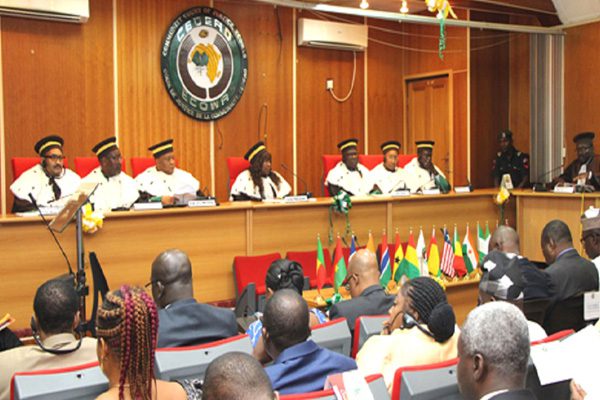
While interim measures often provide temporary protection to applicants in human rights-related applications before the ECOWAS Court, the tribunal maintains a high threshold for urgency, irreparable harm, and exceptional circumstances. By the Court’s own assessment, Justice Torkonoo’s application simply fell short of meeting these standards.
The substantive cases—both at home and before the regional court—remain pending, with final rulings expected to shape the next phase of a dispute that continues to attract national attention due to its significance for judicial accountability, constitutional procedure, and the balance of powers.
For now, however, the former Chief Justice faces yet another legal roadblock, underscoring the steep path ahead in her attempt to overturn the decisions that removed her from office.
READ ALSO: Ghana Opens Africa Trade Summit with Strong Push for Industrialization