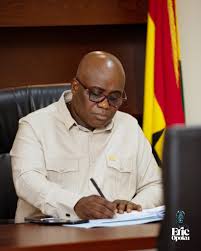
Ghana’s agriculture minister, Hon. Eric Opoku, has given a detailed account of his ministry’s work since the National Democratic Congress assumed office, outlining an ambitious agenda to restructure the sector around productivity growth, agro-industrialisation, climate resilience, youth employment and export diversification.
Speaking at the Government Accountability Series, Hon. Opoku placed the Agriculture for Economic Transformation Agenda (AITA), at the centre of the administration’s vision and identified the Feed Ghana Programme as the practical vehicle for implementation, stressing that the programme must translate policy into measurable results for farmers and consumers alike.
Hon. Opoku warned that Ghana faces a paradox of abundant natural assets and persistent structural gaps that undermine production and discourage investment.
“On one hand, we are blessed with an abundance of arable land, a growing and youthful population, numerous inland water bodies and favourable access to regional and international trade. These assets hold the promise of economic transformation and food sovereignty.
“On the other hand, our farmers and agribusinesses continue to face deep-rooted structural challenges such as persistent food insecurity, high post-harvest losses, crummy chain threats, limited mechanisation and fragmented value chains that suppress growth and discourage investment”
Hon. Eric Opoku, Minister for Food and Agriculture
The minister noted that the nation’s food import bill had risen to about three billion dollars annually and that, between 2022 and early 2025, the cost of basic commodities more than doubled in several urban markets.
“Distinguished ladies and gentlemen, the urgency of this transformative agenda cannot be overemphasised. As of 7th January 2025, when the National Democratic Congress, (NDC) assumed office, Ghana’s food import bill had reached alarming levels”
Hon. Eric Opoku, Minister for Food and Agriculture
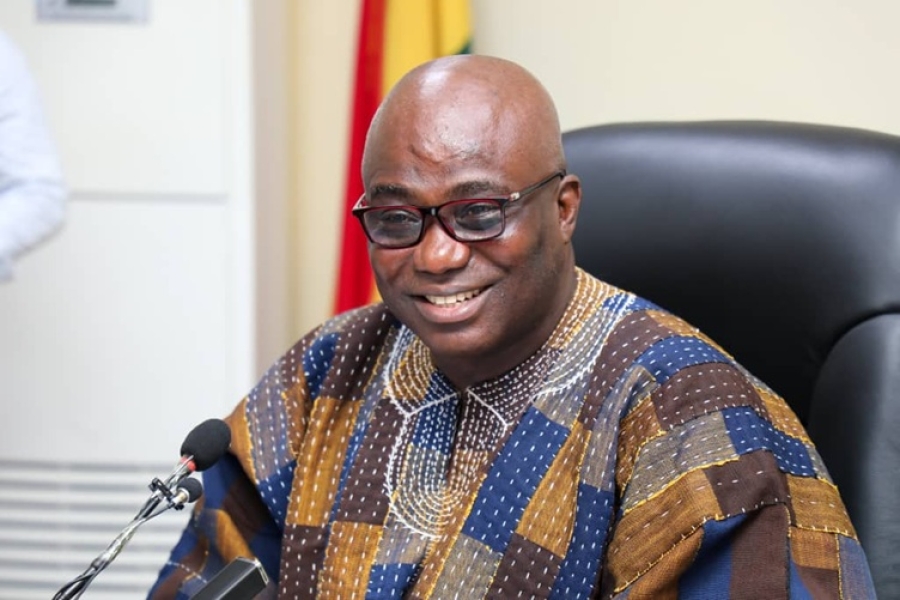
Seed Sovereignty and Partnerships
He said food inflation reached a historic peak of 61 percent in January and argued that the scale of the problem demanded urgent reforms to build resilience and restore domestic supply – describing AITA as the framework for this and Feed Ghana as the implementation route.
He explained that AITA prescribes objectives while Feed Ghana demonstrates how and where to act. He stressed the need to harness research institutions for seed development and pledged a shift to domestically sourced seed supplies


“From 2026, MOFA will only supply locally sourced seeds to the Ghanaian farmers. We recognize the immense potential of our research institutions in seed research, development and testing. And the Ministry stands ready to collaborate with them to work towards full seed sovereignty”
Hon. Eric Opoku, Minister for Food and Agriculture
Hon. Opoku recounted concrete partnerships that support the seed and irrigation agenda. He thanked the Korea Plant Industries Association (KOPIA) for training Ghanaian farmers in seed production and cited the Korea Rural Corporation’s work to build irrigation infrastructure on 100 hectares for rice seed.
He explained that the Korea Institute for the Advancement of Technology had commissioned a one-megawatt solar farm to power the irrigation system with technical support from the Ministry of Energy and said the project will power year-round seed production and reduce dependence on costly imports.
Irrigation, Training and Technology
He also highlighted cooperation with JICA which is training rice seed producers in Weta, Bolgatanga and Tano, and an MoU with the Netherlands to develop vegetable seed production.

Hon. Opoku framed these collaborations as strategic investments to stabilise supply chains, improve yields and reduce reliance on imports.
He noted that KOPIA had supplied three hundred tons of Agyapa rice seed developed by CSIR “free of charge with an additional one hundred and fifty-four tons for lean-season production,” a gesture he said was critical to immediate supply stabilisation and farmer confidence.
The minister argued that seed sovereignty and irrigation investments are critical to lowering post-harvest losses and expanding value addition capacity. Linking these reforms to job creation and export diversification, he insisted that “modern value chains and mechanisation are essential to unlocking agricultural productivity.”
Feed Ghana will scale input delivery, digital registration of farmers and targeted value addition support to create market-ready surpluses and foster agro-processing across regions.
Youth, Agribusiness and Long-term Reform
Hon. Opoku’s account also underscored the role of youth and agribusiness in the transformation agenda. He urged a whole-of-society approach and repeated the administration’s commitment to collaborate with research institutes, development partners and private actors.
He framed the plan as a long-term programme that combines public investment, technical partnerships and private-sector participation to restore food self-sufficiency and protect national food security.
Reiterating project timelines and outcomes, he stressed the anticipated yield from the seed programme and the long-term benefits for local rice production.

“This project is expected to be completed in 2027. It will produce 10,000 tons of high-quality rice seed, and Ghana will be well on its way to rice seed independence”
Hon. Eric Opoku, Minister for Food and Agriculture
The minister reasserted the ministry’s readiness to pursue full seed sovereignty and to align policy, technology and investment behind the Feed Ghana platform.
His appeal reminded stakeholders that Ghana’s agricultural destiny depends on coordinated action and measurable delivery, and he urged farmers, agribusinesses and institutions to support the programme so reforms translate into sustained productivity gains and improved livelihoods across the rural economy.
READ ALSO: Geopolitical Tensions and Market Swings Trigger New BoG Warning