
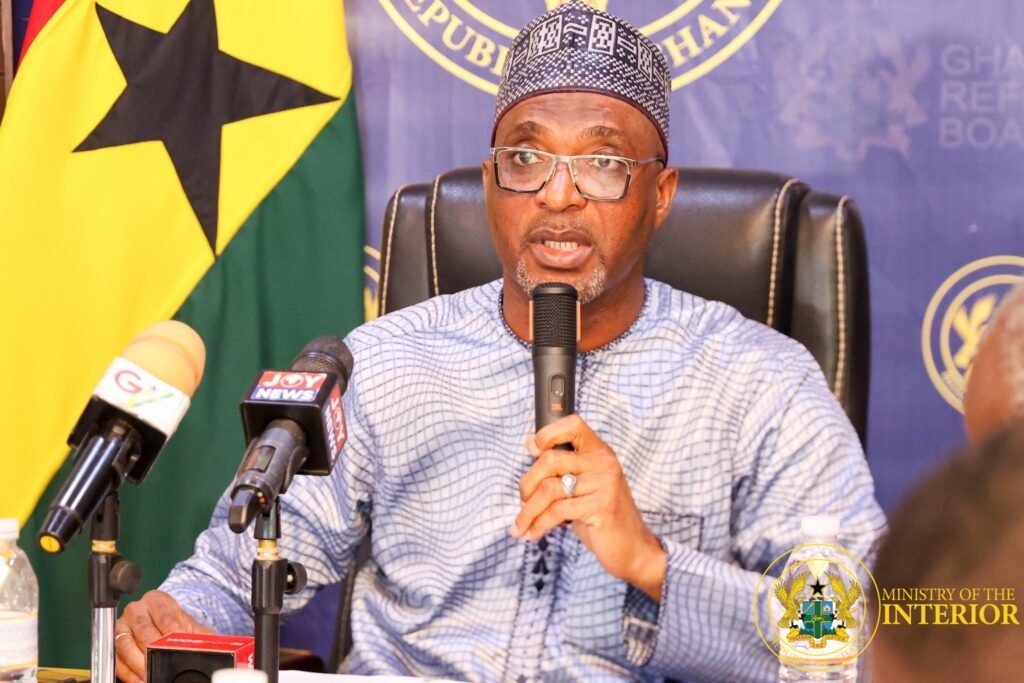
Ghana’s Ministry of the Interior has launched a comprehensive digital services platform, marking what Minister for the Interior, Hon. Muntaka Mubarack Mohammed, described as one of the most transformative reforms in the ministry’s history.
The platform forms part of the government’s broader national digitalisation agenda aimed at expanding e-governance, strengthening cybersecurity, developing a digitally skilled workforce, and creating seamless interactions between citizens and the state.
Speaking at the launch, the Interior Minister said the digital transformation of the ministry is not only timely but essential for modern governance. For decades, he explained, the Interior Ministry has handled some of the most sensitive and essential public services relating to national security, public safety, migration management, business regulation, and the protection of citizenship rights.
Yet much of its work has been rooted in manual, paper-based processes. These, he noted, have slowed down service delivery, created administrative bottlenecks, and imposed burdens on citizens who must often travel long distances to access basic services.
He cited a common example: “If you want to apply for a …., even if you are in Pusiga, you have to walk all the way to Accra and submit it at the minister’s office.” With the new system, he said, such difficulties will be eliminated.
Applicants who require background checks or fingerprint verification will now be referred to the nearest CID office rather than travelling to Accra, ensuring a more efficient and accessible system for all.



According to Hon. Muntaka, the launch of the digital services portal is designed to directly address these long-standing challenges. The platform modernises the ministry’s operations, improves data integration and security, and provides end-to-end digital access to the ministry’s most frequently used services.
“With this launch, we take a decisive step towards a more efficient, transparent, and citizen-centred ministry fully aligned with the government’s commitment to build a forward-looking, technology-driven public sector.”
Minister for the Interior, Hon. Muntaka Mubarack
Digitalisation of Citizenship and Migration Services
A major component of the platform is the digitalisation of citizenship and migration services. These include immigration quota payments, which regulate the number of foreigners companies in Ghana are permitted to employ.
“Companies in Ghana don’t have to hire the services of foreigners. The ministry regulates how many foreigners each company could employ just to make sure they don’t come and take the job space for Ghanaians.This process, previously done manually, will now be completed online”.
Minister for the Interior, Hon. Muntaka Mubarack
Applications for the renunciation of Ghanaian citizenship—used in countries where dual nationality is not recognised—will now be digital. Dual nationality applications, which provide eligible Ghanaians with a dual citizenship card to ease their travel in and out of Ghana, are also moving online.
The minister recounted that he had just finished signing a large book of manual applications before the event, describing the transition to digital as long overdue.
Other services now digitalised include registration as a citizen of Ghana for individuals with Ghanaian parents or grandparents, registration of persons transitioning from residency to citizenship, and the registration of minors whose parents have newly acquired Ghanaian citizenship.
Previously, all these processes required applicants to pick up physical forms, fill them manually, and submit them at the ministry. “Today, this is going to be digitalised, and you can do that online,” Hon. Muntaka said.
Integration with the National Identification Authority
The new system integrates directly with the National Identification Authority, allowing real-time verification of applicants’ information. This means that records will be synchronised across databases to ensure accuracy and prevent identity fraud. The portal also includes a real-time tracking feature that notifies applicants of each stage of their application.
“The moment you put in an application, you receive a text message telling you your application has been received. When it gets to the chief director, it will notify you… You can monitor each time where your application is and how far it is to the end.”
Minister for the Interior, Hon. Muntaka Mubarack
The minister emphasised that this tracking feature also enhances internal accountability. Desk officers will no longer be able to hold onto applications indefinitely, as the system records how long each stage takes and who is responsible for delays. “The minister will be able to see which desk officer is keeping information for how long,” he noted, calling it a major advancement in transparency.
In addition to citizenship and migration services, the ministry has digitalised a second category: security and regulatory services. These include the licensing of private security organisations, a task that previously generated “tonnes of papers” on the minister’s desk at the end of each year.
Through the portal, companies can now submit applications seamlessly, which will then be processed by the chief director and relevant desk officers. Services such as firearms licensing, regulation of controlled materials, and oversight of private security operations have also moved online. The minister said this enhances transparency, minimises human interference, and reduces opportunities for fraud.
Digitalization of Special Services
A third category of services being digitalised is specialised services, including the exportation of dead bodies. The minister admitted that before assuming office, he was unaware that families needed permission from the Interior Ministry to transport a deceased relative to another country.
The manual process often caused delays of up to two weeks, worsening the grief of affected families. “Today, these services are going to be digitalised so that we can work on them with the speed of light,” he said.
Hon. Muntaka outlined several benefits of digitalisation. These include convenience for applicants who can access services from anywhere, enhanced transparency through tracking features, improved data security through integration with national systems, and improved revenue assurance through secure digital payments.
He highlighted how manual payments often resulted in delays and leakages, noting, “You come to the ministry, you are carrying 200 Ghana Cedis, you give the certificate, there’s no change… Today, you just do it with your Momo or bank card.”

He stressed that digitalisation also strengthens national security through better monitoring of explosives, arms, ammunition, and private security organisations. The initiative, he said, is the result of collaboration between the ministry, security agencies, and technical partners committed to advancing government’s public sector digitalisation agenda.
As he launched the digital portal, which takes effect on Monday, 15 December 2025, the minister invited the public, private sector, diaspora community, and international partners to embrace the new platform.
“Ladies and gentlemen, it is now my honour to officially launch the Ministry of the Interior’s online digital service portal,” he declared, concluding with thanks to all partners and stakeholders.
READ ALSO: Ghana Records a Real Growth Rate of 5.5% in 2025 Q3 – GSS